Sizing by venue
Restaurant Water Filter Sizing by Seats and Peak Flow
Quick answer
A restaurant filter is sized by seats, but the equipment is chosen by outlet: ice, coffee, dishwashing and steam each tolerate a different water quality. This guide turns 15–30 L per seat per day into a peak flow, then into a 90-seat worked example with softener, RO and storage sizes.
How much water does a restaurant use per seat per day?
Use 15–30 L per seat per day as the planning range for a restaurant. It covers ice, drinking water, coffee and tea, kitchen preparation, dishwashing and floor cleaning, but excludes toilets and other building services. A quick-service outlet with limited table service sits at the low end, around 15–20 L; a full-service restaurant with a bar, a large ice demand and a combi oven sits at 25–30 L.
Seat count is only the first input. A 90-seat restaurant turning tables three times at dinner serves 270 covers, while the same 90 seats at lunch with one turn serves 90. Water demand follows covers and menu, not seats alone. If the restaurant is already operating, replace the estimate with 7–14 days of metered consumption and note the busiest day; a weekend brunch can use 40% more water than a weekday lunch.
- Quick-service restaurant: 15–20 L per seat per day
- Full-service restaurant with bar: 20–30 L per seat per day
- Coffee shop with light food: 8–15 L per seat per day
- Add 10–20% for takeaway and delivery orders
How do you size a filter for a 90-seat restaurant?
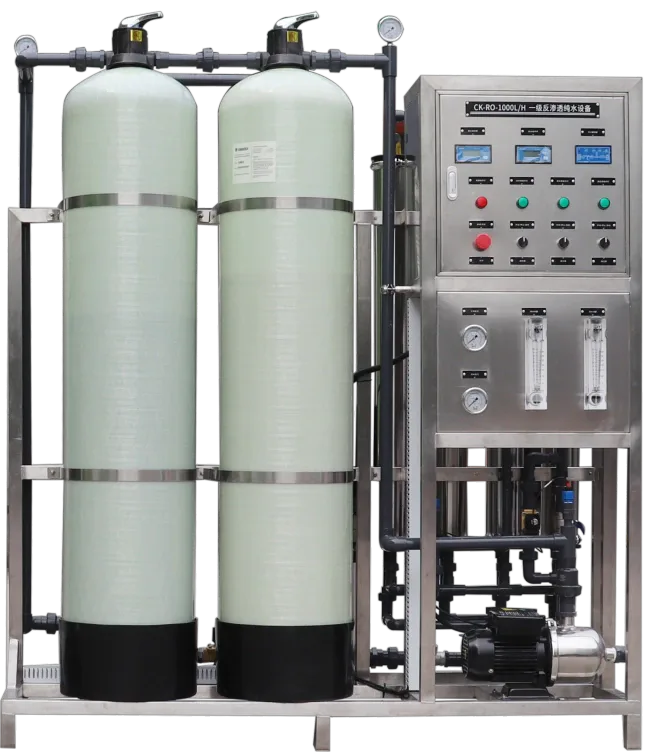
At 20 L per seat, daily demand is 90 × 20 ÷ 1,000 = 1.8 m³/day. With a peak factor of 2.0 over 9 operating hours, peak flow is 1.8 × 2.0 ÷ 9 = 0.40 m³/h. Add 15% for fouling and future load, and the design flow is 0.46 m³/h. A 0.5 m³/h RO is the correct size; a 1 or 2 m³/h unit would cycle on and off, waste concentrate and cost more without improving service.
Storage is what makes the small RO work. A 0.75–1.0 m³ tank holds 40–55% of daily demand, so the membrane can refill at a steady 0.5 m³/h through the afternoon and still cover the dinner rush. Put the tank after the RO, keep it pressurised with a booster set, and return the loop through UV so the water at the tap is fresh. If the kitchen is on the same line, size the RO for the combined ice, coffee and kitchen demand, not for drinking water alone.
| Item | Calculation | Result |
|---|---|---|
| Daily demand | 90 × 20 ÷ 1,000 | 1.8 m³/day |
| Peak flow | 1.8 × 2.0 ÷ 9 | 0.40 m³/h |
| Design flow with margin | 0.40 × 1.15 | 0.46 m³/h |
| RO model | Next standard size above design flow | 0.5 m³/h |
| Storage | 40–55% of daily demand | 0.75–1.0 m³ |
Which restaurant water uses need separate treatment?
One incoming line cannot serve every outlet well. Ice and drinking water need low TDS and no chlorine; coffee needs stable alkalinity; dishwashers and steamers need soft water; hand-wash taps need nothing beyond basic filtration. Splitting the line costs a little more pipework but avoids treating all water to the highest standard or compromising the most sensitive outlet.
| Outlet | Quality issue | Treatment | Sizing basis |
|---|---|---|---|
| Ice machine | Cloudy ice, slow freezing, odour | Carbon block + RO | Ice production kg/day × 1.1 L/kg |
| Coffee and tea | Chlorine masks aroma; high alkalinity flattens acidity | Carbon + RO blend or mineral dosing | Brewer draw, 0.2–0.5 m³/h |
| Dishwasher | Scale on elements, film on glassware | Softener | Peak rinse flow and daily hardness load |
| Combi oven and steamer | Scale on heating elements and probes | Softener, optionally RO | Steam production and fill rate |
| Drinking water dispenser | Taste, bacteria regrowth | RO + UV at 30–40 mJ/cm² | Covers per day × 0.3–0.5 L |
A single carbon + RO line can serve ice, coffee and drinking water; add a separate softener for dishwashing and steam.
How do you size softening for dishwashers and steamers?
Size the softener on the daily hardness load rather than on the whole restaurant demand. If the kitchen uses 1.8 m³/day at 200 ppm as CaCO₃, the load is 1.8 × 200 = 360 g/day. At a resin capacity of 50 g/L and a three-day regeneration interval, the softener needs 21.6 L of resin; a 25–50 L charge gives margin for peak days and for hardness above the design value. Salt use is 100–150 g per litre of resin, or 2.5–7.5 kg per regeneration at this size.
Check the peak rinse flow as well. A dishwasher may draw 0.3–0.6 m³/h during fill and rinse, and a combi oven adds its own fill. A 25 L bed at 30 bed volumes per hour can pass only 0.75 m³/h, so confirm the simultaneous demand before choosing the smallest resin charge. If the kitchen also has a reverse osmosis unit, soften the RO feed and take the dishwasher from the same softener outlet.
- Test hardness at the kitchen inlet, not at the building meter
- Keep the softener outlet below 50 ppm as CaCO₃ for dishwashing
- Install a 5 µm cartridge after the softener to catch resin fines
- Regenerate outside service hours to avoid pressure loss at peak
How much storage do lunch and dinner peaks require?
Plan storage at 40–55% of daily demand: 0.75–1.0 m³ for the 90-seat example. The tank does three jobs: it lets the RO run at a steady rate, it covers the short lunch peak when the ice machine, coffee brewer and dishwasher start together, and it keeps water available during backwash or cartridge changes. Without storage, the RO must match the instantaneous peak, which doubles or triples the membrane size for a demand that lasts 30–60 minutes.
Place the tank indoors, out of direct sun, with a drain and a lid. Use a level switch to start and stop the RO, and a booster pump to hold 2–3 bar at the farthest outlet. If the tank is larger than one day of demand, add a loop and UV; still water in a warm kitchen is a microbiological risk, not a reserve.
| Seats | Daily demand | Peak flow | RO | Storage |
|---|---|---|---|---|
| 40 | 0.8 m³/day | 0.18 m³/h | 0.25–0.5 m³/h | 0.3–0.5 m³ |
| 90 | 1.8 m³/day | 0.40 m³/h | 0.5 m³/h | 0.75–1.0 m³ |
| 180 | 3.6 m³/day | 0.80 m³/h | 1 m³/h | 1.5–2.0 m³ |
Assumes 20 L per seat, a peak factor of 2.0 and 9 operating hours; adjust for actual covers and menu.
What changes the calculation in a café, bar or hotel kitchen?
Different formats shift both the daily figure and the peak shape. A coffee shop sells few covers but runs the espresso machine and ice bin for ten hours, so its peak is flatter and its daily volume lower. A bar peaks late and uses little dishwashing water but a lot of ice. A hotel kitchen serves breakfast, lunch and dinner with banquet spikes, and usually shares a softener with the laundry.
Peak shape matters more than the daily total when selecting storage. A café may draw 0.15 m³/h for ten hours, while a 90-seat restaurant draws 0.4 m³/h for two hours. The first needs a smaller RO and a smaller tank; the second needs a larger tank relative to the RO. Plot the hourly demand before fixing tank volume, and confirm whether the ice machine or the dishwasher starts first.
- Coffee shop: size on brewer count and ice, not on seats alone
- Bar: add 20–30% ice capacity and a late-night storage buffer
- Hotel kitchen: separate the banquet peak from the laundry peak
- Takeaway: add 10–20% for containers, cleaning and extra ice
What data should you collect before choosing a system?
Restaurant projects move quickly, so the data collection should be short and specific. The five items below are enough to size a line and to avoid the two common errors: an RO that is too large for the drinking load and a softener that is too small for the dishwasher.
- 01
Seats and covers
Seat count, turns per service and the busiest day of the week.
- 02
Outlet list
Ice machines, brewers, dishwashers, steamers, hand-wash taps and drinking points.
- 03
Equipment ratings
Ice kg/day, dishwasher rinse flow, steamer fill rate and brewer draw.
- 04
Water analysis
Hardness, TDS, chlorine, iron, turbidity, pH and silica.
- 05
Space and utilities
Under-counter or store-room space, drain, power and access for service.
FAQ
Frequently asked questions
Questions buyers actually ask during sizing and quotation. Answers match the specifications above.
01 Is 15 L per seat per day enough?
02 Do I need RO for the ice machine?
03 Can one filter serve the whole restaurant?
04 How often do cartridges need changing?
05 What if the water is very hard?
06 How do I size for takeaway and delivery?
Related
Systems related to this article
Continue reading
Related technical guides
- Sizing by venue Sizing Water Filters for Hotels, Restaurants and Offices Size hotel, restaurant and office filters from daily demand and peak flow, using 250–400 L per room, 15–30 L per seat and 10–20 L per person, with examples.
- Sizing by venue Hotel Water Demand: Litres per Room per Day Hotel water demand planning: 250–400 L per room per day, where the water goes, and a 120-room example for sizing softeners, storage and drinking-water RO.
- Sizing by venue School Drinking Water: Sizing by Students and Breaks School drinking water sizing: 10–20 L per student per day, break-time storage, and an 800-student worked example for RO, tank and fountain capacity.
Next step
Send your water analysis, get a factory quotation
Tell us the source water, TDS, hardness, iron and daily demand. Factory engineers reply with a flow rate, process train and budget range within one working day.