Sand & multimedia filtration · 0.5–50 m³/h · 100 µm
Commercial Sand Filter — Quartz Sand & Multimedia Filtration
Quick answer
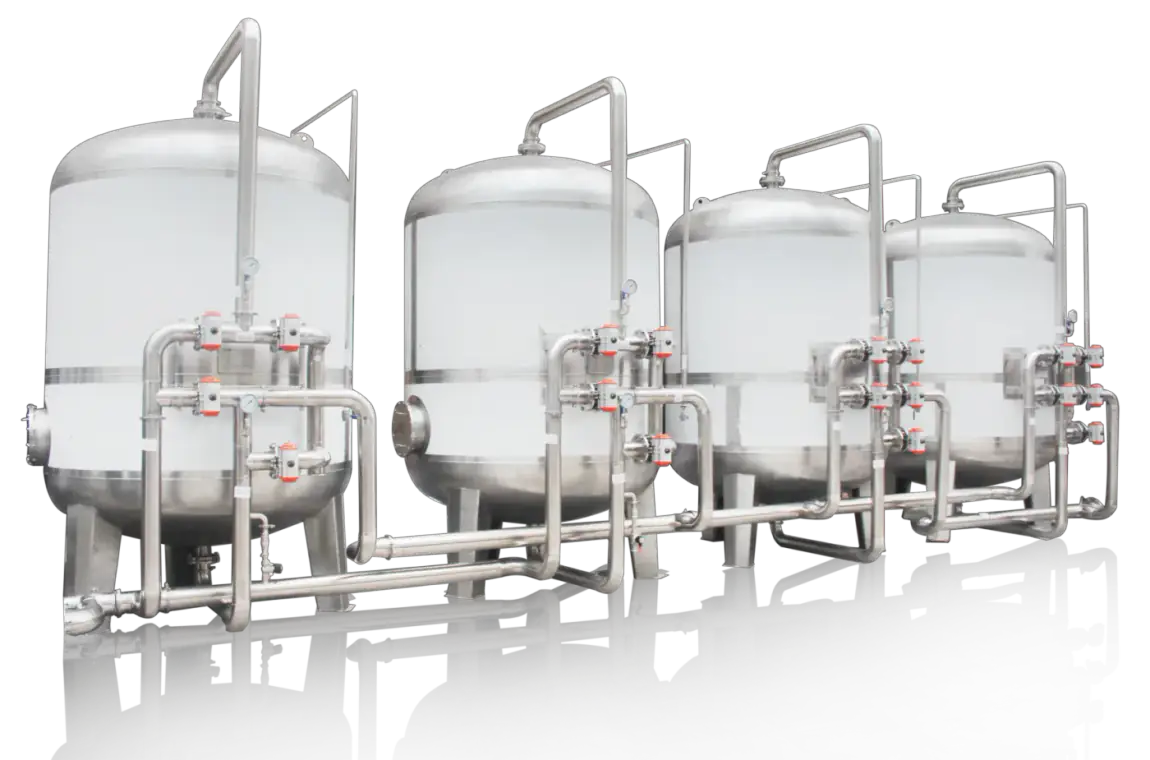
A commercial sand filter is a pressure vessel packed with quartz sand or multimedia. Water passes down through the bed at 10–15 m/h, and particles down to about 100 µm are captured; outlet turbidity is typically ≤5 NTU from feed up to 100 NTU. Backwashing reverses the flow to flush the bed. It is usually the first pretreatment stage.
- Filtration capacity
- 0.5–50 m³/h Filtration capacity
- Inlet turbidity
- ≤100 NTU Inlet turbidity
- Outlet turbidity
- ≤5 NTU Outlet turbidity
- Filtration accuracy
- 100 µm Filtration accuracy
01
What does a commercial sand filter remove, and where does it fit?
A commercial sand filter is a pressure vessel filled with graded quartz sand, anthracite or a multimedia bed. Water flows down through the bed, and suspended particles are captured in the upper layers by a combination of straining and attachment to the grain surfaces. The filter is rated at about 100 µm, so it removes sand, silt, clay flocs, rust particles, algae and other suspended matter. It does not remove dissolved salts, hardness, nitrate or dissolved organics.
Sand filtration is the first stage in most surface-water and well-water trains. It protects downstream carbon beds, softeners, cartridge filters and RO membranes from particulate fouling, and it keeps turbidity low enough for disinfection to work. A sand filter is not a sterilizer: bacteria and viruses pass through unless they are attached to particles, so disinfection is still required for drinking water. In a typical train, sand filtration comes first, followed by carbon, softener and RO, with UV or chlorination at the point of use.
The filter does not replace coagulation, sedimentation or disinfection. It is a physical barrier for particles, and its performance depends on the feed: a stable, low-turbidity source gives long runs and clear water, while a variable source needs upstream treatment and more frequent backwash. Size the bed for the peak flow and the worst turbidity, not for the annual average.
- Removes: turbidity, silt, rust, algae and oxidized iron or manganese flocs
- Does not remove: dissolved salts, hardness, nitrate, colour or chlorine
- Typical duty: first-stage pretreatment ahead of carbon, softener and RO
02
How do service and backwash work?
During service, water enters the top of the vessel through a distributor, passes down through the media, and leaves through a slotted or perforated collector at the bottom. Particles accumulate in the top 100–200 mm of the bed, and the pressure differential rises as the bed clogs. The filter runs until the differential reaches a set limit — commonly 0.5–1 bar — or until a fixed clock time, whichever comes first.
Backwash reverses the flow upward at a rate high enough to expand the bed by 20–30% without washing the media to drain. Sand typically needs 40–60 m/h of backwash flow for 5–10 minutes, and the flow is often supplied by a dedicated backwash pump or an elevated tank. After backwash, a short rinse at service flow settles the bed and clears the first turbid water before the filter returns to service. Air scour can be added for heavy solids or multimedia beds.
- Backwash trigger: differential pressure 0.5–1 bar above the clean-bed baseline, or a fixed interval
- Backwash flow: 40–60 m/h for sand, roughly three to four times the service flow
- Duration: 5–10 minutes, followed by a short rinse at service flow
03
Which filter media should you choose — quartz sand, anthracite or multimedia?
Quartz sand is the default: low-cost, dense and effective on inorganic turbidity. Anthracite is lighter and has more surface area; it allows a coarser top layer, holds more solids and needs less backwash water, which suits surface water with algae or light organics. Multimedia — anthracite over sand over gravel — combines a coarse top layer for capacity with finer lower layers for polish, and is the usual choice when inlet turbidity is variable or high.
Media selection should follow the feed analysis and the downstream requirement. For RO pretreatment, the target is usually SDI15 below 5 and turbidity below 1 NTU, which often needs multimedia followed by a 5 µm cartridge. For drinking water, sand or multimedia plus disinfection is often enough. Activated carbon is a separate stage: it removes chlorine, taste and organics, not turbidity.
| Media | Typical bed depth | Filtration velocity | Strength | Limitation |
|---|---|---|---|---|
| Quartz sand | 700–1,200 mm | 10–15 m/h | Low cost, good on inorganic solids | Shallow bed, higher backwash water |
| Anthracite | 800–1,200 mm | 10–15 m/h | Light, high solids capacity | Lower density, careful backwash needed |
| Multimedia (anthracite/sand/garnet) | 1,000–1,500 mm | 10–15 m/h | Deep bed, stable outlet with variable feed | Higher cost, more complex loading |
| Activated carbon (separate stage) | 800–1,500 mm | 5–15 m/h | Chlorine, taste and organics removal | Not a turbidity filter |
Velocities and bed depths are typical industry values; confirm them against the media supplier and the vessel design.
04
What design and connection parameters should a sand filter quotation state?
A sand filter is sized by service velocity and checked by backwash hydraulics, not by vessel volume alone. The values below are the ones that decide whether a quotation is internally consistent: bed area follows flow divided by velocity; backwash flow follows bed area multiplied by backwash velocity; freeboard must allow the bed to expand without washing media out.
Ask for the vessel diameter, bed depth, design velocity, backwash flow and connection sizes on the drawing. If two quotations use the same flow but different vessel diameters, they are not the same filter even when the price looks comparable.
| Parameter | Typical value | Why it matters |
|---|---|---|
| Service velocity | 10–15 m/h | Sets bed area and prevents fluidisation during service |
| Backwash velocity | 40–60 m/h | Expands the bed and flushes captured solids |
| Backwash duration | 5–10 min | Too short leaves dirt; too long wastes water |
| Sand bed depth | 700–1,200 mm | Run length and filtration quality |
| Multimedia bed depth | 1,000–1,500 mm | Higher solids capacity with variable feed |
| Sand effective size | 0.8–1.2 mm | Balance between removal and pressure drop |
| Uniformity coefficient | ≤ 1.5 | Even flow and predictable backwash |
| Vessel material | Epoxy-coated carbon steel, stainless steel or FRP | Corrosion life and water compatibility |
| Design pressure | 0.6–1.0 MPa typical | Must exceed the maximum pump pressure |
| Connections | DN50–DN200 by flow | Avoid excessive velocity and pressure loss |
| Freeboard | ≥ 50% bed expansion | Prevents media loss during backwash |
Typical industry values. Confirm the final figures against the media supplier, vessel design and site pressure.
05
What feed water quality does a sand filter need?
The catalogue rating is inlet turbidity up to 100 NTU with outlet ≤5 NTU, but that is an operating envelope, not a target. Above roughly 50 NTU, run frequency and backwash water use rise quickly, and above 100 NTU the bed blinds before the cycle ends. For high-turbidity rivers or flood water, add coagulation and sedimentation — or a clarifier — ahead of the filter, and use the sand filter as a polishing stage.
Iron and manganese must be oxidized before they can be filtered. Ferrous iron passes through a sand bed; after aeration, chlorination or ozone dosing it becomes ferric hydroxide, which is filterable. Oil and grease coat the grains and are difficult to backwash out. Algae need pre-chlorination or a rougher upstream stage. Check turbidity, iron, manganese and oxidant demand before selecting the media and the backwash rate.
- Turbidity: ≤100 NTU for direct filtration; above 50 NTU expect shorter runs
- Iron and manganese: oxidize first, then filter; unoxidized iron passes the bed
- Oil and grease: remove upstream; they coat the media and resist backwash
- Backwash source: allow 40–60 m/h for 5–10 minutes without starving the process
06
How do you size a sand filter for flow rate and backwash?
Size from the service velocity, not from the vessel volume. At 10–15 m/h, a 10 m³/h filter needs 0.67–1.0 m² of bed area, which corresponds to a vessel roughly 0.9–1.1 m in diameter. A 30 m³/h filter needs 2–3 m², or about 1.6–2.0 m diameter. Staying inside 10–15 m/h keeps the bed from fluidising during service and gives a realistic backwash requirement.
Backwash flow is roughly three to four times the service flow for sand, so the backwash pump, drain and water source must be sized for that peak, not for the service flow. A 10 m³/h filter may need 35–45 m³/h during backwash for 5–10 minutes. Where the raw-water supply is limited, a backwash storage tank is often lower in cost than a larger supply line. Bed depth and freeboard also matter: too little freeboard and media washes out; too much and the vessel is unnecessarily tall.
Record the vessel diameter, bed depth and design velocity on the nameplate so that a later capacity change can be checked against the original design. The same information is needed when the media is topped up or replaced, because the bed depth determines both the run length and the backwash expansion.
- Worked example: 10 m³/h at 12 m/h needs 0.83 m², or about DN1000
- Worked example: 30 m³/h at 12 m/h needs 2.5 m², or about DN1800
- Check the backwash peak against the raw-water supply, not only the service flow
07
What capacities and motor sizes are available?
The sand filter range covers 0.5–50 m³/h with motors from 0.37 to 7.5 kW. Filtration accuracy is 100 µm, outlet turbidity is ≤5 NTU and inlet turbidity is up to 100 NTU. The range is specified by flow, motor and water quality; the vessel diameter then follows from the 10–15 m/h service velocity. Give the peak flow, raw-water turbidity and backwash source, and the vessel size can be selected from those three inputs.
Vessels are usually epoxy-coated carbon steel, stainless steel or FRP, selected for the water salinity and the installation location. Internals include a top distributor, a graded gravel support layer and a bottom collector. Pressure gauges across the bed, a sight glass on the backwash line and sample taps let operators confirm that the bed is clean and that no media is being lost.
| Parameter | Value |
|---|---|
| Filtration capacity | 0.5–50 m³/h |
| Motor power | 0.37–7.5 kW |
| Filtration accuracy | 100 µm |
| Outlet turbidity | ≤5 NTU |
| Inlet turbidity | ≤100 NTU |
Performance range for the series; selection is by flow, motor and water quality, and vessel size follows from the service velocity.
08
What maintenance keeps a sand filter working?
Backwash on differential pressure or at a fixed interval, whichever comes first. A filter that backwashes only on a timer may run blinded for days; one that backwashes only on pressure may sit dirty through a low-flow period. Record the clean-bed differential pressure after commissioning; a rise of 0.5–1 bar above that baseline is the usual trigger. Check that the backwash flow is actually achieved — a partially closed valve or a worn pump is a common cause of incomplete cleaning.
Inspect the media once a year. Sand is lost during backwash if the freeboard is low or the flow is too high; top up to the design depth. Replace the media every three to five years, or sooner if the bed remains blinded after backwash, if channelling appears, or if the media is coated with oil or biofilm. Check the distributor and collector for cracks, and disinfect the vessel after any media work.
- Weekly: confirm the differential pressure reading and the backwash end point
- Monthly: verify backwash flow and duration; look for media in the sight glass
- Annually: inspect the bed surface for channelling, top up media and check internals
Specifications
Delivery and service — typical ranges
| Item | Typical range |
|---|---|
| Standard skid lead time | 15–30 days after drawing approval |
| Containerized / turnkey lead time | 30–60 days after drawing approval |
| Warranty | 12–18 months from shipment |
| Factory testing | Hydrostatic pressure test and trial run with water before packing |
| Documentation | General arrangement drawing, P&ID, test record, O&M manual and spare-parts list |
| Packaging | Seaworthy plywood crate, or container for containerized plants |
| Installation support | Remote guidance as standard; on-site engineer available on request |
| Operator training | 1–2 days at commissioning, covering operation, CIP and consumables |
| Spare parts | Recommended two-year list quoted separately with the equipment |
| Payment terms | Typically 30% deposit and 70% before shipment; confirmed in the quotation |
| Minimum order | 1 unit |
| Loading port | Guangzhou or Shenzhen, China |
| Power supply | 220/380/415/440 V, 50/60 Hz; confirmed on order |
| Ambient temperature | 5–40 °C |
| Enclosure protection | IP54 for indoor skids; higher IP available on request |
| Certification | CE and ISO 9001; model-specific test reports on request |
Typical industry ranges for planning. Final scope, commercial terms and lead time are confirmed in the quotation.
FAQ
Frequently asked questions
Questions buyers actually ask during sizing and quotation. Answers match the specifications above.
01 What turbidity can a sand filter handle?
02 Does a sand filter remove iron and manganese?
03 Sand filter or multimedia filter — which should I choose?
04 How often should a sand filter backwash?
05 How much water does backwashing use?
06 Can a sand filter make water safe to drink?
07 How long does the filter media last?
08 What operating pressure does a sand filter need?
09 Does a sand filter remove chlorine or taste and odour?
Next step
Send your water analysis, get a factory quotation
Tell us the source water, TDS, hardness, iron and daily demand. Factory engineers reply with a flow rate, process train and budget range within one working day.