Stainless RO plant · 0.5–8 m³/h · UV and chilled fountains
School Water Filter System — Student Drinking Water and Canteen Supply
Quick answer
A school water filter usually combines a stainless RO plant, UV disinfection and a storage tank sized for break-time demand, feeding chilled fountains on each floor. Plan at 10–20 L per student per day, size the RO on refill rate, and keep a separate softener for the canteen.
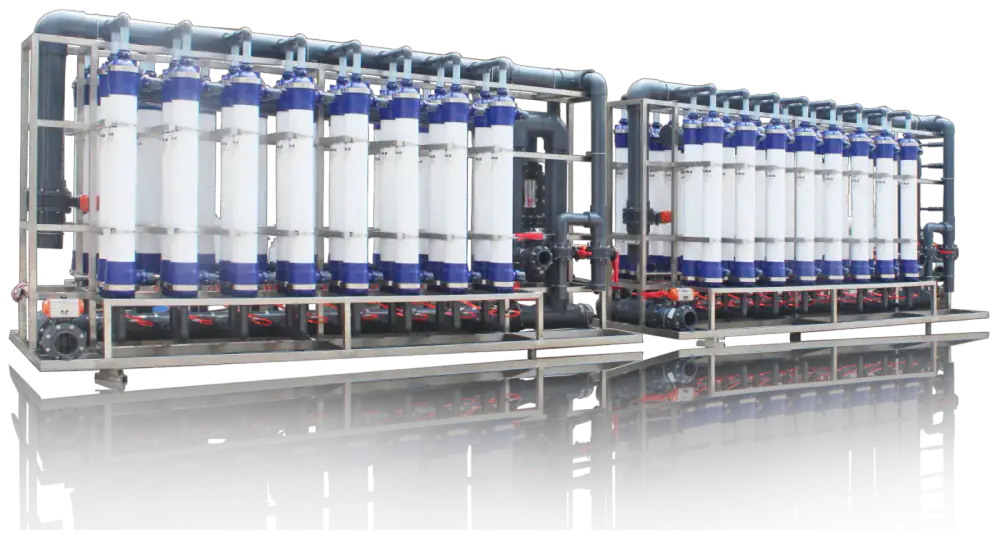
- Planning demand per student per day
- 10–20 L Planning demand per student per day
- RO capacity range
- 0.5–8 m³/h RO capacity range
- UV dose after storage
- 30–40 mJ/cm² UV dose after storage
- Typical break to cover from storage
- 15 min Typical break to cover from storage
01
What water problems show up in a school?
A school has two very different water loads. Drinking water is drawn in short, heavy bursts at break time, when hundreds of students reach the fountains within a few minutes. The canteen draws water steadily for preparation, dishwashing and combi ovens, and is sensitive to hardness. A single filter sized for average flow will fail at the break and may still be too small for the kitchen. A school timetable compresses demand into two or three short windows, so the plant and the fountains must be designed around the break schedule rather than the daily average.
Drinking water quality problems are usually taste, odour and microbiological risk rather than salinity. Chlorine keeps municipal water safe but makes it unpalatable to children, so consumption falls. Storage tanks and long branch pipes create stagnant zones, especially over weekends and holidays. Older buildings may still have lead solder or galvanised pipes, which add metals at the tap.
The canteen has the same scale problem as a restaurant: hard water films glassware, scales dishwashers and combi ovens, and raises detergent use. A school that fixes drinking water but ignores the kitchen will still face equipment downtime and complaints about cloudy ice or flat tea.
- Break-time surges that outrun a small filter or fountain
- Chlorine taste that discourages students from drinking
- Stagnant tanks and pipes over weekends and holidays
- Scale on canteen dishwashers and combi ovens
02
How much water does a school need, and how do you size the plant?
Plan drinking and canteen demand at 10–20 L per student per day, with attendance around 90%. The lower end suits a day school with a simple canteen; the upper end suits a school with full meal service, a gym and a nurse room. Boarding schools add showers and laundry and need a separate calculation, typically 40–80 L per student per day for the whole building.
Size the RO on refill rate, not on the instantaneous break. Daily demand divided by 8–10 refill hours, plus 20% margin, gives the membrane flow. A 1,000-student school at 15 L uses 15 m³/day; 15 ÷ 9 × 1.2 is about 2 m³/h. Storage is sized for the break: 1,000 students drinking 0.2 L each need 200 L, so a 2 m³ tank covers the break and leaves reserve for the canteen. Check the actual break length and fountain count before fixing storage; a school with 10-minute breaks and distant fountains needs more buffer than one with a 20-minute break.
| Students | Typical daily demand | Typical RO flow | Drinking storage | Typical RO model |
|---|---|---|---|---|
| 200–400 | 2–8 m³/day | 0.5–1.0 m³/h | 0.5–1.0 m³ | CK-RO-1000L |
| 500–700 | 5–14 m³/day | 1–2 m³/h | 1.0–2.0 m³ | CK-RO-2000L |
| 800–1,200 | 8–24 m³/day | 2–3 m³/h | 2.0–3.0 m³ | CK-RO-3000L |
| 1,500–2,500 | 15–50 m³/day | 3–5 m³/h | 3.0–5.0 m³ | CK-RO-5000L |
| 3,000–4,000 | 30–80 m³/day | 5–8 m³/h | 5.0–8.0 m³ | CK-RO-10T |
Day-school planning values at 10–20 L/student/day and 90% attendance. Boarding, sports and irrigation loads are additional.
03
Which treatment train does a school need?
The drinking stream needs carbon pretreatment, reverse osmosis where TDS or metals are elevated, UV after storage, and a recirculating loop to the fountains. The canteen stream needs carbon and a softener, not RO, because hardness is the problem and drinking quality is not required. Keeping the two streams separate avoids over-treating kitchen water and keeps the RO small enough to fit a plant room. If the school prepares meals on site, treat the kitchen separately; mixing canteen and drinking loads in one RO train usually produces an oversized membrane and unnecessary concentrate.
Where the source is municipal and TDS is below about 300 ppm, carbon plus UV may be enough for taste and microbiological control. RO is justified when nitrate, lead, sodium or hardness are high, or when the school wants a consistent low-mineral water for all fountains. In either case, the storage tank and loop design matters as much as the filter: a clean tank with turnover and UV is safer than a large tank that sits half full for a week.
| Problem | Treatment stage | Typical equipment |
|---|---|---|
| Chlorine and taste | Pretreatment | Activated carbon filter |
| Turbidity and sediment | Pretreatment | Multimedia filter + 5 µm cartridge |
| Hardness in the canteen | Pretreatment | Softener, 0.5–5 m³/h |
| TDS, nitrate, lead and sodium | Main stage | Reverse osmosis, 0.5–8 m³/h |
| Bacteria in tank and at fountains | Post-treatment | UV sterilizer and loop recirculation |
04
Which capacity and configuration fit your school size?
The table below converts daily demand into a complete train. For schools, the storage tank and the fountain count are as important as the RO flow: a 2 m³/h plant with 2 m³ of storage serves 1,000 students better than a 4 m³/h plant with no buffer, because the demand arrives in a 15-minute window. Provide one fountain per 50–75 students and check that each delivers 4–6 L/min at drinking height. For a boarding school, add showers, laundry and evening study demand; the daily figure can double, and the peak shifts to the evening rather than the morning break.
| Daily demand | RO flow | Pretreatment | Main stage | Post-treatment |
|---|---|---|---|---|
| 2–8 m³/day | 0.5–1 m³/h | Multimedia + carbon + 0.5–1 m³/h softener | CK-RO-1000L | UV + 1 m³ tank + 8–12 fountains |
| 8–16 m³/day | 1–2 m³/h | Multimedia + carbon + 1–2 m³/h softener | CK-RO-2000L | UV + 2 m³ tank + 12–20 fountains |
| 16–30 m³/day | 2–3 m³/h | Multimedia + carbon + 2–3 m³/h softener | CK-RO-3000L | UV + 3 m³ tank + 20–30 fountains |
| 30–50 m³/day | 3–5 m³/h | Multimedia + carbon + 3–5 m³/h softener | CK-RO-5000L | UV + 5 m³ tank + 30–50 fountains |
| 50–80 m³/day | 5–8 m³/h | Multimedia + carbon + 5–8 m³/h softener | CK-RO-10T | UV + 8 m³ tank + 50–80 fountains |
Fountain counts assume one unit per 50–75 students and a 15-minute break. Canteen demand is included in the daily total but not in drinking storage.
05
What are the installation requirements for a school?
Locate the plant room near the canteen or main riser, with 3 × 2 m for a 1–3 m³/h system, 2.2 m clear height and 0.8 m service access. Provide a floor drain, 380 V three phase power and a lockable door: students should not be able to reach valves, chemicals or the UV chamber. The storage tank should be stainless steel, vented, insect-proofed and fitted with a level transmitter and low-level alarm.
Fountains need a dedicated supply and drain, a 220 V socket for the chiller, and a mounting height that fits the age group: about 750–850 mm for primary students and 900–1,000 mm for secondary. Use a two-tier fountain where both age groups share a building. Insulate the loop, fit isolation valves on each floor, and provide a sampling point at the furthest fountain so water quality can be verified at the point of use. Lock the plant room and label the main valve; a curious student should not be able to change a setting that affects the whole building.
- Plant room 3 × 2 m for 1–3 m³/h; 2.2 m clear height
- Lockable room; no student access to valves or UV
- Floor drain and 380 V three phase supply
- Stainless tank with level alarm and insect screen
- Fountain height 750–850 mm primary, 900–1,000 mm secondary
- Sampling point at the furthest fountain
06
How is a school water system maintained?
Term-time maintenance is simple: weekly checks of tank level, UV status and fountain flow; cartridge replacement every one to three months; salt top-up weekly if a softener serves the canteen; and tank sanitation quarterly. Keep a log book in the plant room and assign one staff member as the responsible operator, with a service contract for membrane and valve work. Assign a named operator and a deputy, so the routine survives staff changes.
Holidays need a different routine. If the building is closed for more than two weeks, isolate and drain the loop where possible, sanitise the tank and fountains before the new term, flush all branches, and replace cartridges that have passed their interval. The first morning after a long break is the highest-risk period for stagnant water, so flush and sample before students arrive rather than after a complaint.
| Item | Interval | Action |
|---|---|---|
| Cartridge filters | 1–3 months | Replace; record on housing |
| Carbon filter | 3–6 months | Replace by volume or taste |
| Tank and loop | Quarterly and before term | Drain, sanitise, flush, sample |
| UV lamp | 9,000–12,000 h | Replace lamp; clean quartz sleeve |
| RO membrane | 2–3 years | Replace when flow or rejection falls |
| Canteen softener | Salt weekly; resin 3–5 years | Check salt, hardness and regeneration |
Specifications
Delivery and service — typical ranges
| Item | Typical range |
|---|---|
| Standard skid lead time | 15–30 days after drawing approval |
| Containerized / turnkey lead time | 30–60 days after drawing approval |
| Warranty | 12–18 months from shipment |
| Factory testing | Hydrostatic pressure test and trial run with water before packing |
| Documentation | General arrangement drawing, P&ID, test record, O&M manual and spare-parts list |
| Packaging | Seaworthy plywood crate, or container for containerized plants |
| Installation support | Remote guidance as standard; on-site engineer available on request |
| Operator training | 1–2 days at commissioning, covering operation, CIP and consumables |
| Spare parts | Recommended two-year list quoted separately with the equipment |
| Payment terms | Typically 30% deposit and 70% before shipment; confirmed in the quotation |
| Minimum order | 1 unit |
| Loading port | Guangzhou or Shenzhen, China |
| Power supply | 220/380/415/440 V, 50/60 Hz; confirmed on order |
| Ambient temperature | 5–40 °C |
| Enclosure protection | IP54 for indoor skids; higher IP available on request |
| Certification | CE and ISO 9001; model-specific test reports on request |
Typical industry ranges for planning. Final scope, commercial terms and lead time are confirmed in the quotation.
FAQ
Frequently asked questions
Questions buyers actually ask during sizing and quotation. Answers match the specifications above.
01 Is RO necessary for school drinking water?
02 How many drinking fountains does a school need?
03 Can we just use municipal tap water?
04 How do we handle long school holidays?
05 Does the canteen need a separate softener?
06 What size system does a 1,000-student school need?
07 Who should maintain the system?
08 What water pressure and power are needed?
Next step
Send your water analysis, get a factory quotation
Tell us the source water, TDS, hardness, iron and daily demand. Factory engineers reply with a flow rate, process train and budget range within one working day.