Definitions · units · quotation terms
Water Treatment Glossary — Terms Buyers Meet in Specifications and Quotations
Quick answer
This glossary defines 32 terms used in water treatment specifications and quotations, from TDS and conductivity to SDI, CIP, recovery rate, flux, UV dose and passivation. Each entry gives a short explanation of one or two sentences and, where useful, the unit or typical range. Use it to read a quotation accurately and to ask suppliers the right questions.
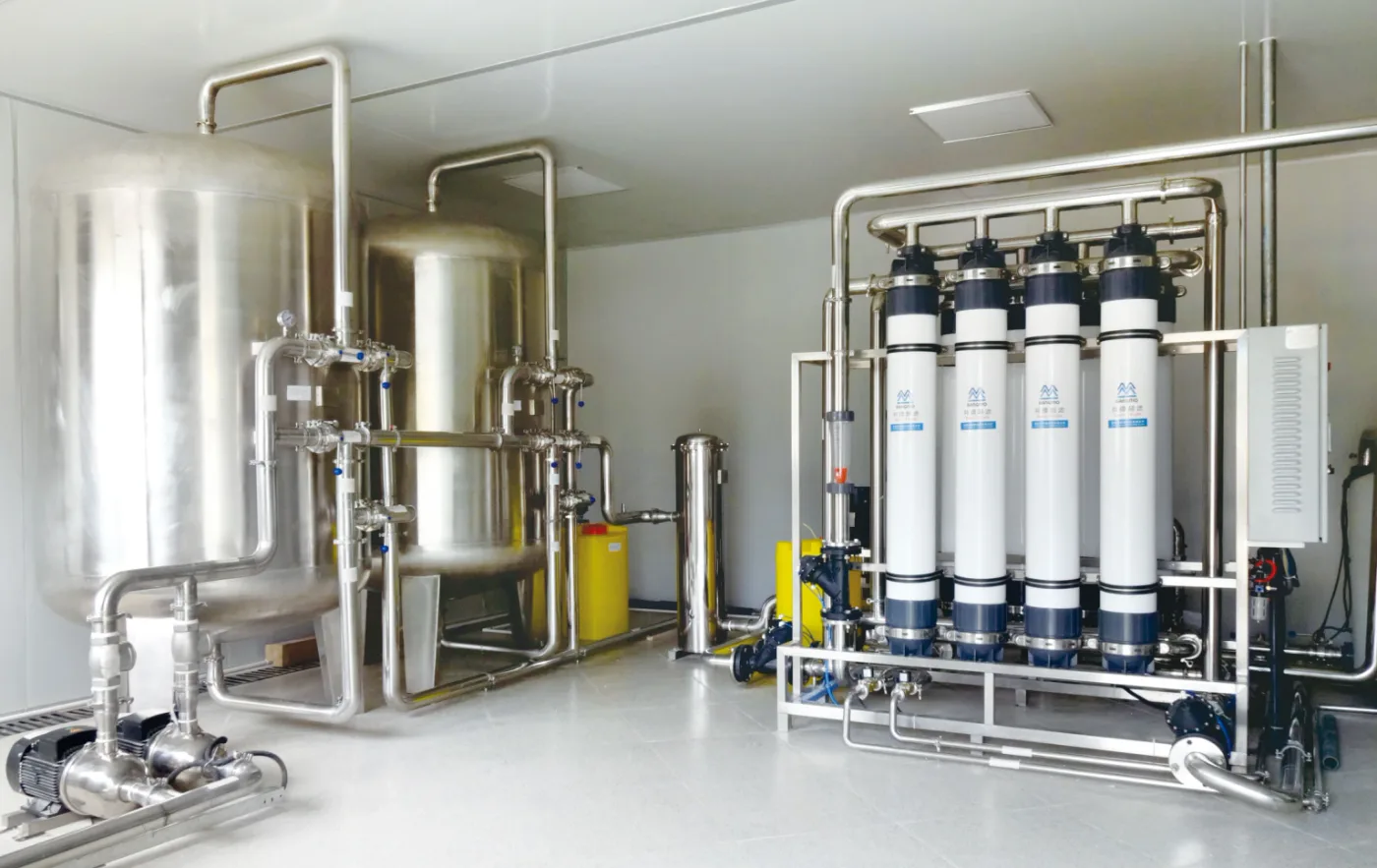
- Terms defined
- 32 Terms defined
- Common units
- 7 Common units
- Quotation checks
- 5 Quotation checks
- Sentences per term
- 1–2 Sentences per term
01
How should you use this glossary?
Water treatment specifications mix physics, chemistry and vendor shorthand. Recovery is a percentage in an RO quotation but a volume in a tank specification; micron rating can be nominal or absolute. The entries below use common commercial meanings. Values are typical ranges, not project guarantees.
Use the letter groups to look up a term, then check the quotation section for terms that change real capacity and cost.
02
What do the A–C terms mean?
| Term | Meaning |
|---|---|
| Antiscalant | A chemical dosed into RO feed to inhibit precipitation of calcium carbonate, sulphate, silica and other sparingly soluble salts. It allows higher recovery without softening but does not remove hardness. |
| Backwash | The reverse flow used to expand a filter bed and flush captured solids to drain. It is defined by flow rate and duration, then followed by a rinse. |
| Brine | The concentrated salt solution used to regenerate ion-exchange resin in a softener. It is made in a salt tank and drawn through the resin. |
| CIP | Clean-in-place: circulating cleaning solution through membranes or vessels without dismantling the system. It is triggered by normalized flow loss or pressure rise. |
| Concentrate | The stream that carries rejected salts away from an RO membrane. At 75% recovery, one quarter of the feed leaves as concentrate. |
| Conductivity | A measure of how well water carries electricity, expressed in µS/cm. It rises with dissolved ions and is the basis of most TDS meter readings. |
| Contact time | The period water spends in contact with ozone, chlorine or carbon. Ozone typically needs 5–15 minutes; UV needs seconds. |
03
What do the D–H terms mean?
| Term | Meaning |
|---|---|
| Differential pressure | The pressure drop across a filter, membrane array or resin bed. A rising value at constant flow indicates fouling or channelling. |
| EBCT | Empty bed contact time: carbon bed volume divided by flow, usually in minutes. It determines how much adsorption capacity the water can use. |
| Flux | Permeate flow per unit membrane area, typically L/m²·h. Design flux falls as feed fouling potential rises. |
| GAC | Granular activated carbon, used to remove chlorine, taste, odour, colour and some dissolved organics. It does not remove dissolved salts or hardness. |
| Hardness | Calcium and magnesium concentration, expressed as mg/L CaCO₃. It causes scale and consumes soap; a softener removes it by ion exchange. |
04
What do the I–M terms mean?
| Term | Meaning |
|---|---|
| Ion exchange | A process in which resin swaps one ion for another, such as calcium for sodium or nitrate for chloride. The resin is regenerated with a concentrated solution. |
| LSI | Langelier Saturation Index: whether water will deposit or dissolve calcium carbonate. Positive values tend to scale; negative values corrode. |
| Membrane | A semi-permeable barrier that separates water from dissolved or suspended material. RO, UF, NF and MF differ mainly in pore size and operating pressure. |
| Micron rating | The nominal particle size a filter is rated to retain, in micrometres. A 5 µm cartridge is a common membrane prefilter; nominal and absolute ratings are not the same. |
05
What do the N–R terms mean?
| Term | Meaning |
|---|---|
| NTU | Nephelometric Turbidity Unit, a measure of light scattered by suspended particles. Drinking-water plants often target below 1 NTU, and RO feed is usually below 1 NTU. |
| ORP | Oxidation-reduction potential, measured in millivolts. It indicates the oxidising or reducing strength of water and is used to monitor chlorine or ozone dosing. |
| Ozone | A strong oxidant (O₃) used for disinfection, colour, taste and iron/manganese removal. It leaves a short-lived residual and can form bromate when bromide is present. |
| Passivation | The formation of a thin oxide layer on stainless steel that restores corrosion resistance after welding or machining. It is usually done with an acid treatment and verified before commissioning. |
| Permeate | The purified water that passes through an RO or UF membrane. Its flow and conductivity are the main performance indicators of an RO system. |
| ppm / mg/L | Parts per million and milligrams per litre are numerically equivalent for dilute aqueous solutions. Both are used for TDS, hardness and contaminant concentrations. |
| Pretreatment | The processes ahead of a membrane or disinfection step that remove chlorine, particles, hardness or iron. Correct pretreatment is the main determinant of membrane life. |
| Recovery rate | Permeate flow divided by feed flow, expressed as a percentage. Higher recovery means less concentrate but greater scaling risk. |
| Regeneration | The process that restores an ion-exchange resin by passing a concentrated brine, acid or caustic solution through it. It consumes salt or chemicals and produces a waste stream. |
| Rejection rate | The percentage of a dissolved species that a membrane removes from the feed. RO membranes typically reject 95–99% of dissolved salts under design conditions. |
06
What do the S–Z terms mean?
| Term | Meaning |
|---|---|
| SDI | Silt Density Index, a measure of how fast a 0.45 µm filter plugs. Most RO manufacturers require SDI15 below 5 and prefer below 3. |
| Service flow | The design flow a treatment unit must handle during normal operation, usually stated in m³/h. It differs from peak flow, which may be higher. |
| Softener | An ion-exchange system that removes calcium and magnesium and regenerates with brine. It reduces hardness but not TDS. |
| TDS | Total dissolved solids, the mass of dissolved inorganic and organic matter in water, expressed in mg/L. A meter estimates it from conductivity. |
| UV dose | The product of UV intensity and exposure time, expressed in mJ/cm². Drinking-water disinfection typically targets 30–40 mJ/cm² at 254 nm. |
| UVT | UV transmittance, the percentage of 254 nm light that passes through 1 cm of water. Lower UVT requires more lamps or a larger reactor to achieve the same dose. |
07
Which terms should you check in a quotation?
Five terms decide whether two quotations describe the same system: recovery, rejection, membrane area, pretreatment scope and warranty. Capacity without these details cannot be compared fairly. Ask for the feed analysis, design flux, membrane model and expected permeate conductivity.
| Term | What to check | Typical reference |
|---|---|---|
| Recovery rate | Stated for the design feed temperature and analysis | 50–75% for RO |
| Rejection rate | Based on a named salt and test condition | 95–99% |
| Membrane area | Total square metres, not just element count | Match design flux |
| SDI | Feed quality assumption and pretreatment | Below 5, preferably below 3 |
| Warranty | Duration and what is excluded | 12–18 months |
08
How do the common units relate to each other?
Most confusion comes from mixing mass, conductivity and flow. mg/L and ppm are interchangeable in dilute water; conductivity needs a conversion factor; flow and pressure depend on design temperature and voltage. The table gives the relationships used here.
| Unit | Measures | Conversion or note |
|---|---|---|
| mg/L | Mass concentration | Approximately equal to ppm in dilute water |
| ppm | Parts per million | 1 ppm is about 1 mg/L for water |
| µS/cm | Electrical conductivity | Multiply by 0.5–0.7 to estimate TDS in mg/L |
| m³/h | Volumetric flow | 1 m³/h equals 1,000 L/h |
| bar | Pressure | 1 bar is about 14.5 psi |
| mJ/cm² | UV dose | Intensity multiplied by exposure time |
| NTU | Turbidity | Optical measurement, not a mass unit |
FAQ
Frequently asked questions
Questions buyers actually ask during sizing and quotation. Answers match the specifications above.
01 What is the difference between TDS and conductivity?
02 What does recovery rate mean in practice?
03 What is a good SDI for RO feed?
04 What is the difference between GAC and a carbon block?
05 What does a 5 micron filter remove?
06 What is CIP and when is it needed?
07 What is flux and why does it matter?
08 What is EBCT in carbon filtration?
09 What is passivation and why is it specified?
Next step
Send your water analysis, get a factory quotation
Tell us the source water, TDS, hardness, iron and daily demand. Factory engineers reply with a flow rate, process train and budget range within one working day.