20 & 40 ft · 4–25 m³/h · factory tested
Containerized Water Treatment Plant — Turnkey Systems in 20 and 40 ft Containers
Quick answer
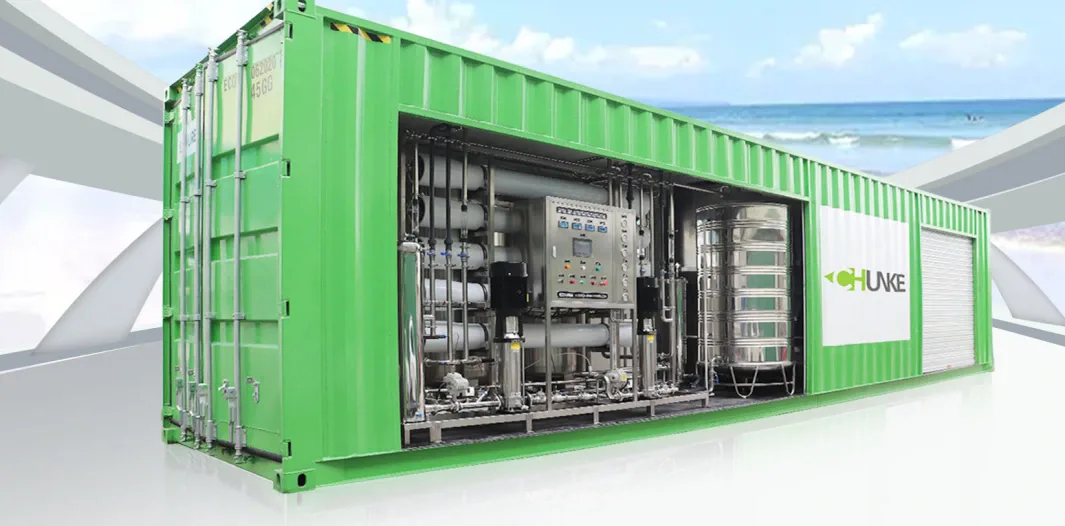
A containerized water treatment plant puts pretreatment, reverse osmosis, disinfection, controls and lighting inside a 20- or 40-foot container. Capacities run from 4 to 25 m³/h. The unit is assembled and wet-tested in the factory, then shipped, set on a foundation and connected to water, drain and power. Turnkey scope covers design, manufacturing, shipping, installation, commissioning and training.
- Permeate per container
- 4–25 m³/h Permeate per container
- Container sizes
- 20 / 40 ft Container sizes
- Installed motor power
- 7–30 kW Installed motor power
- RO recovery
- 55–75% RO recovery
01
What is a containerized water treatment plant?
A containerized plant is a complete treatment train built inside a steel ISO container. Depending on the water analysis, it can hold multimedia filters, softeners, dosing stations, reverse osmosis, UV or ozone, a control panel, lighting, ventilation and drains. The container protects the equipment from weather and unauthorised access, and provides a stable base that can be lifted onto a prepared foundation. The plant arrives as one transportable unit rather than as loose vessels and pipework.
The difference from a skid is the enclosure, not the process. A skid assumes a plant room with walls, lighting, drainage and ventilation; a container supplies all four. That makes the container the usual choice when civil works are slow, the site is remote, or the plant may be relocated later. Where a suitable building already exists, a skid is usually the simpler and more economical option.
The container itself is part of the equipment. Walls and roof are insulated, the floor has a drain, and ventilation maintains a working temperature for pumps, membranes and electronics. Cable trays, service lighting and a lockable door are fitted during fabrication, so the site does not need to build a plant room. Raw water tanks, treated water storage and large chemical tanks usually remain outside because they do not fit or are better placed at ground level.
- 20-foot container for compact trains and lower flows
- 40-foot container for higher flows or more process steps
- ISO corner castings for lifting and securing on the ship
- Lockable access doors, service lighting and a cable tray
02
Which capacity and container size fit your site?
Containerized RO systems are built from 4 to 25 m³/h. A 20-foot container usually carries 4–10 m³/h with pretreatment; a 40-foot container carries 10–25 m³/h or a smaller flow with more treatment steps, such as softening, carbon, RO and a clean-in-place unit. Capacity is set by peak demand and daily volume, not by the container size alone, and the layout is confirmed on a general arrangement drawing before fabrication.
| Model | Permeate (m³/h) | Motor (kW) | Recovery | Container |
|---|---|---|---|---|
| CK-RO-4000L | 4 | 7 | 55–60% | 20 ft |
| CK-RO-5000L | 5 | 8 | 55–65% | 20 ft |
| CK-RO-10T | 10 | 18 | 60–70% | 20 or 40 ft |
| CK-RO-20T | 20 | 30 | 65–75% | 40 ft |
| CK-RO-25T | 25 | 30 | 65–75% | 40 ft |
Permeate rated at 25 °C. Recovery depends on feed TDS, temperature and pretreatment; motor ratings refer to the high-pressure pump.
03
What is included in a turnkey delivery?
Turnkey means one contract covers the plant from design to operator training. The boundary must be written into the quotation, because site work is always shared. The supplier normally provides engineering, fabrication, factory testing, packing, shipping documents, installation supervision, commissioning and training. The buyer normally provides a level foundation, power supply to the container, raw water connection, drain, treated-water storage and local permits.
Scope discipline matters most at the interfaces. The quotation should list who supplies the foundation, the power cable and breaker, the raw water pump, the drain, the treated-water tank and the local permits. It should also state what testing is done at the factory and what is repeated on site, and which party pays for standing time if utilities are not ready. A clear boundary prevents the most common commissioning dispute: equipment that is complete but cannot be started.
| Stage | Supplier scope | Deliverable | Buyer scope |
|---|---|---|---|
| Design | Water analysis review, process design, layout, electrical and piping drawings | Approved drawing set and equipment list | Site data, water analysis, utility limits |
| Manufacturing | Vessel fabrication, skid assembly, piping, wiring, panel building | Completed plant with nameplates and documentation | Approval of submittals and change requests |
| Factory testing | Pressure test, electrical check, instrument calibration, wet test | Test report, photos and inspection record | Witnessing if required by contract |
| Shipping | Preservation, packing, lifting plan, export documents | Container or flat rack ready for transport | Import clearance, inland transport, site unloading |
| Installation | Installation manual, remote support, or supervisor on site | Plant set, levelled and connected | Foundation, power cable, water and drain connections |
| Commissioning | Flushing, membrane loading, pressure and recovery setting, water test | Commissioning report and as-built notes | Feed water, power, chemicals and drain available |
| Training | Operator training on start-up, backwash, CIP and troubleshooting | Training record and operation manual | Operators released from other duties |
Scope is confirmed line by line in the quotation; anything not listed is excluded.
04
How is the plant tested before shipment?
Every containerized plant is assembled and tested as a unit before it is packed. Testing starts with a pressure test of vessels and piping, followed by an electrical inspection and instrument calibration. The plant is then run wet with feed water to check pump rotation, permeate flow, recovery, conductivity, leak points and every alarm and interlock. The test report, with readings and photographs, is issued before shipment.
The wet test uses the actual pretreatment and RO train, not a bypass. Where the customer cannot supply representative feed water, the test is run on prepared water of similar conductivity and the report states the substitution. Membranes are loaded for the test, then preserved for transport; instruments are zeroed and ranged before packing. Photographs of the internal layout, pipe labels and panel are included so the site team can compare on arrival.
- 01
Pressure and leak test
Vessels, headers and piping are tested above working pressure; flanges and welds are checked.
- 02
Electrical and control check
Panel wiring, motor rotation, instrument signals and safety interlocks are verified.
- 03
Wet test
The plant runs on feed water; permeate flow, recovery and conductivity are recorded.
- 04
Alarm and interlock test
Low pressure, high pressure, low level and conductivity alarms are triggered and checked.
- 05
Preservation and packing
Membranes are preserved, loose parts secured, openings sealed and the container prepared for sea freight.
05
Why choose containerized instead of a site-built plant room?
The choice is usually decided by site conditions rather than by process. A container shifts fabrication and testing into a factory, reduces site labour, and removes the need for a permanent building. That matters where the site is remote, the climate is harsh, the project schedule is short, or the plant may move to another location. A site-built plant room can be cheaper when a suitable building already exists and local contractors are available.
| Factor | Containerized | Site-built plant room |
|---|---|---|
| Civil works | Level foundation and cable trench only | Building, drains, lighting, ventilation |
| Schedule | Factory build in parallel with site preparation | Civil works precede equipment installation |
| Quality control | Assembled and tested under factory conditions | Depends on site supervision and weather |
| Relocation | Can be lifted and moved as one unit | Effectively permanent |
| Expansion | Add a second container or extend the train | Building space and civil work required |
| Weather protection | Insulated, ventilated, lockable enclosure | Designed and built for the site |
Both options use the same process equipment; the difference is where it is assembled and how it is protected.
06
Where are containerized plants typically used?
Containerized plants suit sites where a permanent building is impractical or slow to build. Typical uses include remote communities, construction and mining camps, island and coastal settlements, industrial parks, agricultural estates and temporary facilities. The feed water can be borehole, river, lake, municipal supply or seawater where a desalination train is included. The common thread is a need for potable or process water at a defined flow, with limited site labour.
Each site has a different constraint. A mining camp may need dust protection and high recovery because water is trucked in; an island community may need seawater desalination and corrosion protection; an industrial park may need process water at a constant conductivity. The container layout should be confirmed against these constraints rather than chosen from a standard size list.
- Remote communities and worker camps
- Island, coastal and off-grid sites
- Industrial parks and factories without a plant room
- Agricultural estates and livestock operations
- Temporary or relocatable facilities
07
How are shipping, installation and commissioning handled?
A 20-foot container measures about 6.1 m long and a 40-foot container about 12.2 m; weight depends on the process train and must be confirmed on the packing list. The container is lifted by its corner castings, set on a level reinforced foundation, and anchored against wind. Site work then consists of connecting raw water, treated water, drain, power and any chemical dosing lines. Commissioning typically takes three to seven days, including flushing, membrane loading, set-point adjustment, a water test and operator training.
Shipping documents usually include the packing list, weight certificate, lifting points, electrical drawings and the factory test report. The container can travel as a standard ISO unit or on a flat rack if height is restricted. On arrival, inspect the corner castings, doors and visible pipework before lifting; note damage on the delivery receipt and photograph it. Installation supervision can be remote, but the first start-up should be witnessed by someone who can stop the plant if a reading is wrong.
- Confirm foundation dimensions, loading and anchor points before delivery
- Provide a power supply matched to the installed motor and control voltage
- Keep the container accessible for membrane and filter replacement
- Record commissioning readings as the baseline for later maintenance
08
Can a containerized plant work in hot, cold or coastal climates?
Yes, with the right enclosure options. Hot climates need ventilation, insulation and sometimes air conditioning to keep the control panel and membranes within temperature limits. Cold climates need insulation, heat tracing on exposed lines and freeze protection for standby equipment. Coastal sites need corrosion-resistant coatings and stainless or plastic wetted parts. Sand and dust require filters on ventilation openings and a maintenance schedule for cooling surfaces.
RO output falls as feed temperature drops; winter design should use the lowest expected water temperature, not the summer value.
Specifications
Delivery and service — typical ranges
| Item | Typical range |
|---|---|
| Standard skid lead time | 15–30 days after drawing approval |
| Containerized / turnkey lead time | 30–60 days after drawing approval |
| Warranty | 12–18 months from shipment |
| Factory testing | Hydrostatic pressure test and trial run with water before packing |
| Documentation | General arrangement drawing, P&ID, test record, O&M manual and spare-parts list |
| Packaging | Seaworthy plywood crate, or container for containerized plants |
| Installation support | Remote guidance as standard; on-site engineer available on request |
| Operator training | 1–2 days at commissioning, covering operation, CIP and consumables |
| Spare parts | Recommended two-year list quoted separately with the equipment |
| Payment terms | Typically 30% deposit and 70% before shipment; confirmed in the quotation |
| Minimum order | 1 unit |
| Loading port | Guangzhou or Shenzhen, China |
| Power supply | 220/380/415/440 V, 50/60 Hz; confirmed on order |
| Ambient temperature | 5–40 °C |
| Enclosure protection | IP54 for indoor skids; higher IP available on request |
| Certification | CE and ISO 9001; model-specific test reports on request |
Typical industry ranges for planning. Final scope, commercial terms and lead time are confirmed in the quotation.
FAQ
Frequently asked questions
Questions buyers actually ask during sizing and quotation. Answers match the specifications above.
01 What capacity range is available in a container?
02 What is the difference between containerized and skid-mounted?
03 Can a containerized plant treat borehole, river or seawater?
04 Does the container include pretreatment and disinfection?
05 Does a containerized plant need a concrete foundation?
06 How long does installation and commissioning take?
07 Can it operate in cold or hot climates?
08 What warranty and support are included?
09 How much does a containerized water treatment plant cost?
Next step
Send your water analysis, get a factory quotation
Tell us the source water, TDS, hardness, iron and daily demand. Factory engineers reply with a flow rate, process train and budget range within one working day.