Factory reference designs · not delivered projects · planning ranges
Factory Reference Designs — Six Water Treatment Applications
Quick answer
These are factory reference designs, not delivered projects. Each assumes a typical source water, lists the likely contaminants, and proposes a treatment train with a flow range and installation format for hotels, restaurants, schools, hospitals, factories and remote communities or camps. Use them to frame a specification, then confirm the design against a water analysis.
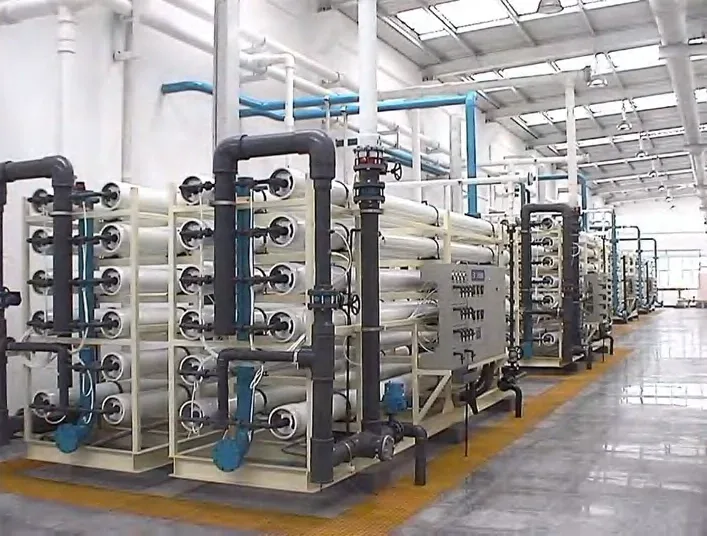
- Reference scenarios
- 6 Reference scenarios
- Planning flow range
- 0.5–50 m³/h Planning flow range
- Typical RO recovery
- 50–75% Typical RO recovery
- Installation formats
- 3 Installation formats
01
What do these reference designs represent?
They are planning references, not delivered projects. No client name, site, contract quantity or commissioning result is shown, because those details belong to the buyer and are not published. Each example states an assumed source water, the contaminants that typically appear, a treatment train that addresses them, a flow range for early sizing and an installation format.
The purpose is to shorten the first conversation. A buyer can point to a scenario that resembles the project, compare the assumed water quality with the actual analysis, and see which process steps are likely to remain. The design still has to be confirmed by a water analysis and a site survey.
All six scenarios use the same structure, so they can be compared without decoding different formats. The ranges are deliberately broad; a single number would imply a precision that the assumptions do not support.
Reference solution only. It does not represent a delivered project, a client site or a guaranteed performance result.
02
How should you read a reference configuration?
Read five lines together: source water, demand profile, treated water target, site and utilities, and operation model. A train that suits a municipal supply with low hardness will be wrong for a borehole with iron and manganese. A plant sized for a single shift will be wrong for a hotel that draws water around the clock.
The tables give a reference train, not a fixed bill of materials. A process step can be removed when the analysis shows it is unnecessary, or added when a contaminant appears above the guideline. The flow range is a planning envelope for the scenario, not a guarantee that any single project in that category will fall inside it.
Cost and footprint follow the train, not the category name. Two hotels with the same flow can need different pretreatment if one uses municipal water and the other uses a borehole. Always replace the assumptions with measurements before comparing quotations.
| Parameter | Assumption to confirm | Why it changes the design |
|---|---|---|
| Source water | Municipal, borehole, river, rainwater or trucked water | Determines pretreatment and disinfection |
| Water quality | TDS, hardness, iron, manganese, turbidity and bacteria | Selects the process steps and membrane array |
| Demand | Peak flow, daily volume, operating hours and storage | Sets permeate capacity and tank volume |
| Treated water target | Drinking, cooking, laundry, process or boiler make-up | Sets conductivity, hardness and disinfection |
| Site and utilities | Power, voltage, space, drain, climate and access | Chooses skid, container or plant-room layout |
| Operation | Who runs it, maintenance skill and spare parts access | Sets control level and redundancy |
03
Which treatment train suits hotels and restaurants?
A hotel typically draws from a municipal supply or a borehole and uses water for guest drinking, kitchens, laundry, pools and cooling. Hardness and chlorine are the usual concerns; iron and manganese appear where borehole water is used. A common reference train is multimedia filtration, activated carbon, softening, RO for drinking and kitchen points, and UV at the outlet. Laundry and cooling may need separate softening rather than RO.
A restaurant or coffee shop has a smaller and more peaky demand. The main risks are chlorine taste, hardness scale in coffee machines and steamers, and bacteria in stored water. A compact train of carbon, softening, RO and UV, with a small treated-water tank, is often enough. Flow range is typically 0.5–3 m³/h, and the equipment usually sits in a back-of-house plant room or a compact skid.
Both scenarios often share a building but not a water quality target. Drinking water needs a lower TDS and disinfection; laundry and cooling need softened water rather than fully demineralised water. Combining them into one RO train can oversize the drinking-water plant and send high-quality water to tasks that do not need it.
| Scenario | Source assumption | Typical issues | Reference process | Flow range | Installation |
|---|---|---|---|---|---|
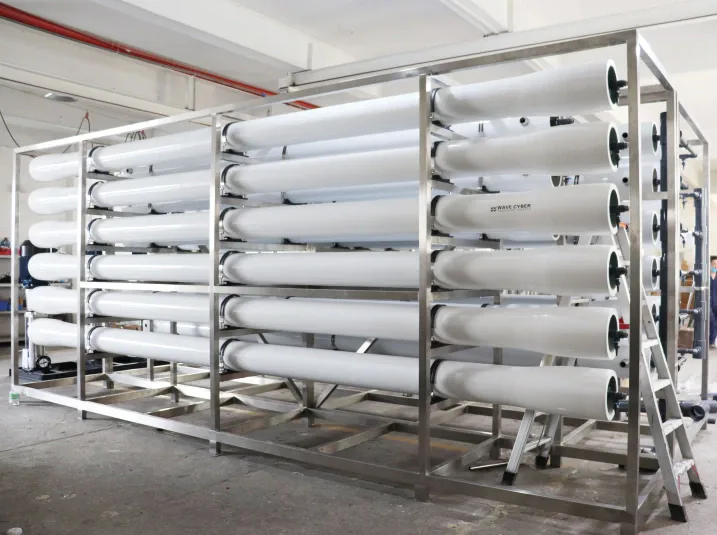
| Hotel | Municipal supply or borehole | Hardness, chlorine, occasional iron and manganese | Multimedia, carbon, softener, RO, UV | 5–20 m³/h | Plant room with raw and treated tanks |
| Restaurant or coffee shop | Municipal supply | Chlorine taste, hardness scale, bacteria in storage | Carbon, softener, RO, UV | 0.5–3 m³/h | Back-of-house room or compact skid |
Planning ranges only; confirm with the fixture count, operating hours and water analysis.
04
Which treatment train suits schools and hospitals?
A school has a predictable daytime load and a long idle period. Drinking fountains, canteens and washrooms create peaks at break times, so storage and a duty and standby transfer pump matter as much as the RO capacity. A reference train is multimedia, carbon, softening where hardness is high, RO and UV, with a treated-water tank sized for the morning peak. Flow range is typically 1–10 m³/h.
A hospital uses water for drinking, food service, laundry, cleaning and some equipment. Drinking water can follow the same train as a school, but process water for sterilizers, laboratories or dialysis needs a dedicated design and a validated quality standard. Do not extend a drinking-water design into a clinical process without a separate review. Reference flow for general hospital use is 2–15 m³/h.
In both cases, storage and distribution matter as much as the treatment skid. A treated-water tank that is too small causes the plant to cycle; dead legs and oversize piping create stagnation. The reference layout therefore includes a hygienic tank, a transfer pump and a return loop where the building layout allows.
| Scenario | Source assumption | Typical issues | Reference process | Flow range | Installation |
|---|---|---|---|---|---|
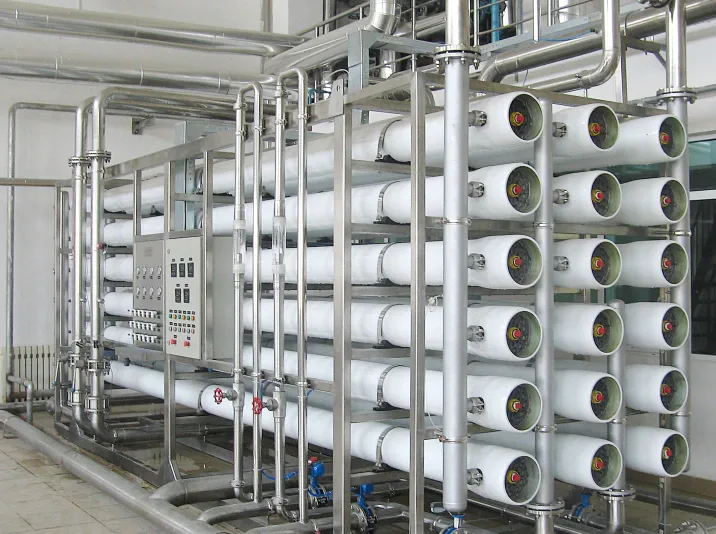
| School | Municipal supply or borehole | Hardness, chlorine, bacteria in storage, peak draw at breaks | Multimedia, carbon, softener, RO, UV | 1–10 m³/h | Plant room or skid with treated-water tank |
| Hospital | Municipal supply or borehole | Hardness, chlorine, bacteria, separate clinical water standards | Multimedia, carbon, softener, RO, UV; separate clinical train | 2–15 m³/h | Plant room with storage and distribution loop |
Clinical process water requires a dedicated design and validation; the drinking-water train is not a substitute.
05
Which treatment train suits factories and remote sites?
A factory may need process water rather than drinking water. The target might be low hardness for boiler make-up, low conductivity for rinsing, or removal of iron for a production line. A reference train starts with the process requirement, then adds pretreatment, RO or softening, and polishing as needed. Flow range is wide, typically 5–50 m³/h, and the plant is usually in a dedicated plant room.
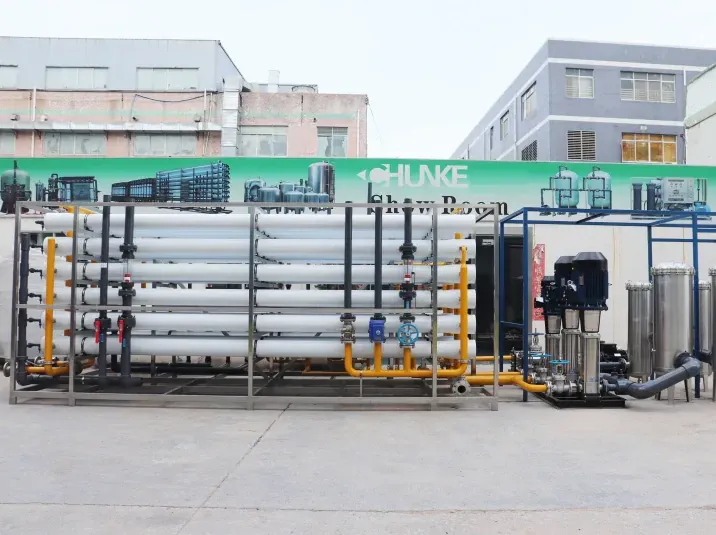
A remote community, camp or construction site usually has a borehole, river or trucked water, no reliable municipal supply and limited maintenance. Turbidity, iron, manganese, hardness, TDS and bacteria can appear together. A containerized train with multimedia, carbon, softener, RO, UV or chlorine and a treated-water tank is the usual reference; flow is typically 1–20 m³/h. It is built and tested as one unit, then connected on site.
The two scenarios differ mainly in infrastructure. A factory usually has power, a plant room and maintenance staff; a remote site may have none of the three. That is why the remote reference is containerized and includes disinfection and storage, while the factory reference can be a skid inside an existing building.
| Scenario | Source assumption | Typical issues | Reference process | Flow range | Installation |
|---|---|---|---|---|---|
| Factory | Municipal supply, borehole or surface water | Hardness, TDS, iron, turbidity, process-specific limits | Multimedia, carbon, softener, RO or DI, polishing | 5–50 m³/h | Dedicated plant room |
| Remote community or camp | Borehole, river or trucked water | Turbidity, iron, manganese, hardness, TDS and bacteria | Multimedia, carbon, softener, RO, UV or chlorine | 1–20 m³/h | Containerized unit with treated-water tank |
The remote reference is containerized because buildings, power and maintenance may be limited.
06
How do you adapt a reference design to your site?
Start with the water analysis and the demand profile, then adjust the train. If hardness is low, softening may be replaced by antiscalant; if turbidity is high, add coagulation or ultrafiltration; if the source is intermittent, increase storage; if power is unstable, add a stabilizer or a generator interface. Each change should be traced to a measured parameter, not to habit.
Site conditions decide the format. An existing plant room favors a skid; a remote site with no building favors a container; a small restaurant favors a compact unit. Climate affects insulation, ventilation and freeze protection. Local discharge rules may require neutralisation, concentrate management or a higher recovery design.
A reference design becomes a project design only when the assumptions are replaced with measurements. Until then, treat the train as a starting point for discussion and planning.
- 01
Confirm the source
Identify the source type and its variability across the year.
- 02
Test the water
Use a laboratory report covering the parameters that change the train.
- 03
Measure demand
Record peak flow, daily volume and operating hours.
- 04
Check the site
Confirm power, space, drain, access and climate.
- 05
Freeze the design
Issue a project-specific process flow diagram and equipment list.
07
What information is needed to confirm a design?
Send the water analysis, the required flow at peak and daily, the intended use, the site conditions and the destination. Add the local power standard, the language for labels and manuals, and any certification or discharge requirement. With those inputs, a reference design can be converted into a project-specific process flow diagram and equipment list.
If a full laboratory analysis is not available, start with the parameters that most often change the train: hardness, iron, manganese, turbidity, TDS and bacteria. A partial analysis narrows the options; it does not replace the full report before the design is frozen.
- Water analysis with source type and sampling date
- Peak flow, daily volume and operating hours
- Intended use and target water quality
- Site conditions: power, space, drain, climate and access
- Destination, voltage, label language and certification needs
- Discharge rules and available storage
Every configuration on this page is a reference design for planning. It does not represent a delivered project and must be confirmed against a water analysis and a site survey.
FAQ
Frequently asked questions
Questions buyers actually ask during sizing and quotation. Answers match the specifications above.
01 Are these real projects?
02 Why do you not show client names or project locations?
03 Can you guarantee the flow range shown?
04 Do I need every treatment step shown?
05 Can a hotel use one system for drinking and laundry?
06 What if I only have a TDS reading?
07 Can the plant be containerized?
08 Do you provide installation and training?
09 How long does a project take?
Next step
Send your water analysis, get a factory quotation
Tell us the source water, TDS, hardness, iron and daily demand. Factory engineers reply with a flow rate, process train and budget range within one working day.