Dual-duty plant · 0.5–15 m³/h softening · RO for guest water
Hotel Water Filter System — Hot Water, Laundry & Guest Drinking Water
Quick answer
A hotel water filter normally has two duties: a softener for the hot water loop, laundry and kitchen, and a smaller RO unit for guest drinking water. Plan at 250–400 L per room per day, then size the softener on peak hot water demand and the RO on drinking points.
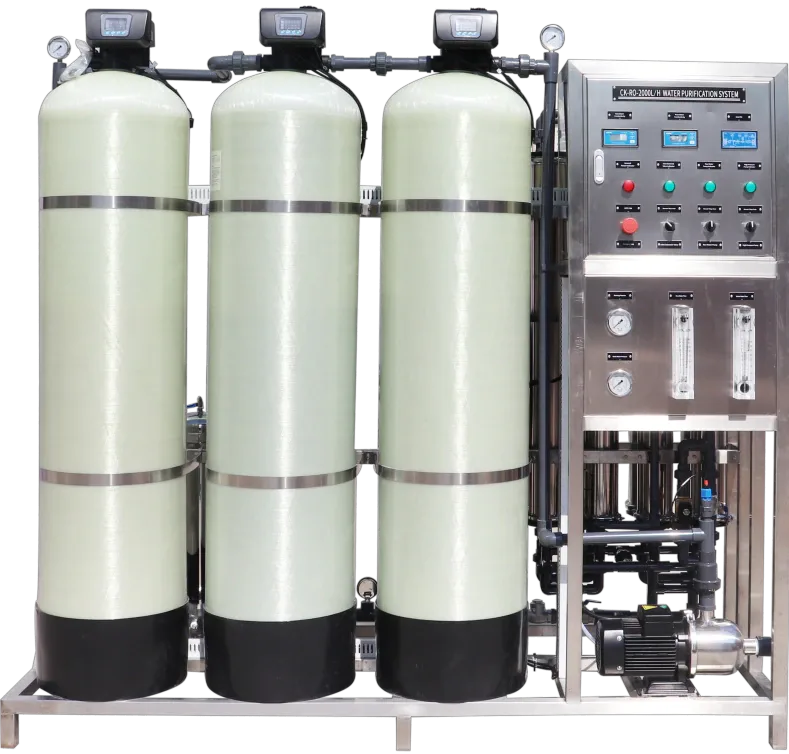
- Planning demand per room per day
- 250–400 L Planning demand per room per day
- Softener capacity range
- 0.5–15 m³/h Softener capacity range
- RO permeate conductivity
- ≤10 µS/cm RO permeate conductivity
- UV dose for drinking water
- 30–40 mJ/cm² UV dose for drinking water
01
What water problems show up in a hotel?
A hotel runs several water systems at once: guest rooms, restaurants and bars, laundry, spa and pool, and back-of-house cleaning. Hardness is the dominant risk in the hot water system. Calcium and magnesium precipitate as scale on calorifier coils, plate heat exchangers, showerheads and tap aerators. Scale insulates the heat transfer surface, so the boiler burns longer for the same output and hot water flow drops at the top floors.
Laundry is the second major load. Hard water consumes detergent, leaves mineral deposits in fabric and forms scale on ironer chests. The result is grey, rough linen and higher chemical cost. In guest rooms, kettles scale, ice machines produce cloudy ice, and bottled water becomes a recurring purchase and waste stream. Food and beverage outlets have the same coffee, ice and dishwashing issues as a restaurant. A hotel with a 300-room tower and a 60-room resort wing will not have the same load profile, even at the same star rating, because laundry, pools and food service change the daily total far more than room count alone.
Microbiological control is a separate duty. Storage tanks, calorifiers and long branch pipes create stagnant zones, especially on low-occupancy floors. Filtration and softening do not disinfect; they must be combined with temperature control, recirculation and routine flushing. A hotel water plant is therefore a treatment train plus an operating routine, not a single filter.
- Scale on calorifiers, heat exchangers, showerheads and taps
- Detergent waste, grey linen and ironer scale in the laundry
- Kettle scale, cloudy ice and bottled water cost in guest rooms
- Stagnant zones in tanks and low-use branches
02
How much water does a hotel use, and how do you size the plant?
Hotel demand is planned per room. A typical figure is 250–400 L per room per day, covering guest rooms, food and beverage, laundry and pool top-up. If laundry is outsourced, 180–280 L per room per day is a more realistic range. Daily demand equals rooms multiplied by litres per room and by occupancy, normally 0.65–0.8 for a city hotel and higher for a resort. Meter the hotel for at least two weeks before finalising the softener; the laundry and kitchen peaks often fall at different times than the guest-room peak.
Peak flow equals daily demand multiplied by 1.3–1.6, divided by 16–20 operating hours. A 150-room hotel at 300 L and 75% occupancy uses about 34 m³/day, with a peak near 2.6 m³/h. That peak sizes the softener. The drinking-water RO is much smaller: guest consumption is typically 2–5 L per room per day, so 0.5–1 m³/h with storage covers most hotels.
| Rooms | Typical daily demand | Typical peak flow | Softener | Drinking-water RO |
|---|---|---|---|---|
| 40–60 | 8–18 m³/day | 0.5–1.5 m³/h | 0.5–1.5 m³/h | CK-RO-500L |
| 80–120 | 15–36 m³/day | 1.0–3.0 m³/h | 1–3 m³/h | CK-RO-500L |
| 150–200 | 28–60 m³/day | 2.0–5.0 m³/h | 2–5 m³/h | CK-RO-1000L |
| 250–350 | 47–105 m³/day | 3.0–8.5 m³/h | 3–8 m³/h | CK-RO-1000L |
| 400–500 | 75–150 m³/day | 5.0–12.0 m³/h | 5–12 m³/h | CK-RO-1000L |
Planning values at 250–400 L/room/day, 65–80% occupancy, 16–20 operating hours and a peaking factor of 1.3–1.6. Laundry and pool loads change the result.
03
Which treatment train does a hotel need?
Treat the hotel as two water qualities. The whole-building stream feeds hot water, laundry, kitchen and toilets, and needs softening rather than desalination. The drinking stream feeds guest rooms, restaurants, bars and ice, and needs reverse osmosis followed by UV. Separating the duties keeps the RO small, the softener correctly sized, and the operating cost predictable.
On the building stream, multimedia filtration handles turbidity, activated carbon removes chlorine before the resin, and the softener removes hardness. On the drinking stream, carbon protects the membrane, RO removes salts at 95–99%, and UV at 30–40 mJ/cm² protects the storage tank and loop. Hot water should be stored at 60 °C or above and return at 55 °C or above, with weekly flushing of low-use outlets; filtration is not a substitute for that routine. If the local supply is chlorinated, carbon must sit before the resin, because chlorine degrades cation resin over time and shortens its life.
| Duty | Water quality target | Treatment |
|---|---|---|
| Hot water and showers | Hardness below 50 ppm as CaCO₃ | Carbon + softener |
| Laundry | Soft, low-iron water | Softener, iron removal if needed |
| Guest drinking water and ice | TDS below 300 ppm, no chlorine | Carbon + RO + UV |
| Kitchen and dishwashing | Soft water, low chlorine | Carbon + softener |
| Pool and spa top-up | Balanced hardness and alkalinity | Softener or blend, pH control |
04
Which capacity and configuration fit your hotel size?
Use the table to translate rooms into a plant layout. The softener follows peak building demand and is often supplied as two vessels so one can regenerate while the other runs. The RO follows drinking and ice demand, not total building demand. Storage of 30–50% of daily drinking demand lets the RO run at a steady rate instead of chasing peaks. A resort with a large pool and spa may need the softener one size larger than its room count suggests, while a city hotel with an outsourced laundry may need one size smaller.
| Daily demand | Peak flow | Pretreatment | Main stage | Post-treatment |
|---|---|---|---|---|
| 8–18 m³/day | 0.5–1.5 m³/h | Multimedia + carbon + 0.5–1.5 m³/h softener | CK-RO-500L for drinking | UV + 1 m³ tank |
| 18–36 m³/day | 1–3 m³/h | Multimedia + carbon + 1–3 m³/h softener | CK-RO-500L for drinking | UV + 2 m³ tank |
| 36–60 m³/day | 2–5 m³/h | Multimedia + carbon + 2–5 m³/h softener | CK-RO-1000L for drinking | UV + 2–3 m³ tank |
| 60–105 m³/day | 3–8.5 m³/h | Multimedia + carbon + 3–8 m³/h softener | CK-RO-1000L for drinking | UV + 3–5 m³ tank |
| 105–150 m³/day | 5–12 m³/h | Multimedia + carbon + 5–12 m³/h softener | CK-RO-1000L for drinking | UV + 5–8 m³ tank |
The softener treats the whole-building stream; the RO treats drinking water only. Resorts with pools, spas or irrigation need a separate load calculation.
05
What are the installation requirements for a hotel plant room?
Allow 3 × 2 m for a softener and drinking-water RO serving 100–200 rooms, and 4 × 3 m for 300 rooms or more. The room needs a floor drain, 2.2 m clear height, 0.8 m service access around vessels, and a separate dry area for the control panel. Twin softeners need space for two resin tanks and a brine tank; place the brine tank within 3 m of the valve heads and keep a pallet area for salt bags.
Power is 380 V three phase for softener valves, pumps and the RO; provide a dedicated circuit and earth. Water pressure should be 2–4 bar at the plant inlet, with a booster set if the top floors are marginal. Install a water meter and a sampling point before and after treatment. The drinking-water loop should recirculate continuously, with no branch longer than 6 m without flow, and the storage tank should be vented and insect-proofed. Mark the main isolation valve and provide a written shutdown procedure, because a plant room failure affects hot water, laundry and guest rooms at the same time.
- Plant room: 3 × 2 m (100–200 rooms), 4 × 3 m (300+ rooms)
- Floor drain and 100 mm bund around chemical or brine areas
- 380 V three phase, dedicated breaker, earth leakage protection
- Brine tank within 3 m of the softener valve head
- Drinking-water storage sized for 30–50% of daily demand
- Recirculating loop with sampling points and no dead legs
06
How is a hotel water system maintained?
Daily checks cover softener salt level, brine draw, inlet and outlet pressure, RO permeate conductivity and UV status. Regeneration is set by water hardness and consumption, not by a fixed clock; a meter-initiated valve avoids unnecessary salt use on low-occupancy days. Resin is replaced every three to five years, RO membranes every two to three years, and UV lamps at 9,000–12,000 hours.
Quarterly tasks include sanitising the drinking-water tank and loop, descaling plate heat exchangers if hardness carry-over is suspected, and reviewing hot water temperatures and low-use outlet flushing records. Keep spare cartridges, a spare UV lamp and a softener valve kit on site. For any hotel with a potable water loop, local microbiological monitoring requirements should be confirmed with the operator and applied consistently. Review the previous season of salt and cartridge consumption before ordering spares, so stock matches actual occupancy rather than a fixed annual allowance.
| Item | Interval | Action |
|---|---|---|
| Softener salt and brine | Daily to weekly | Keep salt above water line; break bridges |
| Cartridge filters | 1–3 months | Replace on pressure differential or volume |
| Drinking-water tank and loop | Quarterly | Drain, sanitise, flush and sample |
| RO membrane | 2–3 years | Replace when rejection or flow falls |
| UV lamp | 9,000–12,000 h | Replace lamp; clean quartz sleeve |
| Hot water system | Monthly / annual | Check temperatures; descale heat exchangers |
Specifications
Delivery and service — typical ranges
| Item | Typical range |
|---|---|
| Standard skid lead time | 15–30 days after drawing approval |
| Containerized / turnkey lead time | 30–60 days after drawing approval |
| Warranty | 12–18 months from shipment |
| Factory testing | Hydrostatic pressure test and trial run with water before packing |
| Documentation | General arrangement drawing, P&ID, test record, O&M manual and spare-parts list |
| Packaging | Seaworthy plywood crate, or container for containerized plants |
| Installation support | Remote guidance as standard; on-site engineer available on request |
| Operator training | 1–2 days at commissioning, covering operation, CIP and consumables |
| Spare parts | Recommended two-year list quoted separately with the equipment |
| Payment terms | Typically 30% deposit and 70% before shipment; confirmed in the quotation |
| Minimum order | 1 unit |
| Loading port | Guangzhou or Shenzhen, China |
| Power supply | 220/380/415/440 V, 50/60 Hz; confirmed on order |
| Ambient temperature | 5–40 °C |
| Enclosure protection | IP54 for indoor skids; higher IP available on request |
| Certification | CE and ISO 9001; model-specific test reports on request |
Typical industry ranges for planning. Final scope, commercial terms and lead time are confirmed in the quotation.
FAQ
Frequently asked questions
Questions buyers actually ask during sizing and quotation. Answers match the specifications above.
01 Does a hotel need RO for all its water?
02 How do you stop scale in the hot water loop?
03 Can guests drink softened water?
04 How should Legionella risk be managed?
05 How much RO capacity does a 200-room hotel need for drinking water?
06 Do we need twin softeners?
07 What space and power does the plant need?
08 How often are consumables replaced?
Next step
Send your water analysis, get a factory quotation
Tell us the source water, TDS, hardness, iron and daily demand. Factory engineers reply with a flow rate, process train and budget range within one working day.