Ion exchange · 0.5–15 m³/h · twin-tank options
Commercial Water Softener System — Ion Exchange for Hard Water
Quick answer
A commercial water softener removes calcium and magnesium by ion exchange. Hard water passes through a bed of strong-acid cation resin, which swaps Ca²⁺ and Mg²⁺ for sodium; brine regeneration restores the resin. Softening is recommended above roughly 120 ppm hardness as CaCO₃, and it protects RO membranes, boilers and laundry equipment from scale.
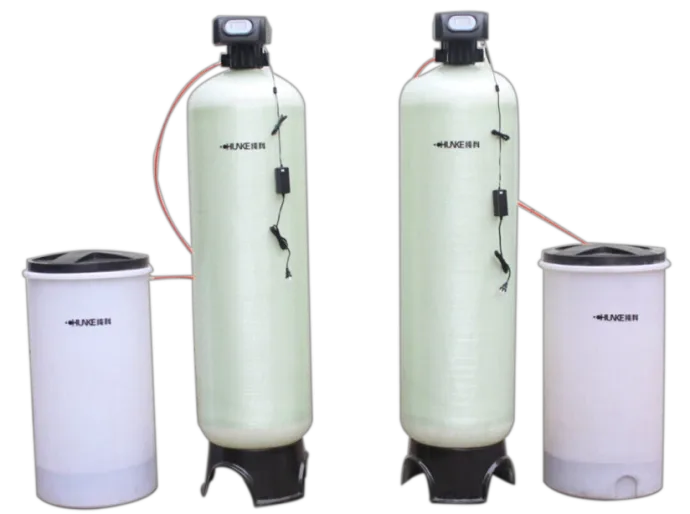
- Softened water capacity
- 0.5–15 m³/h Softened water capacity
- Resin charge
- 30–650 kg Resin charge
- Brine tank volume
- 25–800 L Brine tank volume
- Hardness that usually calls for softening
- >120 ppm Hardness that usually calls for softening
01
What is a commercial water softener system and how does ion exchange work?
A commercial water softener is a pressure vessel filled with strong-acid cation exchange resin in the sodium form. Hard water flows down through the bed; calcium and magnesium ions attach to the resin, and an equivalent number of sodium ions are released into the water. The process removes hardness only — it does not remove particles, bacteria or nitrate, and it does not reduce TDS. Outlet hardness stays below about 1 ppm as CaCO₃ until the resin approaches exhaustion.
A complete system is more than a tank. It includes one or two FRP or stainless steel pressure vessels, a brine tank with a salt grid, an automatic control valve that meters treated volume, a riser and distributor, and sample points for hardness testing. Twin-tank units alternate: one vessel supplies softened water while the other regenerates. Regeneration draws brine from the salt tank through the resin, strips the accumulated calcium and magnesium to drain, then rinses the bed with fresh water.
Softening does not consume resin in the exchange reaction. Calcium and magnesium are held on the resin until regeneration, when concentrated brine reverses the exchange: sodium displaces the hardness ions, which leave with the spent brine. The vessel is then rinsed and returned to service. The cycle repeats for the life of the resin, so salt — not resin — is the routine operating cost.
- Resin: strong-acid gel or macroporous cation resin in sodium form
- Vessels: FRP tank sizes 844–3672, or stainless steel for high-temperature rooms
- Control: volumetric metering with time override, or time-based for steady loads
02
When does water hardness justify a softener?
Hardness is measured as mg/L calcium carbonate, grains per gallon or German degrees. Softening is usually justified above about 120 ppm as CaCO₃ — roughly 7 gpg or 6.7 °dH. Below 60 ppm, scale forms slowly and a softener is rarely economic. Between 60 and 120 ppm the decision depends on temperature and equipment: a coffee machine or steam boiler may still need protection, while a cold-water line may not.
Above 180 ppm, scale usually becomes visible on heating elements and shower heads in hot-water equipment within weeks, and detergent consumption rises. Hardness is not a health parameter, but it is a cost parameter: it shortens the life of heat exchangers, increases cleaning labour and raises chemical use in laundries. Test the raw water with a titration kit or photometer rather than relying on a test strip, and test at the same point where the softener will be installed.
| Band | mg/L as CaCO₃ | Grains per gallon | Typical action |
|---|---|---|---|
| Soft | 0–60 | <3.5 | Little scaling; softening optional |
| Moderately hard | 61–120 | 3.5–7 | Evaluate by equipment and temperature |
| Hard | 121–180 | 7–10.5 | Softening usually recommended |
| Very hard | >180 | >10.5 | Softening required for heaters, boilers and RO |
Bands are industry conventions; the decision also depends on temperature, alkalinity and the equipment being protected.
03
Which configuration fits — single-tank, twin-tank or multi-tank?
Single-tank softeners are the simplest and lowest-cost arrangement. They suit plants that can stop for the 60–90 minutes a regeneration takes, or that have a treated-water storage tank large enough to cover the gap. Twin-tank alternating systems keep softened water flowing while one vessel regenerates and are the usual choice for hotels, laundries, boiler feed and any process that cannot tolerate a hardness spike.
Multi-tank parallel systems split peak flow across two or more vessels. They are used when demand exceeds the largest practical single vessel or when redundancy is required. The control valve is the practical difference between arrangements: metered alternating valves cost more but dose salt in proportion to water treated, while simple time-based valves are lower in cost and suit steady loads.
| Configuration | Supply during regeneration | Typical application | Salt efficiency |
|---|---|---|---|
| Single tank, time-based | None for 60–90 minutes | Small plants with a storage tank | Moderate; fixed schedule can over-regenerate |
| Single tank, metered | None for 60–90 minutes | Variable daily demand with storage | Good; regenerates on volume treated |
| Twin tank, alternating | Continuous | Hotels, laundries, boiler feed | Good; each tank metered separately |
| Multi-tank, parallel | Continuous with N-1 redundancy | Large peak flows, process water | Good; staging matches demand |
| Twin tank, parallel | Continuous; both tanks serve together | Medium peak flows with redundancy | Good; regenerates by volume or schedule |
| Multi-tank, duty/standby | Continuous with a standby vessel | Critical process or boiler feed | Good; standby can be isolated for service |
04
How much salt and water does regeneration consume?
Salt is the main operating consumable. The theoretical minimum is about 1.2 kg of sodium chloride per kilogram of hardness removed as CaCO₃; practical softeners use roughly twice that because regeneration is not perfectly efficient. A common setting is 80–160 g of salt per litre of resin per regeneration, with brine at 8–12% concentration. Higher doses increase capacity but lower salt efficiency; lower doses save salt and shorten the service cycle.
Water use is often overlooked. Backwash, brine draw and rinse typically consume several bed volumes per regeneration, and the volume rises with vessel size. As a worked example, a 10 m³/h softener treating 120 ppm hardness removes about 1.2 kg CaCO₃ per hour. Running continuously, that is about 29 kg per day and, at 2.4 kg salt per kg hardness, roughly 69 kg of salt per day. Most plants run fewer hours, so size the salt storage from the actual daily output.
Salt efficiency is the ratio of hardness removed to salt used, and it falls as the dose rises. A softener set to a high capacity per regeneration passes longer between cycles but uses more salt per cubic metre treated. Where salt cost or brine discharge matters, choose a lower dose and a shorter cycle, then confirm that the service cycle still covers the daily demand.
- Use clean solar, vacuum or pellet salt; rock salt brings insoluble matter into the brine
- Keep the brine tank covered and the air check clear so brine is drawn at the set rate
- Allow for backwash and rinse water when sizing the drain and the raw-water supply
05
Why soften before an RO membrane, a boiler or a laundry?
Scale is the main reason to soften ahead of reverse osmosis. Calcium carbonate and magnesium salts precipitate on the membrane as recovery rises; removing the hardness ions upstream allows higher recovery and longer intervals between cleanings. Softening is usually specified when hardness exceeds about 120 ppm as CaCO₃, when recovery above 65% is required, or when sulphate and silica are high. The trade-off is sodium: softening raises the sodium content of the feed but does not lower TDS, so the RO still does the desalination.
In buildings, hardness appears as scale on shower heads, kettles, steam irons and hot water cylinders, and as soap scum on tiles and linen. Laundries use more detergent and see grey, stiff fabric. Boiler feed needs near-zero hardness because scale on a heat transfer surface reduces efficiency and can overheat tubes; softened make-up water plus controlled blowdown is the standard response. For hotels, the usual targets are soft water at guest outlets, near-zero hardness for laundry and boiler make-up, and a hardness alarm on the softener outlet.
- RO feed: soften above about 120 ppm as CaCO₃ when recovery exceeds 65%
- Boiler make-up: near-zero hardness, with blowdown control
- Laundry: 0–60 ppm protects heaters and reduces detergent use
- Hotel: protect hot water cylinders, shower heads and glassware
06
Which models and capacities are available?
The CK-SF series covers 0.5–15 m³/h in eight catalogue sizes. Vessel sizes run from 844 to 3672 — FRP tank codes giving diameter and height in inches — with resin charges from 30 to 650 kg and brine tanks from 25 to 800 L. CK-SF is the catalogue model designation; the same hydraulic arrangement can be built under a customer model code for OEM projects. Selection starts from peak flow, inlet hardness and the hours available between regenerations, not from the model number alone.
| Model | Softened water (m³/h) | Typical application |
|---|---|---|
| CK-SF-500L | 0.5 | Cafe, clinic, small laboratory |
| CK-SF-1000L | 1 | Restaurant, small guesthouse |
| CK-SF-2000L | 2 | Guesthouse, small laundry |
| CK-SF-3000L | 3 | Hotel, laundry |
| CK-SF-4000L | 4 | Hotel, boiler make-up |
| CK-SF-5000L | 5 | Hotel, laundry, process water |
| CK-SF-10T | 10 | Resort, campus, boiler feed |
| CK-SF-15T | 15 | Large hotel, district boiler feed |
Across the series: resin vessels 844–3672, resin charge 30–650 kg, brine tanks 25–800 L. Confirm vessel size and resin charge against your hardness and regeneration schedule.
07
What maintenance does a commercial softener need?
Test hardness at the outlet weekly with a titration kit or photometer, and log salt added and regeneration frequency. Keep the brine tank at least half full of clean salt. Bridging — a crust with a hollow space beneath — looks full but produces weak brine and hard water. Clean the brine tank once a year, check the injector and brine line for blockages, and confirm that the control valve is set to the actual resin volume and inlet hardness.
Resin typically lasts 5–10 years. Chlorine and other oxidants degrade it, iron, manganese, organics and biofilm foul it, and repeated overheating damages it. Replace the charge when capacity stays well below the calculated value after regeneration settings have been verified. Where municipal water is chlorinated, a carbon prefilter ahead of the softener removes chlorine and extends resin life.
- Hard water after regeneration: check for a salt bridge, a blocked injector or a failed brine draw
- High salt use: verify the capacity setting, resin volume and regeneration frequency
- Rising pressure drop: backwash the resin or inspect for iron and biofilm fouling
Specifications
Delivery and service — typical ranges
| Item | Typical range |
|---|---|
| Standard skid lead time | 15–30 days after drawing approval |
| Containerized / turnkey lead time | 30–60 days after drawing approval |
| Warranty | 12–18 months from shipment |
| Factory testing | Hydrostatic pressure test and trial run with water before packing |
| Documentation | General arrangement drawing, P&ID, test record, O&M manual and spare-parts list |
| Packaging | Seaworthy plywood crate, or container for containerized plants |
| Installation support | Remote guidance as standard; on-site engineer available on request |
| Operator training | 1–2 days at commissioning, covering operation, CIP and consumables |
| Spare parts | Recommended two-year list quoted separately with the equipment |
| Payment terms | Typically 30% deposit and 70% before shipment; confirmed in the quotation |
| Minimum order | 1 unit |
| Loading port | Guangzhou or Shenzhen, China |
| Power supply | 220/380/415/440 V, 50/60 Hz; confirmed on order |
| Ambient temperature | 5–40 °C |
| Enclosure protection | IP54 for indoor skids; higher IP available on request |
| Certification | CE and ISO 9001; model-specific test reports on request |
Typical industry ranges for planning. Final scope, commercial terms and lead time are confirmed in the quotation.
FAQ
Frequently asked questions
Questions buyers actually ask during sizing and quotation. Answers match the specifications above.
01 How do I know whether my water is hard?
02 Does a softener remove TDS or make water safe to drink?
03 Is softened water safe to drink?
04 Do I need a twin-tank softener?
05 How often do I add salt?
06 Can a softener remove iron and manganese?
07 Does softening replace reverse osmosis?
08 What water pressure and flow does a softener need?
09 How long does resin last and how is it replaced?
Next step
Send your water analysis, get a factory quotation
Tell us the source water, TDS, hardness, iron and daily demand. Factory engineers reply with a flow rate, process train and budget range within one working day.