Planning estimate · 0.5–50 m³/h · CK-RO and CK-SF models
Water Filter Sizing Tool — Flow Rate by Seats, Rooms, Staff or Students
Quick answer
Turn seats, hotel rooms, office staff or student numbers into a planning flow rate. The tool applies 10–30 L per person or 250–400 L per room, then recommends a CK-RO model and storage volume. Treat the result as a first estimate and confirm it against a water analysis.
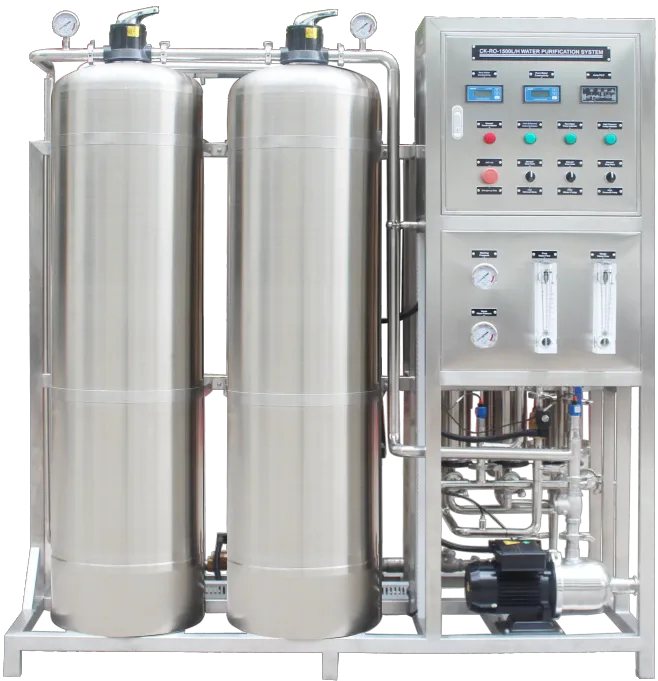
- Venue types
- 4 Venue types
- Model range
- 0.5–50 m³/h Model range
- Engineer reply
- 1 day Engineer reply
- Planning water per person
- 10–30 L Planning water per person
Sizing calculator
Estimate flow by venue
Enter seats, rooms, staff or students to get a planning daily demand, peak flow, recommended model and storage volume. The result is a first estimate, not a quotation.
01
How does the sizing tool calculate flow rate?
The tool uses the same two-step method as the application pages. First, it estimates daily demand from the occupancy figure and a planning water use: litres per seat, room, person or student. Second, it converts daily demand into peak flow with a peaking factor and the number of operating hours, then adds a 10–20% margin for fouling and future growth. Peak flow, not daily volume, decides the membrane and vessel size.
For a restaurant the tool returns the filtered drinking, ice and coffee stream, not the whole building supply. For a hotel it returns two results: the whole-building softener peak and a separate drinking-water RO. For an office and a school it returns the drinking-water train, because that is the stream the products on this site treat.
The output is a planning estimate. It does not replace a water analysis, a site survey or a quotation. Use it to check whether a project is a 0.5 m³/h skid or a 5 m³/h plant room before you contact an engineer.
02
Which planning values does the tool use?
The values below are industry planning references, not measured consumption. If the site has 7–14 days of metered water use, use the meter instead: divide daily consumption by the operating hours and apply the same peaking factor. Metered data usually shows a sharper peak than an occupancy estimate, especially in restaurants and hotels.
| Venue | Basis | Daily demand | Peak flow basis |
|---|---|---|---|
| Restaurant | Per seat, including ice, coffee and kitchen preparation | 15–30 L/seat/day | Daily × 1.5–2.0 ÷ 8–10 h, +10% |
| Hotel | Per room at 65–85% occupancy, including laundry and F&B | 250–400 L/room/day | Daily × 1.3–1.6 ÷ 16–20 h, +10% |
| Office | Per occupant, drinking, coffee and pantry | 10–20 L/person/day | Daily × 2.0–2.5 ÷ 8 h, +10% |
| School | Per student at 90% attendance, canteen included | 10–20 L/student/day | Daily ÷ 8–10 h refill, +20% |
Industry planning values only. Actual demand depends on fixtures, occupancy, laundry, irrigation and operating hours.
03
What do the recommended model and storage mean?
The tool selects the smallest catalogue model at or above the calculated peak. Models step in fixed sizes, so a calculated 0.8 m³/h peak returns a 1 m³/h unit rather than a custom 0.8 m³/h membrane. That spare capacity is deliberate: it covers fouling between cleanings and avoids running the pump at its limit.
Storage decouples production from demand. The tool suggests 1–2 hours of peak flow, with a 0.5 m³ minimum, because a restaurant or school draws most of its water in a short window. A larger tank lets a smaller RO run steadily; a smaller tank forces the RO to follow the peak. For schools the storage figure also covers the break period at 2 L per student.
| Calculated peak | RO model | Softener model (hotel) |
|---|---|---|
| ≤ 0.5 m³/h | CK-RO-500L | CK-SF-500L |
| 0.5–1 m³/h | CK-RO-1000L | CK-SF-1000L |
| 1–2 m³/h | CK-RO-2000L | CK-SF-2000L |
| 2–3 m³/h | CK-RO-3000L | CK-SF-3000L |
| 3–5 m³/h | CK-RO-5000L | CK-SF-5000L |
| 5–10 m³/h | CK-RO-10T | CK-SF-10T |
| 10–20 m³/h | CK-RO-20T | CK-SF-15T or multi-train |
Catalogue bands; the final model depends on the water analysis, pretreatment and recovery target.
04
What does the tool not include?
The calculator sizes flow, not water quality. It cannot tell you whether the source needs sand filtration, carbon, softening, iron and manganese oxidation, RO or EDI. Those decisions come from the raw-water analysis: TDS, hardness, iron, manganese, nitrate, silica, turbidity, SDI, chlorine and bacterial count.
It also does not cover simultaneous loads, fire storage, irrigation, pool top-up, laundry expansion or future phases. Add these as separate lines before a final design. For a hotel, the softener result is a whole-building figure; the drinking-water RO is deliberately much smaller and should not be sized from the same number.
- Water analysis: TDS, hardness, iron, manganese, nitrate, silica, SDI, chlorine, bacteria
- Pretreatment: sand, carbon, softening, oxidation, antiscalant, cartridge guard
- Recovery and concentrate: 50–75% typical for RO, with a disposal route
- Local standard and certification scope for drinking water
- Site data: power, drain, floor loading, ambient temperature, container access
05
How do you turn the estimate into a quotation?
Send the calculated flow, the occupancy figure behind it and a water analysis. If no analysis exists, send the source type and whatever parameters are available; the engineer will specify the minimum test panel. The reply should state the process train, the model, the pretreatment, the recovery, the power and the scope included, so quotations from different suppliers can be compared line by line.
Prices are not published because the configuration changes with water quality, pretreatment and scope. A quotation is prepared against the actual project rather than a catalogue list price.
Planning estimate only. Confirm the final flow, process train and quotation with the water analysis and site data.
FAQ
Frequently asked questions
Questions buyers actually ask during sizing and quotation. Answers match the specifications above.
01 Is the sizing tool result a quotation?
02 Why does the tool ask for seats, rooms or people instead of floor area?
03 What if I already know my metered daily water use?
04 Does the hotel result include laundry, pool and restaurants?
05 Why is the recommended RO larger than my calculated peak?
06 Can the result be used for a containerized plant?
07 Which water analysis should I send with the result?
Next step
Send the sizing result with your water analysis
Include the calculated flow, occupancy figure and available water parameters. Our engineers reply with a process train, model and budget range within one working day.