Selection logic · process boundaries · decision rules
Water Treatment Technology Comparisons — RO, UF, EDI, Softeners, UV and Ozone
Quick answer
Choose by contaminant, not by product name. RO removes dissolved salts and most microorganisms; UF removes particles, colloids and bacteria but passes salts; EDI polishes RO permeate to ultrapure water. Filters remove turbidity and chlorine, softeners remove hardness, UV inactivates microbes, and ozone oxidises organics and leaves a residual. Capacity and duty cycle separate commercial from home equipment.
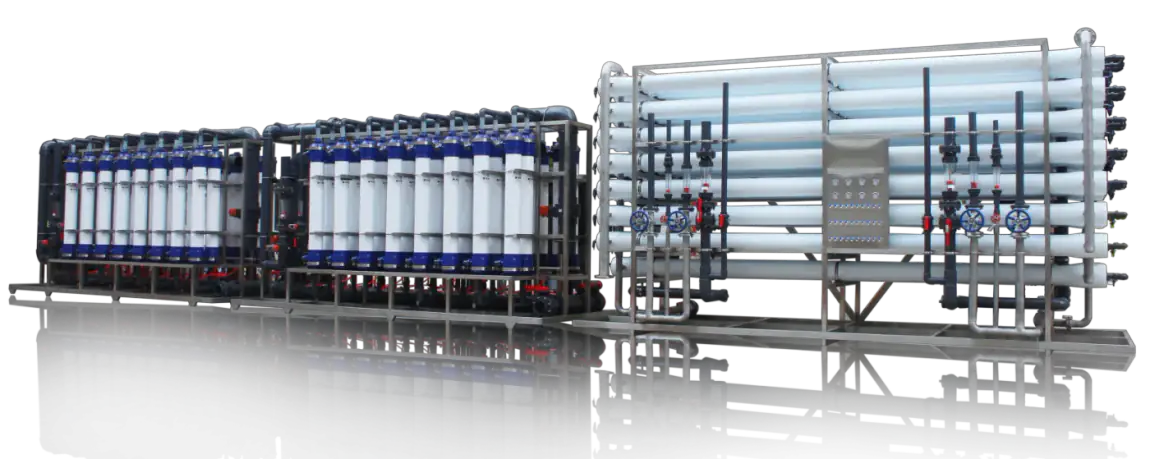
- RO salt rejection
- 95–99% RO salt rejection
- UF pore range
- 0.01–0.1 µm UF pore range
- EDI product water
- >10 MΩ·cm EDI product water
- Typical UV dose
- 30–40 mJ/cm² Typical UV dose
01
Which separation process fits your water: RO, UF or EDI?
These processes sit at different points on one separation scale. Reverse osmosis uses a dense polyamide membrane and 10–25 bar to reject 95–99% of dissolved ions; it is standard when salinity, nitrate, sulphate, arsenic or hardness must fall. Ultrafiltration uses a porous membrane of roughly 0.01–0.1 µm and 1–3 bar to remove particles, colloids, bacteria and viruses while passing dissolved salts; it often makes RO reliable. EDI is not stand-alone: it takes RO permeate and removes residual ions with resin and an electric field, reaching above 10 MΩ·cm without chemical regeneration.
- Dissolved salts are the problem: choose RO.
- Turbidity, bacteria or colloids: choose UF, or UF ahead of RO.
- Ultrapure water for boilers, electronics or laboratories: choose RO followed by EDI.
- Only suspended solids: multimedia filtration is cheaper than UF.
| Criterion | RO | UF | EDI |
|---|---|---|---|
| Removal target | Dissolved salts, nitrate, sulphate, arsenic | Particles, colloids, bacteria, viruses | Residual ions in RO permeate |
| Mechanism | Dense membrane, 10–25 bar | Porous membrane, 1–3 bar | Ion-exchange resin plus electric field |
| Salt passage | 1–5% | Most dissolved salts pass | Removes residual ions |
| Pretreatment | Filtration, carbon, softener or antiscalant | Coarse filtration, backwash | RO permeate, low hardness |
| Waste stream | Concentrate, 25–50% of feed | Backwash water | Small reject stream |
| Typical use | Drinking water, process water, boiler make-up | Surface water clarification, RO pretreatment | Electronics, pharmaceuticals, laboratories |
02
Which one solves your water problem: filter or softener?
A filter and a softener solve different problems; confusing them is a common buying mistake. A multimedia or sand filter removes suspended particles and turbidity; an activated carbon filter removes chlorine, taste, odour and some organics. A softener is an ion-exchange unit that swaps calcium and magnesium for sodium and is regenerated with brine. It does not remove particles, and a filter does not remove hardness.
- White scale, soap that will not lather, hardness above about 120 mg/L as CaCO₃: choose a softener.
- Cloudy water, sediment, chlorine taste or colour: choose filtration.
- Both: filter first, then soften; carbon protects the resin.
- Nitrate, arsenic or salinity: neither; use RO or a selective medium.
| Criterion | Filter (sand or carbon) | Softener |
|---|---|---|
| Removes | Suspended solids, turbidity, chlorine, taste, some organics | Calcium and magnesium |
| Does not remove | Dissolved salts, hardness | Particles, chlorine, dissolved salts |
| Regeneration | Backwash only | Brine regeneration; salt consumption |
| Waste stream | Backwash water | Brine and backwash water |
| Typical use | Clarification, dechlorination, taste control | Scale control, boiler and laundry feed |
03
Which disinfection method should you use: UV or ozone?
UV and ozone are both disinfectants but behave differently after the treatment point. UV at 254 nm delivers 30–40 mJ/cm² in seconds and leaves no residual, so it protects only the water that passes the lamp. Ozone is a dissolved oxidant: it needs 5–15 minutes of contact, leaves a measurable residual, and oxidises iron, manganese, colour and taste. Ozone can form bromate when bromide is present, and the off-gas must be destroyed.
- Clean water, point-of-use protection, no chemical residual: choose UV.
- Storage tank, long loop, iron/manganese/colour removal: choose ozone.
- Both a residual and a final barrier: use ozone followed by UV.
- Turbidity above 1 NTU: filter first; particles shield microbes.
| Criterion | UV at 254 nm | Ozone |
|---|---|---|
| Mechanism | Photochemical damage to DNA and RNA | Oxidation of cell components and organics |
| Contact time | Seconds | 5–15 minutes typical |
| Residual | None | Measurable, short-lived |
| Iron, colour, taste | No removal | Oxidises, then filtration removes the solids |
| By-products | None at 254 nm | Bromate possible with bromide present |
| Maintenance | Lamps and quartz sleeves | Generator, oxygen feed, off-gas destructor |
| Typical use | Point of use, cold loops, small plants | Storage, oxidation, bottled water |
04
Where is the line between commercial and home systems?
The difference is not only size. A home under-sink unit is built for intermittent flow, plastic housings and owner-replaced cartridges. A commercial system is built for continuous duty, with stainless or FRP vessels, industrial pumps, flow and conductivity instruments, pretreatment, alarms and service access. Commercial systems are sized on peak demand and daily volume and need a plant room, drain and power. Home units are rated in litres per day; commercial RO starts at 0.5 m³/h. Choose commercial equipment when demand is continuous or serves multiple points.
| Criterion | Home / point of use | Commercial |
|---|---|---|
| Capacity | 50–500 L/day typical | 0.5–50 m³/h |
| Duty cycle | Intermittent | Continuous or long shifts |
| Materials | Plastic housings, small cartridges | Stainless or FRP vessels, industrial pumps |
| Pretreatment | Cartridge only | Multimedia, carbon, softener, antiscalant |
| Controls | Basic | PLC, conductivity, pressure, alarms |
| Service | Owner replacement | Scheduled maintenance, CIP |
| Typical use | Single tap, household | Hotels, restaurants, plants |
05
What does each choice mean for capital and operating cost?
Capital cost rises in a predictable order: filtration, softener, UV, UF, RO, EDI. Operating cost does not follow the same order. A softener is inexpensive to buy but consumes salt; UV is cheap to run but needs lamps and sleeves; RO has the highest energy and membrane replacement burden, plus pretreatment and concentrate handling; EDI has high capital cost but no chemical regeneration. Compare five-year total cost, not purchase price alone.
| Cost item | Low | Medium | High |
|---|---|---|---|
| Capital | Multimedia filter | Softener, UV, UF | RO, EDI |
| Energy | Filter, softener | UV | RO, EDI |
| Consumables | Filter media | Salt, lamps, cartridges | Membranes, antiscalant |
| Waste handling | Backwash | Brine | RO concentrate |
Relative only. Actual costs depend on capacity, feed quality, energy price and discharge rules.
06
Can these technologies be combined in one treatment train?
Most real plants combine technologies rather than choose one. A common drinking-water train is multimedia filter, activated carbon, softener, 5 µm cartridge, RO and UV. A surface-water train may use coagulation, UF, RO and EDI. An iron-bearing well may use oxidation, sand filtration, carbon and UV. Order matters: remove particles before membranes, protect membranes from chlorine and hardness, and put the final barrier last.
- Particles first: sand before carbon and membranes.
- Chlorine removal before RO: carbon or bisulphite dosing.
- Hardness control before RO when recovery is high.
- UV after storage or at the point of use, never before a tank.
- Ozone before carbon when oxidation is the goal, with off-gas safety.
07
How do you compare quotations for these technologies fairly?
Quotations for the same capacity can differ twofold or more because scope differs. Compare the feed analysis, pretreatment, membrane brand and area, pump brand and material, frame material, instrumentation, control level, CIP, warranty and spare parts. A low price often means a smaller membrane area, no pretreatment or a basic control panel.
| Scope item | What to check | Why it matters |
|---|---|---|
| Feed analysis | Complete laboratory panel, not just TDS | Defines pretreatment and membrane design |
| Pretreatment | Filter, carbon, softener and antiscalant included? | Protects membrane life and warranty |
| Membrane | Brand, model, quantity and area | Determines real capacity and rejection |
| Pump and frame | Brand, material, efficiency, stainless frame | Energy use and service life |
| Controls | PLC or relay, conductivity, pressure, alarms | Operability and troubleshooting |
| Warranty and documents | 12–18 months, drawings, manual, test report | Installation and compliance support |
FAQ
Frequently asked questions
Questions buyers actually ask during sizing and quotation. Answers match the specifications above.
01 RO vs UF: which one removes dissolved salt?
02 Do I need a softener before an RO system?
03 UV or ozone for drinking water?
04 Is EDI a replacement for RO?
05 Can a filter remove hardness?
06 Can a home RO unit serve a restaurant?
07 Which is cheaper to run, UV or ozone?
08 Can UV and ozone be used together?
09 How do I compare quotations from different suppliers?
Next step
Send your water analysis, get a factory quotation
Tell us the source water, TDS, hardness, iron and daily demand. Factory engineers reply with a flow rate, process train and budget range within one working day.