Guangzhou factory · stainless fabrication · CE and ISO 9001
Commercial Water Filter Manufacturer — Factory, Quality Control and OEM Support
Quick answer
HydroWorks is a commercial water filter manufacturer in Baiyun District, Guangzhou, with a plant of more than 5,000 m². We fabricate stainless steel frames and tanks in-house, assemble pretreatment and RO systems, pressure-test and trial-run every unit, and ship to more than 100 countries under CE and ISO 9001.
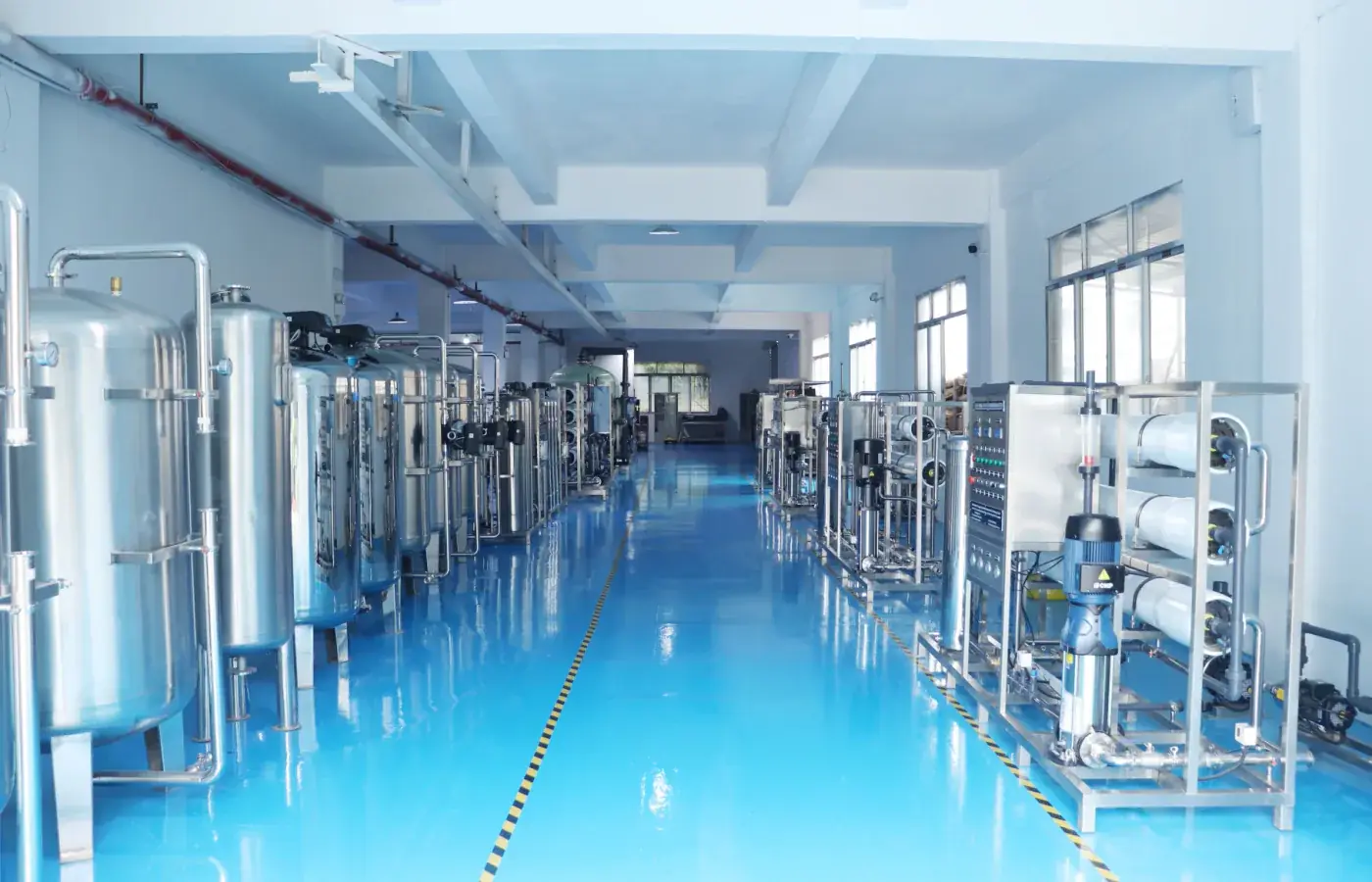
- Manufacturing plant
- 5,000+ m² Manufacturing plant
- Export markets
- 100+ countries Export markets
- Equipment warranty
- 12–18 months Equipment warranty
- Certification
- CE / ISO 9001 Certification
01
Where is the factory, and what can you verify during an audit?
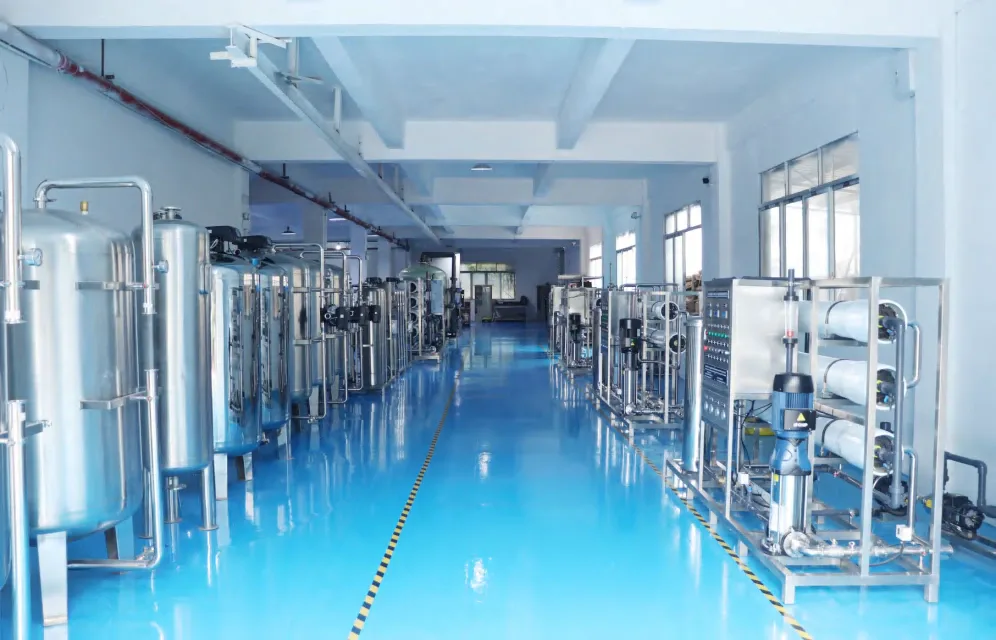
The factory is in Baiyun District, Guangzhou, China. The covered workshop is more than 5,000 m² and handles stainless steel fabrication, skid assembly, piping, electrical work, pressure testing and trial running. The dividing line is deliberate: stainless fabrication, frame and tank assembly, piping, electrical work, pressure testing and trial running are done in-house; pumps, membranes, valves, instruments and UV reactors are bought from long-term suppliers and recorded in the bill of materials. The company is a national high-tech enterprise with registered capital of RMB 10 million, holds CE and ISO 9001 certification, and has multiple water treatment patents.
A visit can cover the material store, the welding bays, the tank and frame assembly area, the test bay and the packing area. Ask to see the pressure test record and the trial run log for a unit in progress, not only a finished show unit. The factory exports to more than 100 countries.
Buyers often ask for a factory video before booking a visit. A useful walkthrough shows the welding area, the test bay and the packing area in one continuous shot, with the date visible. Edited clips and catalogue renders do not prove that the equipment is made on site.
02
What does a water treatment plant manufacturer do?
A water treatment plant manufacturer designs the process train, fabricates the frames, tanks and piping, assembles the skid, wires the controls, pressure-tests the unit, runs it on water, documents the test and supports commissioning. It is more than a trading company that forwards a catalogue: the manufacturer owns the drawing, the bill of materials and the factory test record.
Some components are bought in — pumps, membranes, valves, instruments and UV reactors — while stainless fabrication and skid assembly are usually in-house. A buyer verifying a manufacturer should ask which steps are actually done on site, see the test bay and the packing area, and check that the certification scope covers the models being quoted. OEM and ODM projects additionally need agreed drawings, nameplate and manual branding, and a clear change-control process.
- In-house: stainless fabrication, frame and tank assembly, piping, electrical, pressure test, trial run
- Bought in: pumps, membranes, valves, instruments, UV reactors
- Documents: drawing, bill of materials, test record, manual, spare-parts list
- OEM/ODM: agreed drawing, nameplate, manual branding and change control
03
How is a commercial water filter built, step by step?
Production follows the approved drawing and bill of materials. Stainless sheet and pipe are cut, formed and welded into tanks, frames and skids; bought-in pumps, membranes, valves and instruments are checked on receipt and then fitted. The unit moves through assembly, pressure testing, trial running and packing in a fixed sequence, so each stage has a record before the next begins.
The sequence matters because a defect found at the welding stage is cheap to correct, while the same defect found after painting and packing is not. The six stages below are the minimum traceable path for a skid; larger turnkey plants add civil, tank and hydraulic works around the same core.
- 01
Material intake
Stainless sheet, pipe, fittings and bought-in components are checked against the bill of materials, with material certificates kept on file.
- 02
Cutting and forming
Sheet and pipe are cut, rolled, bevelled and prepared for welding; edges and fit-up are inspected before assembly.
- 03
Welding and assembly
Tanks, frames and skids are welded, cleaned and fitted with nozzles, supports and lifting points.
- 04
Piping and electrical
Valves, instruments, pumps, membrane housings and the control panel are installed to the approved drawings.
- 05
Pressure test and trial run
The unit is filled, pressurised, checked for leaks and run with test water; readings are recorded.
- 06
Packing and dispatch
Surfaces are protected, connections capped, spares boxed and the unit packed for export with the document set.
| Stage | Key check | Record |
|---|---|---|
| Incoming material | Grade, thickness, dimensions and component nameplate | Material certificate and incoming inspection sheet |
| Cutting and welding | Weld appearance, penetration, fit-up and nozzle position | Welder ID and weld inspection record |
| Assembly | Dimensions, level, bolt torque and pipe alignment | Assembly checklist |
| Pressure test | Test pressure, hold time and leak inspection | Signed pressure test report |
| Trial run and adjustment | Pump current, flow, pressure, conductivity and alarm response | Trial run log with instrument readings |
| Packing and dispatch | Packing list, labels, caps, documents and spare parts | Packing list and shipping marks |
The record set follows the unit serial number from material intake to dispatch.
04
What quality control happens before shipment?
Every unit is pressure-tested and trial-run before packing. The pressure test proves the welds and joints; the trial run proves the pump, valves, instruments, control sequence and membrane performance on the available test water. Instruments are checked against reference meters, and the control panel is tested for interlocks, low-pressure protection, high-pressure protection and emergency stop.
The test record travels with the unit. It lists the test pressure, duration, leak inspection, pump current, flow and conductivity readings, alarm checks and the final result. A unit that fails a check is repaired and retested; it is not packed with an open deviation.
Where a buyer appoints a third-party inspector, the inspection should be scheduled before packing, while the unit is still accessible. Inspectors who arrive after crating can check labels and documents, but not welds, wiring or the trial run.
| Test | Method | Acceptance |
|---|---|---|
| Shell and weld integrity | Hydrostatic test at the design test pressure, held for the specified time | No leakage and no permanent deformation |
| Piping and joints | Visual and pressure check across the complete train | No seepage at flanges, threads or welds |
| Pump and motor | Run at the duty point and check current and rotation | Current within nameplate and no abnormal vibration |
| Instrumentation | Compare flow, pressure and conductivity against reference instruments | Reading within the instrument tolerance |
| Control sequence | Simulate low pressure, high pressure, stop and restart | Correct interlock and alarm response |
| Permeate quality | Run on test water and record conductivity and flow | Meets the design basis for the test conditions |
| Final inspection | Check labels, guards, documents and spare parts | Complete and matching the packing list |
05
Which components are made in-house and which are sourced?
Stainless steel tanks, frames, skids and pipe spools are fabricated in-house, and control cabinets are assembled and wired to the approved drawings. That keeps wall thickness, weld quality, surface finish and dimensions under direct control. Pumps, membranes, valves, instruments, UV reactors and dosing equipment are bought from established suppliers; the factory checks them on receipt and keeps the brand and model traceable in the quotation and the manual.
The split matters to buyers because it shows where a specification can be changed. Frame and tank dimensions, nozzle positions and skid layout are flexible. Membrane and pump brands are selected from approved options; substituting a brand changes performance, lead time and warranty, so it is recorded as a deviation.
| Component group | Source | Incoming check |
|---|---|---|
| Tanks, frames and skids | In-house stainless fabrication | Material certificate, dimensions and weld inspection |
| Pipe spools and supports | In-house cutting, welding and finishing | Weld quality, passivation and fit-up |
| Control cabinets | In-house assembly and wiring | Component brand, wiring schedule and insulation test |
| Pumps | Approved suppliers | Nameplate, curve, mechanical seal and rotation |
| Membranes | Approved membrane manufacturers | Model, batch, packaging and storage |
| Valves and instruments | Approved suppliers | Range, material and calibration certificate |
| UV and dosing units | Approved suppliers | Lamp power, reactor test and dosing pump output |
06
What certifications and warranty apply?
The company holds CE certification and ISO 9001 quality management certification, and has multiple water treatment technology patents. Certificates apply to the company and to the product families stated on them; a buyer who needs a specific directive or marking should raise it before the order, because it may change the electrical package or the documentation.
Equipment warranty is 12–18 months as stated in the order. The warranty covers manufacturing defects in the equipment supplied; wear parts and consumables are handled through the spare parts list. The start date, response process and excluded items are written into the contract so that both sides work from the same terms.
- CE certification held by the company
- ISO 9001 quality management certification
- Multiple water treatment technology patents
- 12–18 months equipment warranty
- Installation guidance and operator training
07
Can the factory produce OEM and private-label units?
Yes. Nameplates, control cabinet labels, manuals, packaging and frame colours can carry the buyer brand. The unit is built on a standard hydraulic platform, with the electrical and document package adapted to the buyer market. Drawings are approved before production, and a golden sample or first-article inspection is used to keep later batches consistent.
OEM is not a sticker exercise. The voltage, plug, language, alarm labels, certification marking and spare parts list must all match the destination market. Buyers who need a different cabinet layout or a new model name should expect an engineering review, not a same-day change.
- Private-label nameplate, cabinet labels and manual
- Frame colour, logo plate and packaging artwork
- Voltage, plug, language and alarm text adapted to the market
- Drawing approval and first-article inspection before batch production
08
How do you audit a water filter supplier before ordering?
Audit evidence, not presentation. Ask for the business licence, the CE certificate and its scope, the ISO 9001 certificate, the patent list, and a live or recorded walk through the welding, assembly and test areas. Then ask for a pressure test record, a trial run log and a packing list from a recent unit. A supplier who can produce these documents quickly is easier to verify than one who only sends catalogue pages.
Match every document to the legal entity and the factory address. A certificate issued to a trading company or to another product family does not prove the unit you are buying. If a claim cannot be supported by a document, treat it as unconfirmed and ask for the missing evidence before the deposit.
The practical test is simple: ask who signs the test report and who answers a warranty claim. A factory that controls fabrication and testing can trace a serial number through welding, assembly and trial run; a trading office usually cannot.
| Evidence | What it proves | Red flag |
|---|---|---|
| Business licence and factory address | Legal entity and manufacturing location | Address differs from the audit site |
| CE certificate and scope | Which product families are covered | Certificate names another company or an unrelated product |
| ISO 9001 certificate | Quality system is audited | Expired certificate or no scope statement |
| Welding and pressure test records | Welds and vessels are tested | Records without serial numbers or dates |
| Trial run log | The unit was run before shipment | Only blank forms or no instrument readings |
| Spare parts list and manual | Support after shipment | No parts list and no wiring diagram |
| Export documents | Experience with destination requirements | No packing list or certificate of origin |
09
How are units packed, shipped and commissioned?
Skids are protected with film or export packing, fragile instruments are boxed, connections are capped and loose parts are packed in a marked crate with the packing list. Container loading follows a loading plan so that the heaviest items sit on the floor and the control panel is protected from movement. Documents include the packing list, manual, wiring diagram, test report and, where applicable, the certificate of origin.
Commissioning can be remote or on site. Remote support covers flushing, membrane installation, pressure and recovery settings, conductivity checks and operator questions by video. On-site commissioning adds mechanical and electrical checks, a full trial run, water quality verification and operator training. The scope is agreed before shipment so that the site is ready when the unit arrives.
- Export packing with capped connections and boxed instruments
- Loading plan for container or flat rack
- Packing list, manual, wiring diagram and test report
- Remote commissioning or on-site engineer support
- Operator training on startup, CIP and consumables
FAQ
Frequently asked questions
Questions buyers actually ask during sizing and quotation. Answers match the specifications above.
01 Where is the factory located?
02 What certifications does the factory hold?
03 Are the stainless steel tanks and frames made in-house?
04 Is every unit tested before shipment?
05 What warranty do you provide?
06 Can I visit the factory or audit it remotely?
07 Do you produce OEM and private-label units?
08 How are spare parts handled?
09 What is the lead time?
Related
Related pages
Next step
Send your water analysis, get a factory quotation
Tell us the source water, TDS, hardness, iron and daily demand. Factory engineers reply with a flow rate, process train and budget range within one working day.