One train, three stages, sized to your analysis
Commercial Water Filtration System — Pretreatment, RO, UV & Turnkey
Quick answer
A commercial water filtration system combines pretreatment, a core process and post-treatment into one train sized to your flow and water analysis. Pretreatment removes turbidity, chlorine and hardness; the core removes dissolved salts or fine particles; post-treatment disinfects and polishes. HydroWorks builds 0.5–50 m³/h systems, including containerized and turnkey plants.
- System capacity
- 0.5–50 m³/h System capacity
- Pretreatment, core, post
- 3 stages Pretreatment, core, post
- Filtered water turbidity
- ≤5 NTU Filtered water turbidity
- Countries supplied
- 100+ Countries supplied
01
What is a commercial water filtration system?
A commercial water filtration system is an engineered train of treatment units that turns a specific source water into water fit for drinking, food service, hospitality or industrial use — at a defined flow rate. It is not a single filter housing. The train is designed around the contaminants present in the feed, the target quality at the point of use, and the water, power and space available on site.
The distinction matters commercially. A buyer who asks for “a filter” may receive a cartridge that removes sediment but leaves hardness, nitrate and bacteria untouched. A buyer who specifies the water problem — scale, salinity, iron, turbidity, taste or microbiological risk — receives a train with the right unit operations in the right order, and a quotation that can be compared line by line.
- Design basis: source water analysis, daily and peak demand, target standard
- Delivered as skid, container or plant room, with controls and documentation
- Capacity range 0.5–50 m³/h for a single train
- Applicable to municipal, well, surface and brackish water
02
What is a commercial water treatment system?
A commercial water treatment system is the broader category: any engineered train that makes water fit for a commercial building or process. It can include filtration, softening, reverse osmosis, disinfection, storage and distribution. A commercial water filtration system is the subset that focuses on removing suspended solids, chlorine, organics and colour; it may stop at carbon and a cartridge guard, while a treatment system continues through RO, disinfection and storage.
The distinction matters when comparing quotations. Ask each supplier to state the battery limit: where the train starts and where it ends, what is included in pretreatment, whether storage and disinfection are in scope, and who supplies power, drain and treated-water piping. Two prices for “a treatment system” can differ by a whole RO stage or a storage tank.
- Filtration handles turbidity and chlorine; softening handles hardness; RO handles dissolved salts
- Disinfection and hygienic storage are part of a treatment system, not of a filter skid
- Define the battery limit before comparing price or delivery scope
03
What is a commercial water purification system?
A commercial water purification system is specified around a water-quality target rather than a single contaminant. Typical targets are potable water, low-TDS process water or water with a controlled bacterial count. The train usually combines pretreatment, reverse osmosis, polishing and disinfection, and the finished water is tested against the target before it is accepted.
Not every filtration system is a purification system. Activated carbon improves taste and removes chlorine, but it does not remove nitrate, sodium or TDS; a 5 µm cartridge removes particles, not dissolved ions. If the requirement is “safe to drink” or “low conductivity”, the specification must name the parameters and the standard, not only the filter type.
- Name the target: potable standard, TDS limit, conductivity or bacterial count
- Purification usually needs RO, not only carbon and cartridge filtration
- Agree on the finished-water test and the acceptance criteria before shipment
04
What are the three stages of a commercial system?
Pretreatment protects everything downstream. Multimedia or sand filtration removes turbidity and oxidized metals; activated carbon removes chlorine, chloramine, taste and colour; softening removes hardness; antiscalant dosing controls scale without salt. A 5 µm cartridge filter is the final guard before membranes or UV.
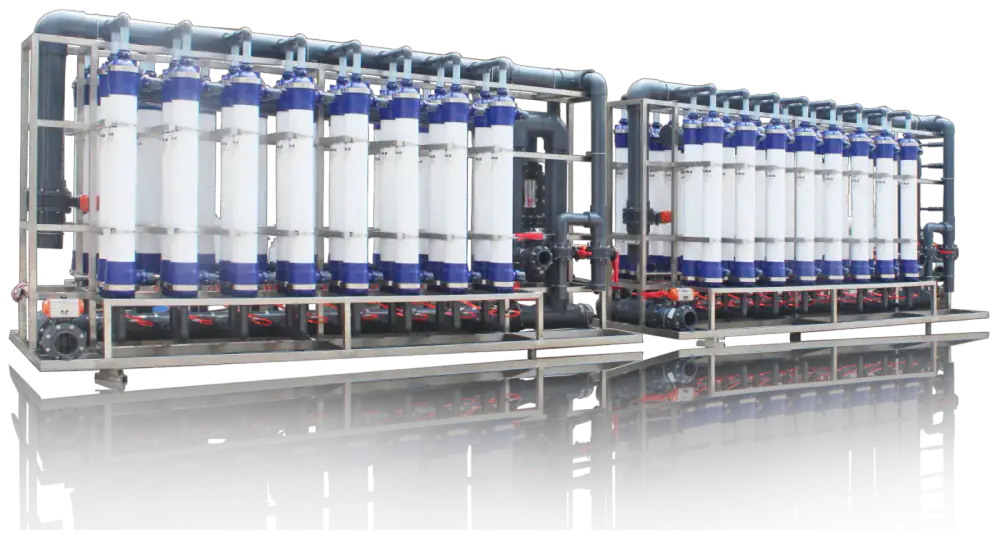
The core stage does the main separation. Reverse osmosis removes dissolved salts; ultrafiltration removes particles and microorganisms without desalting; EDI polishes RO permeate to ultrapure quality. Post-treatment makes the water safe and pleasant at the tap: UV or ozone for disinfection, polishing filters for particles, and hygienic storage with recirculation.
| Stage | Unit operations | Removes | Why it matters |
|---|---|---|---|
| Pretreatment | Multimedia / sand filter, activated carbon, softener, antiscalant, 5 µm cartridge | Turbidity, chlorine, organics, hardness, iron and manganese | Protects membranes, UV lamps and downstream equipment |
| Core | RO, UF, EDI | Dissolved salts, fine particles, microorganisms | Delivers the target water quality |
| Post-treatment | UV, ozone, polishing filter, storage and recirculation | Bacteria, viruses, residual organics, particles | Keeps water safe between the plant and the tap |
| Storage & distribution | Hygienic tank, vent filter, recirculating loop, point-of-use UV | Recontamination, stagnation, biofilm | Protects water quality after the treatment train |
05
How do you choose the process train?
Start from the contaminant, not from the equipment list. Each water problem has a standard first response; combinations are common when the analysis shows several issues at once. The table below is the selection logic we apply before quoting.
| Problem | Indicator | First response | Add when needed |
|---|---|---|---|
| Turbidity and suspended solids | > 1 NTU, visible sediment | Multimedia or sand filtration | Coagulation, ultrafiltration |
| Chlorine taste and odour | Free chlorine > 0.2 ppm | Activated carbon | Catalytic carbon for chloramine |
| Hardness and scale | > 120 ppm as CaCO₃ | Ion-exchange softener | Antiscalant where salt is impractical |
| Iron and manganese | > 0.3 ppm Fe, > 0.05 ppm Mn | Oxidation plus multimedia filtration | Ozone or chlorine dosing |
| Salinity and high TDS | > 500–1,000 ppm for drinking | Reverse osmosis | Two-stage RO, blending |
| Bacteria and viruses | Positive microbiological result | UV at 30–40 mJ/cm² | Ozone, tank sanitation |
| Nitrate | Above 10 mg/L as N, or local limit | Reverse osmosis | Blending, ion exchange for small flows |
| Arsenic and fluoride | Above local drinking-water limit | RO, adsorption or coagulation | Source-specific pilot test |
06
What flow rate and configuration do you need?
Flow rate follows peak demand, not average demand. A hotel that uses 40 m³ a day may still draw 4 m³ in the busiest hour; a school may draw most of its water in two breaks. Size the plant for the peak, and use storage to decouple production from demand where the peak is short.
| Capacity | Typical users | Typical train | Footprint |
|---|---|---|---|
| 0.5–1 m³/h | Café, small clinic, office pantry | Carbon + RO + UV | Skid, 1–2 m² |
| 1–2 m³/h | Small restaurant, guesthouse, small school | Carbon + softener + RO + UV | Skid, 1.5–3 m² |
| 2–5 m³/h | Hotel, school, clinic, restaurant group | Multimedia + carbon + softener + RO + UV | Skid or plant room, 4–10 m² |
| 5–10 m³/h | Hospital wing, factory, bottling line | Full pretreatment + two-stage RO | Plant room, 8–15 m² |
| 10–20 m³/h | Hospital, industrial plant, large hotel | Full pretreatment + two-stage RO or RO+EDI | Plant room or container, 12–25 m² |
| 20–50 m³/h | Industrial park, community, large plant | Custom train, duplicate membrane arrays | Containerized or civil works |
| 50+ m³/h | Multiple buildings or process lines | Multiple trains, staged duty | Civil works or multiple containers |
| Containerized 4–25 m³/h | Remote sites, camps, communities | Full train pre-assembled and tested | 20 ft or 40 ft container |
Footprint excludes storage tanks and is indicative only; final layout follows the approved drawing.
07
What does installation and maintenance involve?
A commercial train needs a drained, ventilated room with power at the specified voltage, a raw-water inlet at adequate pressure, a concentrate or backwash drain, and space for consumable replacement. Softeners need a brine tank and salt storage; RO systems need a CIP tank or connection; UV systems need a 5 µm prefilter and lamp access.
Maintenance is scheduled by consumable, not by calendar alone. Cartridges follow differential pressure; carbon follows chlorine breakthrough; resin follows hardness leakage; membranes follow normalized flow and conductivity; UV lamps follow hours and dose. A logbook with weekly readings is the cheapest reliability tool a site can keep.
- Pre-treatment backwash: automatic by valve timer or differential pressure
- Cartridge filters: every 1–3 months, or at 0.5–1 bar rise
- Carbon media: every 12–24 months depending on chlorine load
- UV lamps: every 8,000–9,000 hours or once a year
08
When should you choose a turnkey or containerized system?
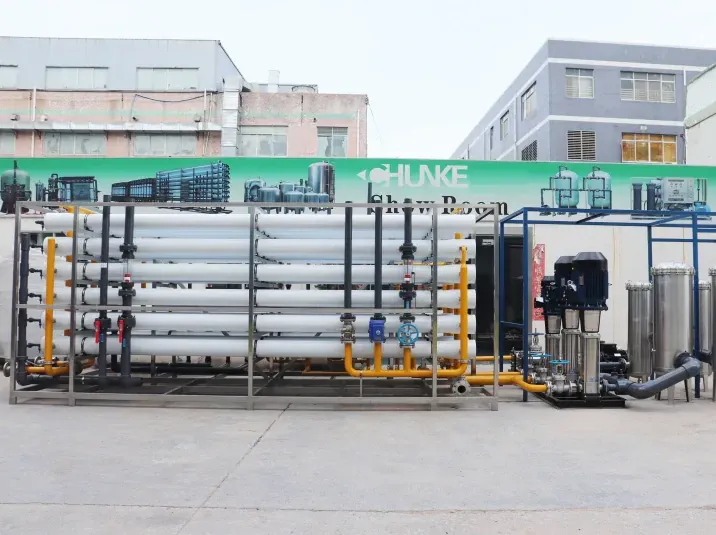
Choose turnkey when the site has no treatment experience, when the plant must be commissioned quickly, or when responsibility for the whole train should sit with one supplier. Containerized systems are prefabricated, tested as a unit and shipped complete; on site they need a foundation, power, water connections and drain. They are particularly useful for remote sites, camps and projects where civil works would otherwise delay commissioning.
Specifications
Delivery and service — typical ranges
| Item | Typical range |
|---|---|
| Standard skid lead time | 15–30 days after drawing approval |
| Containerized / turnkey lead time | 30–60 days after drawing approval |
| Warranty | 12–18 months from shipment |
| Factory testing | Hydrostatic pressure test and trial run with water before packing |
| Documentation | General arrangement drawing, P&ID, test record, O&M manual and spare-parts list |
| Packaging | Seaworthy plywood crate, or container for containerized plants |
| Installation support | Remote guidance as standard; on-site engineer available on request |
| Operator training | 1–2 days at commissioning, covering operation, CIP and consumables |
| Spare parts | Recommended two-year list quoted separately with the equipment |
| Payment terms | Typically 30% deposit and 70% before shipment; confirmed in the quotation |
| Minimum order | 1 unit |
| Loading port | Guangzhou or Shenzhen, China |
| Power supply | 220/380/415/440 V, 50/60 Hz; confirmed on order |
| Ambient temperature | 5–40 °C |
| Enclosure protection | IP54 for indoor skids; higher IP available on request |
| Certification | CE and ISO 9001; model-specific test reports on request |
Typical industry ranges for planning. Final scope, commercial terms and lead time are confirmed in the quotation.
FAQ
Frequently asked questions
Questions buyers actually ask during sizing and quotation. Answers match the specifications above.
01 What is the difference between a water filter and a filtration system?
02 How do I know which treatment stages my water needs?
03 Can one system handle drinking water and process water?
04 How much space does a commercial system need?
05 What water pressure and power supply are required?
06 How often are filters and membranes replaced?
07 Can the system be expanded later?
08 What documentation is supplied?
09 Can you supply to my country and voltage?
Related
Related pages
Next step
Send your water analysis, get a factory quotation
Tell us the source water, TDS, hardness, iron and daily demand. Factory engineers reply with a flow rate, process train and budget range within one working day.