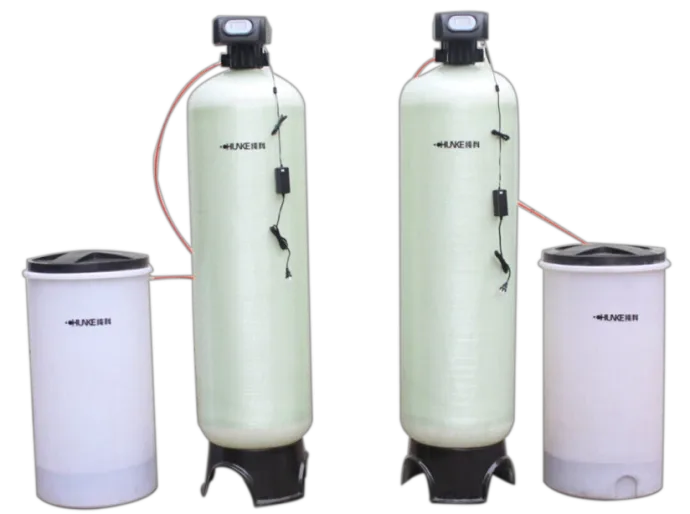
Twin softener · RO blending · 0.25–2 m³/h
Coffee Shop Water Filter System — Hardness, Alkalinity and Flavour
Quick answer
A coffee shop water filter controls hardness, alkalinity and TDS: carbon removes chlorine, a softener or RO reduces hardness, and a blending valve sets the mineral level. Plan at 0.1–0.2 m³ per day per 100 cups, then add 20–30% for cleaning and steam.
- Daily water per 100 cups
- 0.1–0.2 m³ Daily water per 100 cups
- Typical hardness target
- 50–100 ppm Typical hardness target
- Typical alkalinity target
- 40–70 ppm Typical alkalinity target
- Carbon block replacement
- 3–6 months Carbon block replacement
01
What water problems show up in a coffee shop?
Coffee is mostly water, so the water recipe matters as much as the beans. Three parameters drive the cup: hardness, alkalinity and chlorine. Hardness above roughly 100 ppm as CaCO₃ scales espresso boilers, steam wands and level probes, causing temperature drift and service calls. Alkalinity above roughly 70 ppm buffers the acids that give coffee its brightness, so the cup tastes flat, chalky or muddy.
Chlorine and chloramine are the third problem. They react with coffee aromatics and produce medicinal, plastic or papery notes that no grind adjustment can fix. High TDS adds a salty or mineral edge, while water that is too pure tastes hollow and can corrode copper and brass in the machine. The goal is not zero minerals; it is a stable, repeatable mineral profile.
Different brew methods also need different water. Espresso machines recirculate water in a boiler and are sensitive to scale; filter brewers and iced coffee use water once and are more sensitive to alkalinity and chlorine. A shop that serves both may need two points of use with different blending settings rather than one compromise. Milk steaming also concentrates minerals in the steam boiler, so the steam circuit deserves the same water quality as the brew water.
- Scale in the espresso boiler, steam wand and probes
- High alkalinity flattening acidity and sweetness
- Chlorine and chloramine creating medicinal off-flavours
- Water that is too pure tasting hollow and corroding metal
02
What water chemistry makes good coffee?
A widely used starting point for specialty coffee is 75–250 ppm TDS, 40–70 ppm alkalinity as CaCO₃, 50–100 ppm hardness as CaCO₃ and pH 6.5–7.5. These are typical ranges, not a universal rule: light roasts usually show better with lower alkalinity, while dark roasts and milk drinks tolerate more minerals. Establish a target with tastings, then hold it steady.
Measure the source before choosing equipment. A shop on municipal water at 120 ppm hardness and 80 ppm alkalinity may need only carbon and a softener set to blend. A shop at 350 ppm hardness with 200 ppm alkalinity needs RO, because softening alone exchanges hardness for sodium but leaves alkalinity in place. That distinction decides whether you buy a softener or an RO with blending. Alkalinity is the parameter most often ignored and most responsible for flat coffee.
| Parameter | Typical target | Effect on the cup |
|---|---|---|
| TDS | 75–250 ppm | Too low: hollow; too high: salty or muddy |
| Alkalinity | 40–70 ppm as CaCO₃ | Buffers acidity; high values flatten flavour |
| Hardness | 50–100 ppm as CaCO₃ | Contributes body; high values scale the boiler |
| pH | 6.5–7.5 | Affects extraction and perceived acidity |
| Free chlorine | Below 0.05 ppm | Above this: medicinal or plastic notes |
| Iron and manganese | Below 0.1 ppm | Staining, metallic taste and equipment deposits |
Typical specialty-coffee guidance; confirm the target by tasting and adjust the blend rather than chasing a single number.
03
How much water does a coffee shop use, and how do you size the filter?
Plan 0.1–0.2 m³ per day per 100 cups. The range covers espresso, filter coffee, tea, drinking water and the water lost to backflushing and steam. Add 20–30% for cleaning, pitcher rinsing and milk station use. A shop serving 300 cups per day therefore needs roughly 0.4–0.8 m³/day, not the 0.3–0.6 m³ the cup count alone suggests. Cup count is a rough guide only; a shop with heavy iced-coffee sales uses more water per cup than one serving mostly espresso, because ice and larger serve volumes add draw.
Peak flow is set by the espresso machine, not by daily cups. A single-group machine typically fills and backflushes at 0.25–0.5 m³/h; a two-group machine with a high-volume brew bar may draw 0.5–1.0 m³/h. Size the softener or RO at or above that peak, and keep a 0.5–1.0 m³ storage tank if the machine has a boiler fill pump that cycles frequently. If the shop uses reverse osmosis, install a pressure gauge and a sample point after the blend so the barista can verify the recipe at the start of each shift.
| Cups per day | Typical daily water | Typical peak flow | Typical configuration |
|---|---|---|---|
| 50–100 | 0.1–0.2 m³/day | 0.25–0.5 m³/h | Carbon block + 0.5 m³/h softener |
| 150–250 | 0.2–0.5 m³/day | 0.25–0.5 m³/h | Carbon + 0.5–1 m³/h softener |
| 300–500 | 0.4–1.0 m³/day | 0.5–1.0 m³/h | Carbon + 1 m³/h RO with blend |
| 600–1,000 | 0.8–2.0 m³/day | 1.0–1.5 m³/h | Carbon + 1–2 m³/h RO with blend |
| 1,200–2,000 | 1.8–4.0 m³/day | 1.5–2.5 m³/h | Carbon + 2–3 m³/h RO + twin softener |
Values include 20–30% for cleaning and steam. Peak flow follows the espresso machine fill rate, not the daily cup count.
04
Which capacity and configuration fit your coffee bar?
The required table below links daily volume to a complete train. The key decision is softening versus RO. Softening is cheaper to run and preserves alkalinity, which suits shops with moderate hardness and good-tasting municipal water. RO removes both hardness and alkalinity, so it needs a blending valve or a remineralisation cartridge to bring the water back to the target recipe. A twin softener is preferred when the bar opens long hours, because regeneration can happen during service without sending hard water to the machine.
| Daily demand | Peak flow | Pretreatment | Main stage | Post-treatment |
|---|---|---|---|---|
| 0.1–0.3 m³/day | 0.25–0.5 m³/h | 5 µm + carbon block | 0.5 m³/h softener | Carbon polishing + UV optional |
| 0.3–0.6 m³/day | 0.5–1.0 m³/h | Carbon + 1 m³/h softener | CK-RO-1000L with blend | Blend valve + carbon polishing |
| 0.6–1.2 m³/day | 0.5–1.0 m³/h | Carbon + 1 m³/h softener | CK-RO-1000L with blend | Blend valve + remineralisation |
| 1.2–2.0 m³/day | 1.0–1.5 m³/h | Carbon + twin 1–2 m³/h softener | CK-RO-2000L with blend | Blend valve + UV + 0.5 m³ tank |
| 2.0–4.0 m³/day | 1.5–2.5 m³/h | Carbon + twin 2–3 m³/h softener | CK-RO-3000L with blend | Blend valve + UV + 1 m³ tank |
Choose softening when alkalinity is already in range; choose RO with blending when hardness or alkalinity is too high for the target recipe.
05
What are the installation requirements for a coffee shop?
Most coffee systems fit under the counter: allow 0.8 × 0.6 m and 1.6 m height for a twin softener or a 0.5–1 m³/h RO with a small tank. Provide a 220 V socket, a drain for regeneration and concentrate, and 2–4 bar inlet pressure. Keep the brine tank accessible for salt bags and place it within 3 m of the valve head.
Run separate food-grade lines to the espresso machine, brew bar and ice machine, with a blending valve on the espresso line so the barista can adjust TDS without changing the whole system. Avoid copper and brass downstream of RO, because low-mineral water is aggressive; use PEX, stainless or food-grade composite. Fit isolation valves and a sampling point at each machine so a water sample can be taken without disconnecting the line. Label the blend setting and record it in the bar log, so a new opener does not reset it by accident.
- Under-counter space 0.8 × 0.6 m, height 1.6 m
- 220 V socket and drain for regeneration and concentrate
- Inlet pressure 2–4 bar; booster if below 1.5 bar
- Brine tank within 3 m with a clear salt path
- Separate lines to espresso, brew bar and ice
- Blending valve and sampling point at each machine
06
How is a coffee shop water system maintained?
Replace the carbon block every three to six months, or by rated volume, because chlorine breakthrough is invisible and shows up as an off-flavour. Check softener salt weekly and test hardness monthly; a sudden rise in hardness usually means the resin is exhausted, the brine is weak or the valve is not drawing. Replace resin every three to five years and the RO membrane every two to three years. Test free chlorine after the carbon block monthly; a fading test result means the block is exhausted even if the calendar says otherwise.
Keep a log of TDS, hardness, alkalinity and pH at the espresso line, and taste the water blind against the target. Descale the espresso machine on the manufacturer schedule even when the filter is working, because boilers concentrate minerals between services. If the shop changes water source or the utility switches supply, retest and reset the blend before service rather than after complaints.
| Item | Interval | Action |
|---|---|---|
| Carbon block | 3–6 months | Replace by volume or chlorine test |
| Softener salt | Weekly | Top up; break salt bridges |
| Hardness and alkalinity | Monthly | Test at the espresso line; adjust blend |
| Resin | 3–5 years | Replace when capacity falls |
| RO membrane | 2–3 years | Replace when TDS or flow drifts |
| Espresso machine | Manufacturer schedule | Descale and replace gaskets |
Specifications
Delivery and service — typical ranges
| Item | Typical range |
|---|---|
| Standard skid lead time | 15–30 days after drawing approval |
| Containerized / turnkey lead time | 30–60 days after drawing approval |
| Warranty | 12–18 months from shipment |
| Factory testing | Hydrostatic pressure test and trial run with water before packing |
| Documentation | General arrangement drawing, P&ID, test record, O&M manual and spare-parts list |
| Packaging | Seaworthy plywood crate, or container for containerized plants |
| Installation support | Remote guidance as standard; on-site engineer available on request |
| Operator training | 1–2 days at commissioning, covering operation, CIP and consumables |
| Spare parts | Recommended two-year list quoted separately with the equipment |
| Payment terms | Typically 30% deposit and 70% before shipment; confirmed in the quotation |
| Minimum order | 1 unit |
| Loading port | Guangzhou or Shenzhen, China |
| Power supply | 220/380/415/440 V, 50/60 Hz; confirmed on order |
| Ambient temperature | 5–40 °C |
| Enclosure protection | IP54 for indoor skids; higher IP available on request |
| Certification | CE and ISO 9001; model-specific test reports on request |
Typical industry ranges for planning. Final scope, commercial terms and lead time are confirmed in the quotation.
FAQ
Frequently asked questions
Questions buyers actually ask during sizing and quotation. Answers match the specifications above.
01 Does espresso need RO water?
02 What hardness should espresso water have?
03 Why does my coffee taste flat or chalky?
04 Why does my coffee taste sour or metallic?
05 Can one filter serve espresso, filter coffee and ice?
06 How often should the carbon block be changed?
07 Do I need a twin softener?
08 What maintenance can staff do daily?
Next step
Send your water analysis, get a factory quotation
Tell us the source water, TDS, hardness, iron and daily demand. Factory engineers reply with a flow rate, process train and budget range within one working day.