Electrodeionisation · >10 MΩ·cm · no acid or caustic
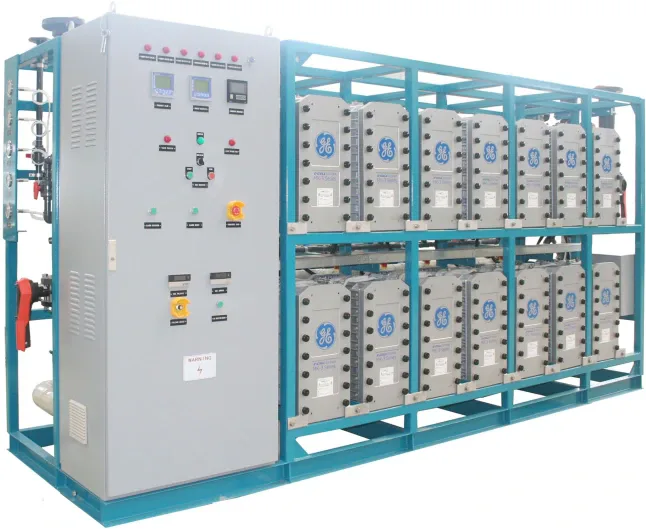
EDI Water Treatment System — Ultrapure Water Without Chemical Regeneration
Quick answer
EDI, or electrodeionisation, removes residual ions from RO permeate using ion-exchange resin, ion-selective membranes and a DC electric field. The field continuously regenerates the resin, so no acid or caustic is needed. Feed should be RO permeate at 10–20 µS/cm or lower, with CO₂ controlled. Product water is typically above 10 MΩ·cm.
- Typical product resistivity
- >10 MΩ·cm Typical product resistivity
- Maximum feed conductivity
- 10–20 µS/cm Maximum feed conductivity
- Acid and caustic for regeneration
- 0 Acid and caustic for regeneration
- Typical feed temperature
- 5–35 °C Typical feed temperature
01
What is EDI and how does it work?
EDI stands for electrodeionisation. It is a polishing process that removes the small amount of dissolved ions left after reverse osmosis. A stack contains ion-exchange resin between alternating cation and anion membranes, with a direct-current electric field across the cells. Feed water passes through the resin, which captures ions; the field drives those ions through the membranes into a separate concentrate stream. At the same time, water splits into hydrogen and hydroxide ions at the resin surface, regenerating the resin continuously without acid or caustic.
Because regeneration happens in service, EDI runs continuously and avoids the chemical storage, neutralisation and waste handling of a mixed bed. The trade-off is that EDI needs good feed water: it is a polisher, not a primary desalinator. A stack also needs a DC power supply, a concentrate stream, a drain and controls that monitor resistivity, current, flow and pressure.
- 01
RO permeate enters the dilute compartments
Feed passes through resin beds in the dilute compartments; ions are captured and conductivity falls.
- 02
The electric field moves the ions
A DC field drives cations and anions in opposite directions toward their selective membranes.
- 03
Concentrate carries ions away
Ions cross the membranes into concentrate compartments and leave the stack as a small waste stream.
- 04
Water splitting regenerates the resin
Hydrogen and hydroxide ions produced at the resin surface replace captured ions, restoring capacity.
02
Which feed water quality does EDI require?
EDI must be fed with RO permeate, not raw or softened water. Typical limits are conductivity of 10–20 µS/cm or lower, carbon dioxide below about 5 ppm, hardness below 1 ppm as CaCO₃, silica below 0.5 ppm, free chlorine below 0.05 ppm and TOC below 0.5 ppm. Turbidity and SDI should be low enough to protect the resin and membranes. These are screening values: the stack datasheet and warranty conditions take precedence.
Carbon dioxide is the most common reason an EDI underperforms. RO does not reject CO₂ gas, so it passes into the EDI and consumes current without contributing to resistivity. If the feed alkalinity is high, add a degasser, a membrane contactor or pH adjustment before the stack. Hardness and silica are the second common cause: they scale the concentrate side, raise pressure drop and permanently damage the stack.
| Parameter | Typical limit | Why it matters |
|---|---|---|
| Conductivity | 10–20 µS/cm or lower | Sets the ionic load and the required current |
| Carbon dioxide | Below about 5 ppm | Consumes current; not rejected by RO |
| Hardness | Below 1 ppm as CaCO₃ | Scales the concentrate side of the stack |
| Silica | Below 0.5 ppm | Hard scale that is difficult to remove |
| Free chlorine | Below 0.05 ppm | Oxidises the resin and membranes |
| TOC | Below 0.5 ppm | Fouls resin and raises product TOC |
| Turbidity / SDI | Below 0.1 NTU; SDI below 1 | Particles block resin beds and channels |
| Temperature | 5–35 °C | Affects conductivity and resin kinetics |
| Inlet pressure | About 2–4 bar | Must stay within the stack design range |
Confirm limits with the selected stack manufacturer; warranty may require tighter values.
03
What purity can EDI reach?
A well-designed RO+EDI train typically produces more than 10 MΩ·cm, and 15–18 MΩ·cm is achievable with low-CO₂ feed and clean upstream stages. Resistivity is measured at 25 °C; readings at other temperatures must be compensated before comparison. Purity also depends on current density, flow rate, feed conductivity and the condition of the resin and membranes.
Resistivity alone does not describe ultrapure water. For electronics, TOC, particles, silica and dissolved oxygen may matter more than the resistivity number. For pharmaceutical use, microbial control and validated sanitisation of the loop are critical. EDI is one stage in a train; storage tank design, loop velocity, polishing filters and UV can all change the final water quality.
04
How does EDI compare with mixed-bed deionisation?
Both processes can produce ultrapure water. A mixed bed uses a single vessel of cation and anion resin and is regenerated with acid and caustic, either in place or off site. It tolerates a wider feed quality and often has a lower capital cost for small or intermittent duty. EDI regenerates electrically while running, so it avoids chemical handling, neutralisation, regeneration waste and the downtime of a regeneration cycle.
The choice usually comes down to feed reliability and operating pattern. EDI is favoured for continuous, automated duty with stable RO feed; a mixed bed is favoured where feed quality varies, where the plant runs intermittently, or where very low TOC is required and a polishing mixed bed is used after EDI.
| Aspect | EDI | Mixed bed |
|---|---|---|
| Regeneration | Continuous, electrical, in service | Batch, with acid and caustic |
| Chemicals | None for regeneration | Hydrochloric acid and sodium hydroxide |
| Waste stream | Small concentrate stream | Regeneration wastewater requiring neutralisation |
| Product quality | Typically above 10 MΩ·cm | Can exceed 18 MΩ·cm when freshly regenerated |
| Operating pattern | Continuous; no regeneration downtime | Cyclic; quality and flow fall before regeneration |
| Feed tolerance | Narrow; requires good RO permeate | Wider; can handle higher ionic load |
| Operator skill | Instrumentation and DC power | Chemical handling and regeneration procedure |
| Footprint | Compact stack, no chemical storage | Vessels plus acid and caustic storage |
| Best for | Continuous ultrapure duty with stable feed | Variable feed, intermittent duty, final polishing |
05
Which applications use EDI water?
EDI is used wherever a continuous supply of demineralised water is needed and chemical regeneration is undesirable. The common sectors are electronics, pharmaceuticals, cosmetics, laboratories and power generation. Each has different priorities: electronics focuses on TOC, particles and trace metals; pharmaceutical production focuses on microbial control and validated sanitisation; cosmetics focuses on colour, odour and microbial quality; laboratories need consistent resistivity for analytical work.
- Electronics: wafer rinsing, chemical dilution, precision cleaning
- Pharmaceutical: purified water pretreatment, clean utilities
- Cosmetics: formulation water, equipment rinsing
- Laboratories: reagent water, glassware rinsing, analytical instruments
- Power and glass: boiler make-up polishing, high-purity process water
06
How is EDI integrated into an RO system?
The usual train is pretreatment, RO, CO₂ removal, EDI, polishing and a storage or distribution loop. Softening or antiscalant protects the RO; a 5 µm cartridge filter protects the EDI stack; a degasser or membrane contactor removes CO₂ between the RO and EDI. Instruments monitor feed conductivity, product resistivity, flow, pressure and temperature, and interlock the stack off if feed quality falls outside the set points.
Hydraulics matter as much as water chemistry. The stack needs a stable feed pressure and a concentrate flow within the design range; too little concentrate flow causes scaling, too much wastes water. A recirculation loop keeps flow across the stack during low demand. The product line should be short, with no dead legs, and the storage tank should be vented and protected from airborne contamination.
| Application | RO configuration | CO₂ control | Post-treatment |
|---|---|---|---|
| Electronics | Two-stage RO | Membrane contactor | UV, polishing filter, distribution loop |
| Pharmaceutical | Two-stage RO, sanitizable | Degasser or contactor | UV, ultrafiltration, loop |
| Cosmetics | Single- or two-stage RO | Degasser if alkalinity is high | UV, 0.2 µm filter |
| Laboratory | Two-stage RO | Contactor | UV, polishing cartridge |
Confirm the final train against the feed analysis and the water quality standard for the application; the table shows common combinations.
07
What operating parameters and maintenance keep EDI stable?
The stack is stable when current, feed conductivity, CO₂, flow and temperature stay within the design envelope. Rising stack differential pressure points to scaling or fouling; falling resistivity at constant current points to exhausted resin, membrane damage or a feed problem. Free chlorine is the most destructive common fault: it oxidises the resin and membranes, and the damage is permanent. Check the upstream carbon or bisulphite dosing before blaming the stack.
Maintenance is mostly inspection and record keeping. Log resistivity, current, voltage, flow, pressure and temperature daily or weekly; verify instrument calibration; replace cartridge filters on differential pressure; and keep the RO and CO₂ removal stages in specification. Stack replacement is expected after several years of service, depending on feed quality and operating hours, and should be planned rather than treated as a failure.
- Keep feed conductivity below the stack limit at all times
- Control CO₂ before the stack; it is an electrical load, not a solid
- Watch stack differential pressure for scaling
- Protect the stack from chlorine and other oxidants
- Record resistivity and current to detect drift early
- Plan stack replacement from operating hours and feed history
08
Can EDI replace an existing mixed-bed polisher?
Often it can, but the existing RO must be able to produce consistent low-conductivity permeate, and the CO₂ load must be handled. A retrofit needs space for the stack, a DC power supply, a concentrate drain, new instruments and revised controls. If the existing mixed bed is in good condition, it can remain as a backup or final polisher while EDI takes over the bulk duty, which reduces chemical use without sacrificing redundancy.
A retrofit is not always justified. If the plant runs only a few hours a day, if the feed quality swings widely, or if the existing mixed bed is already cheap to regenerate, the payback may be long. The decision should compare chemical and waste costs, downtime, labour and stack replacement against the capital cost of the retrofit.
Specifications
Delivery and service — typical ranges
| Item | Typical range |
|---|---|
| Standard skid lead time | 15–30 days after drawing approval |
| Containerized / turnkey lead time | 30–60 days after drawing approval |
| Warranty | 12–18 months from shipment |
| Factory testing | Hydrostatic pressure test and trial run with water before packing |
| Documentation | General arrangement drawing, P&ID, test record, O&M manual and spare-parts list |
| Packaging | Seaworthy plywood crate, or container for containerized plants |
| Installation support | Remote guidance as standard; on-site engineer available on request |
| Operator training | 1–2 days at commissioning, covering operation, CIP and consumables |
| Spare parts | Recommended two-year list quoted separately with the equipment |
| Payment terms | Typically 30% deposit and 70% before shipment; confirmed in the quotation |
| Minimum order | 1 unit |
| Loading port | Guangzhou or Shenzhen, China |
| Power supply | 220/380/415/440 V, 50/60 Hz; confirmed on order |
| Ambient temperature | 5–40 °C |
| Enclosure protection | IP54 for indoor skids; higher IP available on request |
| Certification | CE and ISO 9001; model-specific test reports on request |
Typical industry ranges for planning. Final scope, commercial terms and lead time are confirmed in the quotation.
FAQ
Frequently asked questions
Questions buyers actually ask during sizing and quotation. Answers match the specifications above.
01 What does EDI stand for and how is it different from DI?
02 Does EDI really need no chemicals?
03 Can EDI treat tap water directly?
04 What feed water quality does EDI require?
05 What purity does EDI produce?
06 How long do EDI stacks last?
07 What maintenance does an EDI system need?
08 Can EDI be added to an existing RO system?
09 What does an EDI water treatment system cost?
Next step
Send your water analysis, get a factory quotation
Tell us the source water, TDS, hardness, iron and daily demand. Factory engineers reply with a flow rate, process train and budget range within one working day.