Sizing by venue
Sizing Water Filters for Hotels, Restaurants and Offices
Quick answer
Sizing a commercial water filter starts with two numbers, not with a model list: daily demand and peak flow. This guide gives planning figures for hotels, restaurants and offices, the formulas that turn them into equipment capacity, and three worked examples for a 120-room hotel, a 90-seat restaurant and a 150-person office.
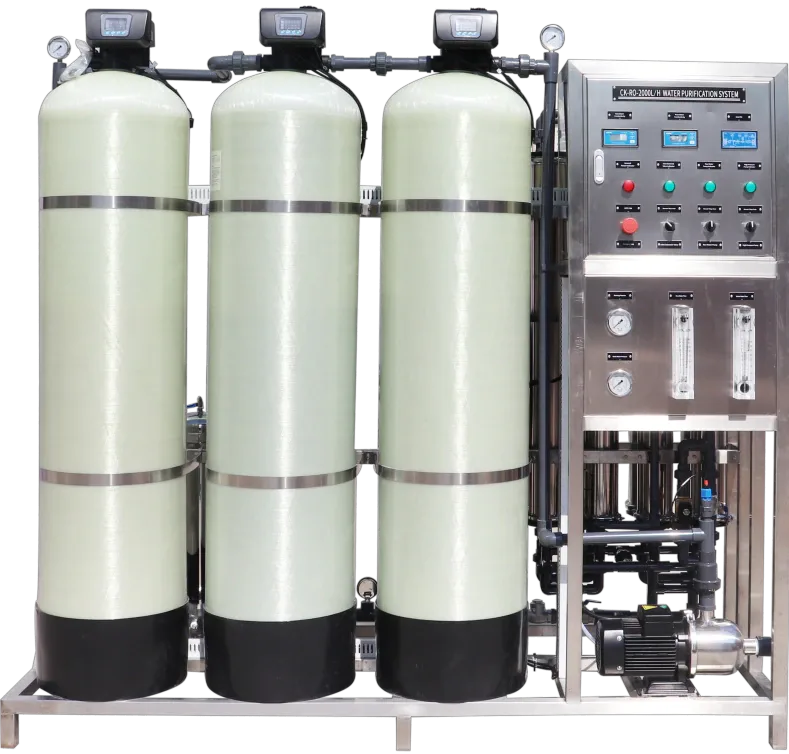
What demand figures should you use for hotels, restaurants and offices?
Planning figures are a starting point, not a design. For hotels, use 250–400 L per room per day, covering guest rooms, food and beverage, laundry and pool top-up; drop to 180–280 L when laundry is outsourced. For restaurants, use 15–30 L per seat per day for ice, drinks, preparation and washing, excluding toilets. For offices, use 10–20 L per person per day for drinking, coffee and pantry use. Schools sit in the same range at 10–20 L per student per day.
The lower end of each range fits a compact site with short operating hours and no laundry or pool. The upper end fits full service: a hotel with a busy kitchen and on-site laundry, an all-day restaurant with a large ice demand, or an office with a canteen and gym. These figures describe the water you treat, not the whole building meter. If a meter is available, replace the estimate with 7–14 days of readings, because the peak hour is usually sharper than the daily average suggests.
- Hotel: 250–400 L per room per day; 180–280 L with outsourced laundry
- Restaurant: 15–30 L per seat per day; add 10–20% for bars and takeaway
- Office: 10–20 L per person per day; count visitors and co-working seats
- School: 10–20 L per student per day; boarding schools 40–80 L
| Venue | Planning demand | Peak factor | Operating hours | Scope of figure |
|---|---|---|---|---|
| Hotel | 250–400 L/room/day | 1.5–2.5 | 18–24 | Guest rooms, F&B, laundry, pool |
| Restaurant | 15–30 L/seat/day | 1.5–2.0 | 8–12 | Ice, drinks, kitchen, washing |
| Office | 10–20 L/person/day | 2.0–2.5 | 8–10 | Drinking, coffee, pantry |
| School | 10–20 L/student/day | 2.0–2.5 | 8–10 | Drinking water and canteen |
Figures exclude toilets and building services unless stated. Confirm with metered data where available.
How do you convert daily demand into peak flow and equipment size?
Use three calculations in order. Daily demand: Qd = N × q × f ÷ 1,000, where N is rooms, seats or people, q is litres per unit per day and f is occupancy or utilisation — typically 0.65–0.80 for a city hotel and 0.85–0.95 for a school. Peak flow: Qpeak = Qd × PF ÷ T, where PF is the peak factor of 1.5–2.5 and T is operating hours. Treatment flow: QRO = Qd × 1.15 ÷ R, where R is refill hours and 1.15 is a fouling margin.
Peak flow sizes pipes, softeners and pretreatment; treatment flow sizes the RO membrane, because the membrane refills storage over hours rather than serving the tap directly. For hotels, restaurants and offices, storage should hold 30–50% of daily demand so the plant runs at steady output through the busiest period; schools are sized on the break, not the daily average. Do not size the RO on the instantaneous peak: a 120-room hotel may draw 3 m³/h at 08:00 but only needs 0.5 m³/h of drinking water when a 1 m³ tank sits between the membrane and the tap.
- Qd (m³/day) = units × litres per unit × occupancy ÷ 1,000
- Qpeak (m³/h) = Qd × 1.5–2.5 ÷ operating hours
- QRO (m³/h) = Qd × 1.15 ÷ refill hours
- Storage (m³) = 0.3–0.5 × Qd for hotels, restaurants and offices; schools use break volume plus 20–30%
What does a 120-room hotel need?
At 300 L per room and 75% occupancy, daily demand is 120 × 300 × 0.75 ÷ 1,000 = 27 m³/day. With a peaking factor of 1.8 over 18 operating hours, peak flow is 27 × 1.8 ÷ 18 = 2.7 m³/h. A 3 m³/h softener covers the hot water, laundry and kitchen load with a small margin. Drinking water is a separate stream: at 3 L per room per day, the hotel needs 0.36 m³/day, so a 0.5 m³/h RO with a 1 m³ tank is adequate.
Keep the two duties separate in the quotation. The softener protects calorifiers, dishwashers and laundry equipment and is sized on peak flow and daily hardness load. The RO supplies guest drinking water, ice and coffee, and is sized on consumption plus storage. Combining them into one oversized RO raises capital cost and wastewater without improving hot water performance.
- Softener: 3 m³/h, sized for peak hot water and laundry
- Drinking RO: 0.5 m³/h with a 1 m³ stainless tank
- Carbon pretreatment: removes chlorine before the membrane
- UV: 30–40 mJ/cm² at the dispenser or storage outlet
What does a 90-seat restaurant need?
At 20 L per seat, daily demand is 90 × 20 ÷ 1,000 = 1.8 m³/day. A peaking factor of 2.0 over 9 operating hours gives 1.8 × 2.0 ÷ 9 = 0.40 m³/h. Add 15% for fouling and future load, and the design flow is 0.46 m³/h; a 0.5 m³/h RO is the correct size, not a 2 m³/h unit. Store 0.5–1.0 m³ to cover the lunch and dinner rush while the membrane refills.
If hardness is 200 ppm as CaCO₃, the daily hardness load is 1.8 m³ × 200 g/m³ = 360 g. At a resin capacity of 50 g/L and a three-day regeneration interval, the softener needs roughly 25–50 L of resin, plus margin for peak days. That is a small softener, but it protects the dishwasher, combi oven and steam table, which are the most expensive items in the kitchen.
- Ice: 0.5 µm carbon block plus RO; check freeze time and clarity
- Coffee: carbon for chlorine, RO for TDS; keep alkalinity in range
- Dishwasher: softened water and a 60–82 °C final rinse
- Steamer: softened feed to prevent scale on the heating element
How do you size an office drinking-water system?
Use 10–20 L per person per day, then count the people who actually drink on site. A 150-person office at 15 L uses 150 × 15 ÷ 1,000 = 2.25 m³/day. With a peaking factor of 2.2 over 8 working hours, peak flow is 2.25 × 2.2 ÷ 8 = 0.62 m³/h. A 1 m³/h RO with a 1–1.5 m³ tank covers the morning arrival and lunch peaks and leaves capacity for growth.
Offices are better served by a central plant and a circulation loop than by a cooler on every floor. A loop keeps water moving, reduces stagnation and gives one point for filter and UV maintenance. If the building has a canteen, gym or public café, meter or estimate those loads separately; they can add 20–40% to the drinking demand without appearing in the staff count.
- Central RO: 1 m³/h for 150–250 staff
- Storage: 30–50% of daily demand, typically 1–1.5 m³
- Loop: return line with UV at 30–40 mJ/cm²
- Points: pantry, meeting rooms, reception and gym
Which site conditions change the sizing result?
Four conditions move the numbers most: hardness, iron and manganese, TDS, and water temperature. Hardness above 120 ppm as CaCO₃ usually justifies softening before RO; iron above 0.3 ppm or manganese above 0.05 ppm needs oxidation and filtration, or the membrane and resin will foul. TDS above 1,000 ppm raises osmotic pressure and lowers recovery. Cold feed water reduces RO output by roughly 3% per °C below 25 °C, so winter design must use the lowest expected temperature.
| Condition | Effect on sizing | Design response |
|---|---|---|
| Hardness above 120 ppm | Scaling risk at recovery above 65% | Softener or antiscalant before RO |
| Iron above 0.3 ppm, manganese above 0.05 ppm | Fouling of resin and membrane | Oxidation plus multimedia filtration |
| TDS above 1,000 ppm | Higher pressure, lower recovery | Two-stage RO or larger pump |
| Feed water below 15 °C | Permeate flow falls by about 3% per °C | Size on winter temperature, not summer |
| Occupancy above 85% | Daily demand and peak both rise | Use metered data and add 10–20% margin |
| Planned expansion within 3 years | Current size becomes marginal | Select one model larger or leave space |
What information should you collect before requesting a quotation?
A quotation is only as good as its inputs. Collect the following before asking for a price, and state which values are measured and which are estimated. The difference matters when the plant is later tested against its design flow.
- 01
Count and utilisation
Rooms, seats, staff or students, plus occupancy, opening hours and seasonality.
- 02
Meter log
Seven to fourteen days of daily and hourly readings if the site is already operating.
- 03
Water analysis
Hardness, TDS, iron, manganese, turbidity, chlorine, pH and temperature.
- 04
Peak schedule
When the busiest hour occurs, how long it lasts and which outlets drive it.
- 05
Site constraints
Plant room size, power, drain, storage space and delivery access.
FAQ
Frequently asked questions
Questions buyers actually ask during sizing and quotation. Answers match the specifications above.
01 Should I size on daily demand or peak flow?
02 What if the site has no water meter?
03 Can one RO system serve a hotel and its restaurant?
04 How much storage should I install?
05 Does occupancy change the equipment size?
06 What is the difference between treatment flow and peak flow?
Related
Systems related to this article
Continue reading
Related technical guides
- Sizing by venue Hotel Water Demand: Litres per Room per Day Hotel water demand planning: 250–400 L per room per day, where the water goes, and a 120-room example for sizing softeners, storage and drinking-water RO.
- Sizing by venue Restaurant Water Filter Sizing by Seats and Peak Flow Restaurant filter sizing: 15–30 L per seat per day, a 90-seat example, and how to split ice, coffee, dishwashing and steam loads by peak flow.
- Sizing by venue School Drinking Water: Sizing by Students and Breaks School drinking water sizing: 10–20 L per student per day, break-time storage, and an 800-student worked example for RO, tank and fountain capacity.
Next step
Send your water analysis, get a factory quotation
Tell us the source water, TDS, hardness, iron and daily demand. Factory engineers reply with a flow rate, process train and budget range within one working day.