Private label · drawing approval · batch consistency
OEM / ODM Water Filter Manufacturing — Private Label and Custom Builds
Quick answer
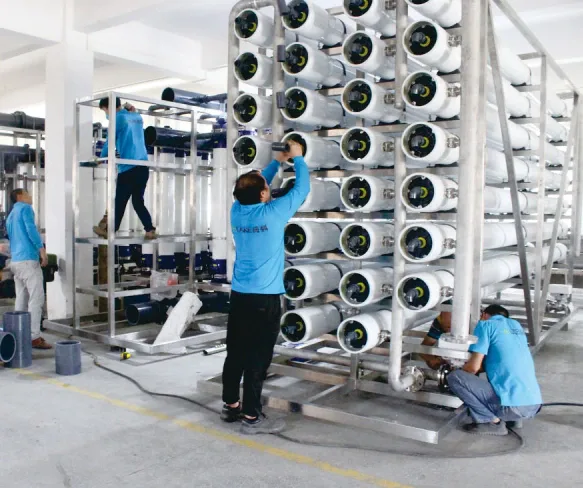
OEM builds a water treatment system to your specification and brand in our Guangzhou factory; ODM adapts an existing platform to your market. HydroWorks supports private-label nameplates, control cabinets, manuals, packaging, voltage and plug options, with drawings approved before production and batch records kept for repeat orders.
- Service model
- OEM / ODM Service model
- Factory certification
- CE / ISO 9001 Factory certification
- Reference capacity
- 0.5–50 m³/h Reference capacity
- Equipment warranty
- 12–18 months Equipment warranty
01
What is the difference between OEM and ODM in water treatment?
OEM means the factory builds equipment to the buyer specification and applies the buyer brand. The buyer usually owns the market, the model name and the customer relationship; the factory owns the manufacturing process. ODM means the factory starts from an existing platform, adapts the hydraulics, controls, cabinet and documentation to the buyer market, and may allow the buyer to sell it under a new model name.
In practice most projects sit between the two. A buyer may want a standard RO platform with a new cabinet layout and a private manual; another may need a different pretreatment train for a local water source. The first question is therefore not OEM or ODM, but which parts must change and which should stay standard.
Keeping the process standard reduces engineering risk, test time and spare parts complexity. Changing the process is possible, but it should be justified by the water analysis or by a market requirement, not by a preference for a different layout. A clear split between standard and custom also makes the quotation easier to compare.
02
Which parts of a water filter can carry your brand?
The visible and documentary parts can be branded: nameplate, control cabinet, frame colour, safety labels, manual, wiring diagram, packing carton and shipping marks. The hydraulic platform, membrane array and pump selection can also be changed, but those changes affect engineering, testing and lead time, so they are treated as configuration, not decoration.
Branding must stay consistent with the certification and the destination market. A nameplate that claims a model or a standard not covered by the test record creates a problem at customs or on site. We therefore freeze the nameplate artwork together with the technical file. The more that stays standard, the faster the approval and the lower the risk of a hidden incompatibility.
| Item | Customisation options | What we need from you |
|---|---|---|
| Nameplate | Brand, model, serial format, voltage and country of origin | Artwork and model naming rule |
| Control cabinet | Label language, colour, logo and layout | Panel drawing approval and text list |
| Manual | Language, cover, warning sections and spare parts list | Source text and market requirements |
| Packaging | Carton print, foam layout and shipping marks | Artwork and handling requirements |
| Frame and tank | Colour, logo plate and label position | Colour code and label artwork |
| Model range | New model names mapped to standard platforms | Mapping table and target market |
| Certification marking | CE marking where covered by the certificate | Destination and directive list |
A nameplate cannot claim a standard that is not covered by the test record and certificate.
03
What is the minimum order quantity and lead time?
Minimum order quantity is confirmed per configuration, not published as a single number. A standard platform with a nameplate and manual change has a different minimum from a new cabinet, a custom frame or a new packaging design. Component minimums, printing setup and test time all move the threshold, so the figure is given in the quotation after the scope is clear.
Lead time is counted from drawing approval and receipt of the deposit, not from the first inquiry. It includes procurement of long-lead pumps, membranes and instruments, fabrication, pressure testing, trial running, packing and documentation. A change to the approved drawing restarts the affected steps. The confirmed lead time is written into the order.
Buyers sometimes ask for a single unit before committing to a batch. That can be discussed as a sample or first-article order, but the commercial terms differ from a repeat batch because setup, artwork and testing are carried by one unit. The quotation states whether the sample is standalone or credited against the batch.
- Standard platform with label and manual change: lower threshold
- New cabinet, frame colour or packaging: tooling and print setup apply
- New hydraulic layout or model name: engineering review first
- Mixed model batch: quantity and test plan agreed together
04
How does the drawing approval process work?
Every OEM project runs on one controlled drawing set. The buyer comments on the general arrangement, the process and instrument diagram, the electrical schematic, the nameplate artwork and the manual text before production starts. Comments are consolidated into one revision, signed off, and released to the workshop; verbal changes are not accepted after that point.
The approval sequence matters because the documents depend on each other. A change to the membrane array changes the skid layout, the instrument list and the panel schematic. Approving the electrical drawing before the process drawing is frozen usually creates rework, so the process is approved first.
- 01
Requirement brief
Market, model, flow, voltage, language and target application are written into a short brief.
- 02
Water analysis
Source water and required product quality define the process steps.
- 03
Concept drawing
General arrangement, skid layout and main components are issued for review.
- 04
Process and electrical
P&ID, instrument list and panel schematic are added to the same drawing set.
- 05
Buyer review
The buyer marks up one combined set; comments are answered line by line.
- 06
Frozen revision
Revision number, date and approval signature are recorded.
- 07
Production release
Bill of materials, artwork and test plan are released to the workshop.
| Document | Purpose | Approved by |
|---|---|---|
| General arrangement | Space, access and lifting | Buyer and factory |
| P&ID | Process steps, valves and instruments | Buyer and process engineer |
| Electrical schematic | Power, control and interlocks | Buyer and electrical engineer |
| Nameplate artwork | Brand, model and ratings | Buyer |
| Manual and label text | Operation and safety | Buyer |
| Packaging artwork | Transport and storage | Buyer |
Only the frozen revision is released to production; later changes follow the same approval path.
05
How do you keep a sample and later batches identical?
The approved sample is sealed and kept as the golden sample. Its bill of materials, wiring schedule, artwork files and test record are frozen under a revision number. Production uses the same drawings and approved suppliers; any substitution requires a written deviation approved by the buyer.
Each batch is checked at incoming inspection, first-article inspection and final test. The first unit of a repeat batch is compared with the golden sample for dimensions, labels, wiring and finish. Test records are filed by serial number, so a later question can be traced to the actual unit. A repeat order references the frozen revision rather than sending new samples. If the buyer changes a supplier or a label, the change is reviewed against the golden sample before the batch is accepted.
| Change type | Approval | Record |
|---|---|---|
| Label or manual text | Buyer and factory quality team | Artwork revision |
| Component brand substitution | Buyer and engineering | Deviation note and BOM revision |
| Hydraulic layout change | Buyer and process engineer | Drawing revision and retest |
| Supplier change for a standard part | Factory quality team, buyer informed | Incoming inspection update |
| Packaging change | Buyer | Packing specification revision |
06
Where are the intellectual property boundaries?
The buyer owns its trademark, brand artwork, model names and any drawings or specifications it supplies. The factory owns its base platform, standard hydraulic layout, control logic, jigs, process know-how and pre-existing documentation. A project does not transfer ownership of the platform unless a separate agreement says so.
We do not copy a competitor brand, a patented mechanism or a counterfeit component. Where a buyer supplies a logo or a design, the buyer confirms the right to use it. Confidential drawings and water data are handled under an NDA when one is signed. Certification responsibility is split: the factory certifies the equipment it builds; the buyer is responsible for local registration and market compliance. Where a buyer needs a new enclosure, a custom manifold or a private control philosophy, the project-specific design should be documented and assigned in the agreement.
- Buyer: trademark, brand artwork, supplied drawings and market registrations
- Factory: base platform, standard hydraulics, control logic, tooling and process know-how
- No counterfeit components or copied competitor branding
- NDA available before technical exchange
07
Which documents ship with an OEM unit?
A complete document set prevents a good unit from failing at installation. The nameplate must match the manual, the wiring diagram must match the panel, and the packing list must match the crates. Missing documents are treated as an incomplete shipment, not as an after-sales issue.
- Nameplate matching the approved artwork and ratings
- Operation and maintenance manual in the agreed language
- Wiring diagram, instrument list and terminal schedule
- Pressure test and trial run report
- Packing list, spare parts list and warranty statement
- CE declaration where applicable, and certificate of origin if required
Document language and content are frozen with the drawing set, before production.
08
How do you start an OEM project?
Start with the market and the model, not with a price. A short specification sheet, a water analysis and a target application are enough for a first review. We then confirm what can stay standard, what must change and which documents are needed before a drawing is issued.
The first review usually produces a list of open questions rather than a final offer. That is normal: voltage, certification, label language and packaging often change the design. Answering those questions early is faster than discovering them after the drawing is frozen. Prepare the specification before the first call: target market, model name, flow, voltage, water analysis, branding items and expected batch size. Missing items are listed as open questions, and the drawing is not released until they are closed.
- 01
Introduction and NDA
Market, role and confidentiality terms are agreed before drawings are exchanged.
- 02
Specification sheet
Model, flow, voltage, application and branding scope are listed.
- 03
Water analysis
The source water and target quality are confirmed.
- 04
Proposal and sample plan
Configuration, MOQ, lead time basis and sample or first-article plan are agreed.
- 05
Drawing approval and batch order
The frozen drawing set releases production and the batch schedule.
FAQ
Frequently asked questions
Questions buyers actually ask during sizing and quotation. Answers match the specifications above.
01 Do you offer both OEM and ODM?
02 Can you put our logo on the machine?
03 What is the minimum order quantity?
04 How long does an OEM order take?
05 Can we use our own membrane or pump brand?
06 Who owns the drawings?
07 Can you sign an NDA?
08 Do you provide a sample before the batch?
09 Which languages are available for manuals and labels?
Next step
Send your water analysis, get a factory quotation
Tell us the source water, TDS, hardness, iron and daily demand. Factory engineers reply with a flow rate, process train and budget range within one working day.