Softening + RO · hardness and metals control · in-plant reuse
Printing & Dyeing Water Treatment — Consistent Water for Repeatable Shade
Quick answer
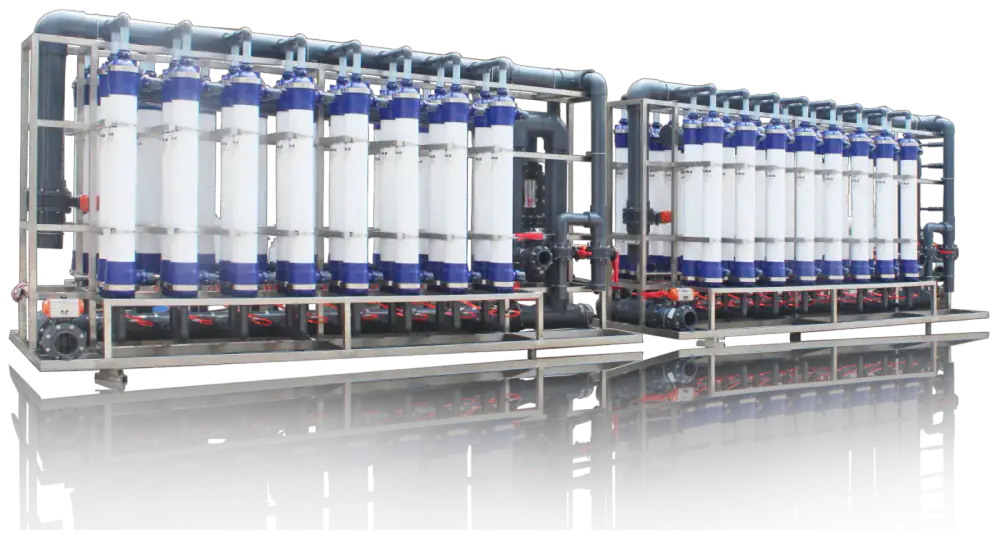
Dyehouses need consistent, low-hardness water because calcium, magnesium, iron and manganese shift dye uptake, cause spots and make shade repeatability difficult. A typical train combines multimedia filtration, softening and reverse osmosis, with storage and a ring main. The same plant usually supplies boiler make-up, which needs lower hardness than the dyeing process.
- Typical dyeing hardness target, as CaCO₃
- <25 ppm Typical dyeing hardness target, as CaCO₃
- Typical iron limit for fabric quality
- <0.1 ppm Typical iron limit for fabric quality
- RO recovery rate
- 50–75% RO recovery rate
- Process water and boiler make-up
- 2 streams Process water and boiler make-up
01
What water problems affect printing and dyeing?
Dyeing is a chemical process carried out in water, so variation in the water becomes variation in the fabric. The common problems are hardness, iron and manganese, turbidity and colour, and inconsistent dissolved solids. Hardness consumes dye and auxiliaries; iron and manganese leave spots or catalyse fibre damage; turbidity and colour deposit on the fabric or tint light shades; fluctuating TDS changes dye solubility and the amount of salt needed. Any of these can turn a laboratory recipe into a shade that needs correction.
The problems compound across the process. Water used in pretreatment, dyeing, soaping and rinsing all contacts the fabric, and a fault at any stage may appear only after drying or finishing. That is why dyehouses that repeat the same recipe across many batches treat water quality as a process variable, with a specification and a monitoring record, rather than as a utility that is either available or not.
02
How does hardness cause shade variation?
Calcium and magnesium consume dyes and auxiliaries in the bath. In reactive dyeing, hardness can reduce fixation efficiency and shift the shade, especially in deep shades where dye concentration is high. In soaping and rinsing, hardness forms insoluble calcium salts with anionic surfactants and with hydrolysed dye, which deposit as scum or dull the colour. The effect is not always a simple lightening: hue and brightness can move in different directions, so adding dye rarely restores the original shade.
The acceptable hardness depends on the fibre, dye class and shade. Many dyehouses work with softened water below 25 ppm as CaCO₃, and some reactive and optical-brightening processes specify below 10 ppm. Rather than adopt one number, define the limit for each process route and verify it at the point of use, because hardness can rise between the softener and the machine if the resin is exhausted or a bypass is open.
| Hardness as CaCO₃ | Typical effect | Usual response |
|---|---|---|
| Below 10 ppm | Minimal interference, suitable for reactive and bright shades | Softened or RO water |
| 10–25 ppm | Acceptable for many routes, some shade drift | Softener with daily monitoring |
| 25–50 ppm | Higher dye consumption, scum risk | Soften before use, review recipes |
| Above 50 ppm | Visible shade variation, scale and deposits | RO or partial desalination |
Indicative ranges. Confirm the limit with the dyestuff and auxiliary suppliers for each recipe.
03
What do iron and manganese do to fabric?
Iron is the more damaging of the two. Even at low concentrations it can produce yellowish or rusty spots on white and pastel goods, and in bleaching it catalyses the decomposition of peroxide, which can create pinholes and tender spots in cotton. Manganese behaves similarly and tends to give brown or black marks that are difficult to remove after fixation. Both can come from well water, from rust in pipework, or from reclaimed water that has not been fully treated.
Removal requires oxidation followed by filtration, and the design depends on the form of the iron. Ferrous iron in groundwater is usually oxidised with air, chlorine or permanganate and filtered through multimedia; organic-bound iron may need stronger oxidation or a different medium. A softener alone is not a reliable iron-removal step: it can exchange some iron but will foul if the load is high. Test the raw water for total and dissolved iron, manganese, hardness and turbidity before selecting a train.
| Parameter | Common target | Why it matters |
|---|---|---|
| Total iron | <0.1 ppm | Spots and catalytic bleach damage |
| Manganese | <0.05 ppm | Dark marks and oxidation stains |
| Turbidity | <5 NTU | Deposits and dull shades |
| Colour | Clear, no visible tint | Tinting of light shades |
| Hardness | <25 ppm as CaCO₃ | Dye uptake and scum formation |
| COD | Low, typically <20 mg/L | Organic load, foaming and odour |
Guideline values used in textile water specifications. Confirm against the dyes and auxiliaries in use.
04
Which treatment train suits a dyehouse?
A practical train is multimedia filtration, softening and reverse osmosis, with a storage tank and a ring main to the machines. Multimedia filtration removes turbidity and protects the softener; softening removes hardness with modest energy demand and is enough for many processes; RO removes the remaining hardness, metals and dissolved solids where the specification is tighter or water is reused. A carbon filter is added when chlorine, colour or organics are present, and a 5 µm cartridge protects the membranes.
Not every stream needs RO. Separating the plant into a softened process main and a lower-hardness RO main is often more economical than treating everything to the highest standard. Boiler make-up, final rinse and bright shades can take the RO stream; general washing and pretreatment can use softened water. The distribution design should make that separation visible, with different pipe marking and sampling points, so a machine is not accidentally fed from the wrong main.
- 01
Multimedia filtration
Reduce turbidity and protect the softener and membranes.
- 02
Carbon
Remove chlorine, colour and organics where present.
- 03
Softening
Remove hardness and reduce dye and auxiliary consumption.
- 04
Reverse osmosis
Remove residual hardness, metals and dissolved solids.
- 05
Storage and ring main
Keep softened and RO streams separate and monitor at use points.
05
Can RO permeate and reclaimed water be reused in the dyehouse?
Yes, within limits. RO permeate from a process-water system can be returned to the ring main, and rinse water from dyeing can be recovered, treated and reused for less critical steps such as first rinse, washing or floor cleaning. Reuse is limited by salt accumulation, colour, COD and hygiene, not only by hardness. Each reuse route needs its own specification and a mass balance, because water acceptable for dark shades may be unacceptable for pastels.
The boundary matters. Wastewater treatment — biological treatment, decolourisation and sludge handling — is a separate engineering scope, usually designed by a wastewater specialist. Our scope is the treatment that prepares water for the process and the polishing stage that makes a treated stream suitable for reuse. If a project includes reuse, the upstream effluent treatment must be defined first, because the RO design depends on its output quality and variability.
| Source | Possible reuse | Constraint |
|---|---|---|
| RO permeate | Ring main, final rinse | Conductivity and microbial control |
| Softener outlet | General washing, pretreatment | Hardness only, no metals removal |
| Recovered rinse water | First rinse, washing, floor cleaning | Colour, COD and salt build-up |
| RO concentrate | Washing, floor cleaning, flushing | High TDS, local rules apply |
Reuse needs a site-specific risk assessment. Effluent treatment itself is outside our scope.
06
What is the difference between process water and boiler make-up?
Process water and boiler make-up come from the same plant but have different limits. Dyeing tolerates some hardness but is sensitive to metals, colour and COD, which affect shade. Boiler make-up must be almost free of hardness and scale-forming salts because concentration in the boiler multiplies the scale risk; even a small hardness leak can deposit on tubes and reduce efficiency. Silica and alkalinity also matter for boilers, and condensate return quality affects the treatment design.
Using one quality for both usually means over-treating the dyehouse or under-treating the boiler. The usual arrangement is a softener for the process main and a softener plus RO, or demineralization, for boiler make-up, with separate storage and monitoring. Where the boiler is small, a single RO stream may serve both, but the boiler specification still governs the design.
| Parameter | Dyeing process water | Boiler make-up |
|---|---|---|
| Hardness | Typically <25 ppm as CaCO₃ | Near zero, often <0.03 mmol/L |
| Iron and manganese | <0.1 ppm Fe, <0.05 ppm Mn | Trace levels, avoid tube deposits |
| Conductivity | Moderate but consistent | Low, to limit blowdown |
| Silica | Not usually critical | Controlled to limit scaling |
| Colour and COD | Must be low | Not directly relevant; organics can carry over |
| Typical train | Multimedia plus softener, RO where needed | Softener plus RO or demineralization |
Typical design guidance. The boiler manufacturer’s limits and local codes take precedence.
07
How do you size and monitor a dyehouse water system?
Size on the peak hourly draw of the dye machines plus filling and washing cycles, not on the average daily volume. A dyehouse often draws most of its water in a few hours when machines fill simultaneously, so the storage tank and transfer pumps are sized for that peak while the RO runs at a steady rate. Add boiler make-up, laboratory and cleaning loads, and check that the softener can regenerate without interrupting the peak.
Monitoring should match the risks: hardness after the softener, iron and manganese in the raw water, conductivity and recovery on the RO, and turbidity on the filtered stream. A daily log of hardness and conductivity at the ring main catches resin exhaustion and membrane drift before a batch is lost. Shade complaints are easier to trace when the water record is time-stamped and kept with the production record for that batch.
- Softener outlet hardness daily, or continuous with an alarm
- RO conductivity, flow, pressure and recovery daily
- Raw water iron, manganese and turbidity weekly, or when the source changes
- Ring-main hardness and conductivity at the farthest machine daily
- Cartridge replacement and sanitization on schedule and after shutdowns
Specifications
Delivery and service — typical ranges
| Item | Typical range |
|---|---|
| Standard skid lead time | 15–30 days after drawing approval |
| Containerized / turnkey lead time | 30–60 days after drawing approval |
| Warranty | 12–18 months from shipment |
| Factory testing | Hydrostatic pressure test and trial run with water before packing |
| Documentation | General arrangement drawing, P&ID, test record, O&M manual and spare-parts list |
| Packaging | Seaworthy plywood crate, or container for containerized plants |
| Installation support | Remote guidance as standard; on-site engineer available on request |
| Operator training | 1–2 days at commissioning, covering operation, CIP and consumables |
| Spare parts | Recommended two-year list quoted separately with the equipment |
| Payment terms | Typically 30% deposit and 70% before shipment; confirmed in the quotation |
| Minimum order | 1 unit |
| Loading port | Guangzhou or Shenzhen, China |
| Power supply | 220/380/415/440 V, 50/60 Hz; confirmed on order |
| Ambient temperature | 5–40 °C |
| Enclosure protection | IP54 for indoor skids; higher IP available on request |
| Certification | CE and ISO 9001; model-specific test reports on request |
Typical industry ranges for planning. Final scope, commercial terms and lead time are confirmed in the quotation.
FAQ
Frequently asked questions
Questions buyers actually ask during sizing and quotation. Answers match the specifications above.
01 Why does hard water cause shade differences?
02 What hardness should dyehouse water have?
03 Can a softener remove iron and manganese?
04 Does RO waste too much water for a dyehouse?
05 Do you build wastewater treatment plants?
06 What is the difference between process water and boiler make-up?
07 Can reclaimed water be used for dyeing?
08 What water analysis is needed for a quotation?
Next step
Send your water analysis, get a factory quotation
Tell us the source water, TDS, hardness, iron and daily demand. Factory engineers reply with a flow rate, process train and budget range within one working day.