GAC adsorption · 10–15 min EBCT · RO pretreatment
Commercial Activated Carbon Filter — Chlorine, Taste & Odour Removal
Quick answer
A commercial activated carbon filter passes water through a bed of granular carbon that adsorbs chlorine, chloramine, taste, odour, colour and dissolved organics. A 10–15 minute empty bed contact time is typical. The main job in a treatment train is dechlorination ahead of reverse osmosis, because free chlorine above 0.1 ppm oxidises polyamide membranes.
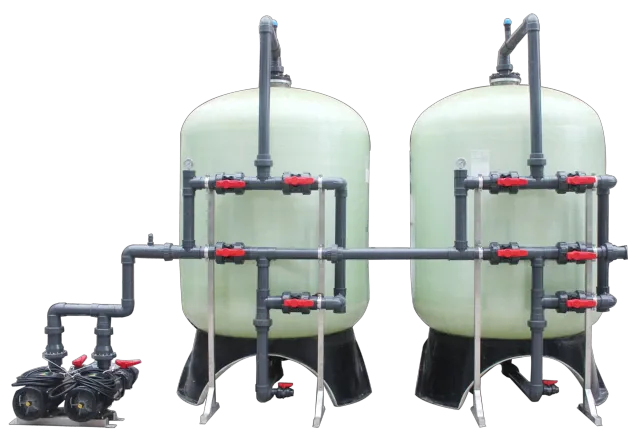
- Empty bed contact time
- 10–15 min Empty bed contact time
- Typical iodine value
- 700–1100 mg/g Typical iodine value
- Free chlorine at RO inlet
- <0.1 ppm Free chlorine at RO inlet
- Service velocity
- 5–15 m/h Service velocity
01
What does an activated carbon filter remove?
Activated carbon is a porous adsorbent made from coal, coconut shell, wood or nutshell. Its internal surface area is very large — typically 500–1,500 m² per gram — and dissolved molecules attach to that surface as water passes through the bed. A commercial carbon filter removes free chlorine, chloramine (more slowly), taste and odour compounds, colour, humic substances, some pesticides and solvents, and ozone. It does not remove dissolved salts, hardness, nitrate, fluoride or microorganisms.
Carbon filtration is a polishing and protection stage, not a complete treatment. It is placed after sand filtration, because turbidity blinds the carbon and shortens its life, and before softeners, RO membranes or UV units, because it removes the oxidants that damage them. In drinking-water plants it improves taste and removes the chlorine used upstream; in process water it protects membranes, ion exchange resin and stainless steel surfaces.
Carbon is not designed as a particle filter. Turbidity, rust and precipitated iron coat the grains and block the pores, so a sand filter or a cartridge precedes the bed in most designs. Carbon also supports bacterial growth once it has adsorbed organics, which is why backwashing, disinfection and a downstream barrier are part of a drinking-water design.
- Removes: free chlorine, chloramine, taste, odour, colour, humic matter and some organics
- Does not remove: dissolved salts, hardness, nitrate, fluoride or bacteria
- Placement: after sand filtration, before softener, RO or UV
02
How does adsorption work, and what is breakthrough?
Adsorption is a surface phenomenon. Organic molecules diffuse from the water into the carbon pores and bind to the surface; the capacity depends on the compound, its concentration, temperature, pH and the contact time available. The top layer loads first, and a concentration profile — the mass transfer zone — moves down through the bed as the bed becomes exhausted. When the zone reaches the bottom, the outlet concentration rises sharply: that is breakthrough.
Empty bed contact time, or EBCT, is bed volume divided by flow. It is a key design number because it compares systems of different sizes. For dechlorination, 10–15 minutes is typical; chloramine and strong organics need 15–20 minutes. Iodine value indicates micropore volume — 700–1100 mg/g is the common range for water-treatment carbons — but it is a laboratory index, not a guarantee of performance on a specific contaminant.
- EBCT = bed volume ÷ flow; doubling the flow halves the contact time
- Breakthrough is detected at the outlet, not predicted from the calendar
- Lower temperature slows kinetics; cold water needs more contact time
03
Which activated carbon form do you need — GAC or PAC?
Granular activated carbon (GAC) is held in a pressure vessel and treated water flows through it. It is the standard choice for continuous dechlorination, taste and odour control, and RO pretreatment, because the bed can be backwashed and the carbon replaced independently of the rest of the plant. Powdered activated carbon (PAC) is dosed as a slurry into the water, mixed, and removed later by coagulation, sedimentation or filtration.
PAC suits seasonal problems — an algal bloom, a temporary taste event — because it can be added only when needed and does not require a vessel. It is less efficient per kilogram, produces sludge and cannot be regenerated on site. Carbon block cartridges are a third option for small flows, point-of-use units and polishing after a GAC bed; they are not practical for large plants because of replacement frequency and pressure drop.
| Form | Contact method | Typical use | Advantage | Limitation |
|---|---|---|---|---|
| GAC | Fixed bed in a pressure vessel | Continuous dechlorination, RO pretreatment, taste and odour | Backwashable, predictable breakthrough, large flows | Larger footprint, periodic backwash water |
| PAC | Slurry dosed and mixed, then removed | Seasonal taste and odour, algal blooms, emergency dosing | Fast response, no vessel, dose on demand | Sludge, higher consumption, not regenerated on site |
| Carbon block | Cartridge in a housing | Point of use, small flows, final polish | Compact, easy replacement, fine filtration | High replacement frequency, limited capacity |
04
What empty bed contact time and iodine value should you specify?
Specify EBCT from the duty, not from the vessel size. For free-chlorine removal ahead of RO, 10 minutes is a common minimum; for chloramine, taste and odour, or a variable organic load, 15–20 minutes gives more margin. The same vessel at half the flow doubles the EBCT, so a unit sized at peak flow has extra contact margin at low flow; the risk at low flow is uneven distribution through the bed, not insufficient contact time.
Iodine value is a measure of micropore volume, reported in mg/g. Water-treatment carbons commonly fall in the 700–1100 mg/g range; higher values generally mean more capacity for small molecules such as chlorine and volatile organics, but they do not predict performance on colour or large organics. Ask for the iodine number, the apparent density, the mesh size and the raw material, and test the carbon against the actual contaminant where the duty is critical.
| Duty | Typical EBCT | Note |
|---|---|---|
| Free chlorine removal before RO | 10 minutes | Monitor outlet free chlorine below 0.1 ppm |
| Chloramine removal | 15–20 minutes | Slower kinetics; more carbon volume required |
| Taste, odour and colour | 10–15 minutes | Depends on the compound and its concentration |
| Organics and THM precursors | 15–20 minutes | Consider coagulation upstream |
Contact times are industry guidance; confirm by pilot or supplier isotherm data for critical duties.
05
Why is a carbon filter used before an RO membrane?
Polyamide RO membranes are attacked by free chlorine and other oxidants. The damage is not reversible: salt rejection falls and the element must be replaced. Most membrane manufacturers set a maximum of 0.1 ppm free chlorine at the inlet, and many specify zero. A carbon filter ahead of the RO removes the chlorine from municipal water; sodium bisulphite dosing is the alternative where carbon is impractical or where chloramine is present at high concentration.
Carbon also protects the RO from organic fouling. Humic acids, oils and some surfactants adsorb on the membrane surface and raise differential pressure; removing them upstream lowers SDI and extends cleaning intervals. The carbon must be followed by a 5 µm cartridge filter to catch carbon fines. Monitor free chlorine or ORP after the carbon bed, not before it, and replace the carbon on breakthrough rather than on a fixed date alone.
- Membrane limit: free chlorine below 0.1 ppm at the RO inlet, ideally zero
- Placement: after sand filter, before softener and RO; 5 µm cartridge after the carbon
- Monitoring: free chlorine or ORP at the carbon outlet, with an alarm
- Risk: exhausted carbon passes chlorine and can destroy a membrane in days
06
How is the carbon bed backwashed and when is it replaced?
Backwash removes trapped particles, carbon fines and biofilm, and reclassifies the bed. Use a rate that expands the bed by about 20–30% — typically 20–40 m/h for GAC — for 10–15 minutes, and backwash at least every one to two weeks or whenever the differential pressure rises. Over-aggressive backwash washes carbon to drain; under-backwash leaves the bed compacted and channelled. Air scour can help with heavy solids but is not universal.
Carbon is replaced when the outlet shows breakthrough: chlorine above 0.1 ppm, returning taste or odour, or rising UV254. In dechlorination service, 12–24 months is a common interval; in taste and odour service it may be shorter, and in clean municipal water with low chlorine it can be longer. Spent carbon is not hazardous in most drinking-water applications, but check local disposal rules and the contaminants it has adsorbed.
Backwash water can come from the treated-water line or from a dedicated tank. Use a sequence of backwash, rinse and return to service, and do not return the first rinse water to the product line. In dechlorination service, keep a spare carbon charge or schedule replacement before the projected breakthrough date so that a chlorine slip does not reach the membrane.
- Backwash when differential pressure rises 0.5–1 bar above the clean-bed baseline
- Replace on chlorine breakthrough, taste return or rising UV254, not only on age
- Allow for the backwash peak when sizing the supply, drain and pump
07
What are the design limits and typical specifications?
Carbon beds work over a wide pH range but adsorb most effectively at near-neutral pH; very high or low pH changes the charge of the carbon surface and the speciation of the contaminant. Water temperature affects kinetics, and cold water needs a longer contact time. Turbidity should be low — a sand filter or cartridge ahead of the carbon is standard — because particles coat the carbon and create a food source for bacteria. Stainless steel or FRP vessels are used, with a gravel support layer and a distribution system that avoids channelling.
Design the vessel for the backwash flow, not only the service flow, and leave enough freeboard for bed expansion. Provide sample taps before and after the bed, a differential-pressure gauge and a drain sized for backwash. For RO pretreatment, the carbon outlet should be monitored continuously for free chlorine or ORP, with an alarm and an automatic shutdown if the setpoint is exceeded.
| Parameter | Typical value |
|---|---|
| Empty bed contact time | 10–15 minutes |
| Iodine value | 700–1100 mg/g |
| Service velocity | 5–15 m/h |
| Bed depth | 0.8–1.5 m |
| Backwash bed expansion | 20–30% |
| Outlet free chlorine for RO feed | <0.1 ppm |
Values are typical industry ranges; final design follows the water analysis, carbon supplier data and membrane warranty requirements.
Specifications
Delivery and service — typical ranges
| Item | Typical range |
|---|---|
| Standard skid lead time | 15–30 days after drawing approval |
| Containerized / turnkey lead time | 30–60 days after drawing approval |
| Warranty | 12–18 months from shipment |
| Factory testing | Hydrostatic pressure test and trial run with water before packing |
| Documentation | General arrangement drawing, P&ID, test record, O&M manual and spare-parts list |
| Packaging | Seaworthy plywood crate, or container for containerized plants |
| Installation support | Remote guidance as standard; on-site engineer available on request |
| Operator training | 1–2 days at commissioning, covering operation, CIP and consumables |
| Spare parts | Recommended two-year list quoted separately with the equipment |
| Payment terms | Typically 30% deposit and 70% before shipment; confirmed in the quotation |
| Minimum order | 1 unit |
| Loading port | Guangzhou or Shenzhen, China |
| Power supply | 220/380/415/440 V, 50/60 Hz; confirmed on order |
| Ambient temperature | 5–40 °C |
| Enclosure protection | IP54 for indoor skids; higher IP available on request |
| Certification | CE and ISO 9001; model-specific test reports on request |
Typical industry ranges for planning. Final scope, commercial terms and lead time are confirmed in the quotation.
FAQ
Frequently asked questions
Questions buyers actually ask during sizing and quotation. Answers match the specifications above.
01 Does activated carbon remove chloramine?
02 Does carbon remove fluoride, nitrate or hardness?
03 Can a carbon filter make water safe to drink?
04 How often should carbon be replaced?
05 Why is chlorine harmful to an RO membrane?
06 Does a carbon filter need backwashing?
07 GAC or PAC — which should I choose?
08 What causes pressure drop or channelling in a carbon bed?
09 Where should the carbon filter sit in a treatment train?
Next step
Send your water analysis, get a factory quotation
Tell us the source water, TDS, hardness, iron and daily demand. Factory engineers reply with a flow rate, process train and budget range within one working day.