Split-stream filtration · 0.5–5 m³/h RO · softened kitchen water
Restaurant Water Filter System — Ice, Coffee, Dishwashing & Drinking Water
Quick answer
A restaurant water filter usually combines carbon pretreatment, a softener for dishwashers and steamers, and a small RO unit for ice, coffee and drinking water, with UV at the dispenser. Size it from seats at 15–30 L per seat per day, then check peak hourly flow.
- Planning demand per seat per day
- 15–30 L Planning demand per seat per day
- RO capacity range
- 0.5–5 m³/h RO capacity range
- UV dose at the dispenser
- 30–40 mJ/cm² UV dose at the dispenser
- Cartridge replacement
- 1–3 months Cartridge replacement
01
What water problems show up in a restaurant?
A restaurant combines four water uses with different quality needs: ice making, coffee and tea brewing, dishwashing and steam cooking. One incoming line rarely serves all four well. Chlorine and dissolved solids that are acceptable at a hand-wash sink become visible in a glass of ice, and hardness that passes through a dishwasher leaves film on glassware and scale on heating elements.
Ice is the most sensitive point. Freezing pushes dissolved salts toward the centre of the cube, so high TDS or hardness produces cloudy, brittle ice that melts quickly and dilutes drinks unevenly. Chlorine and chloramine carry odour into ice and cold brew. Coffee extracts aroma compounds, and chlorine binds them; high alkalinity neutralises the acids that give brightness, so the same beans taste flat.
Dishwashers and combi steamers are equipment problems rather than taste problems. At 200 ppm hardness, scale forms on heating elements and spray arms within months, raising energy use and service calls. Well water adds iron, manganese and turbidity, which stain fixtures and clog aerators. Water quality also changes with the season: municipal supplies switch sources, and well levels draw down in dry months. A filter sized on one test may be marginal six months later, so design for the worst case and keep pretreatment easy to upgrade.
- Cloudy ice, slow freezing and off-taste from high TDS and chlorine
- Scale on dishwasher elements, glassware film and spotting
- Flat coffee and tea from chlorine and high alkalinity
- Steamer and combi oven downtime from hard water
02
What water filter for ice machine do restaurants need?
Ice machines need low TDS and low hardness for clear, hard ice, plus carbon for chlorine and taste. A 0.5 µm carbon block is often enough where TDS is below about 300 ppm and hardness is controlled; above that, or when ice clarity is a selling point, use RO and blend a small fraction of bypass water to keep the ice slightly mineralised and the machine from becoming aggressive.
Feed the ice machine from its own line, not from the general kitchen supply. A dedicated line lets you set the blend for ice without changing the water at the coffee machine or steamer, and it gives the technician a sampling point. Keep the filter and the machine sanitation separate: the filter protects the water, but the ice bin, spout and auger still need the manufacturer’s cleaning schedule.
- Target: TDS below about 300 ppm, hardness below 120 ppm for clear ice
- Carbon: remove chlorine and taste before the machine
- RO: use when TDS or hardness is high; blend 10–20% bypass if needed
- Sanitation: filter protects water, not the ice bin or dispenser
03
How much water does a restaurant use, and how do you size the filter?
Sizing starts from two numbers: daily demand and peak hourly flow. For food service, a planning value of 15–30 L per seat per day is typically used for ice, beverages, kitchen preparation and washing. It is not the total building water demand, which also includes toilets and cleaning. Daily demand in cubic metres equals seats multiplied by litres per seat, divided by 1,000. If the restaurant is already trading, replace the estimate with 7–14 days of metered consumption; the meter usually shows a sharper morning prep peak than the seat count suggests.
Peak flow equals daily demand multiplied by a peaking factor of 1.5–2.0, divided by 8–10 operating hours, plus 10–15% margin. A 120-seat restaurant at 20 L per seat uses 2.4 m³/day; its peak is about 0.47 m³/h. A 0.5 m³/h RO unit with 1–2 m³ of storage covers the lunch and dinner rush without oversizing the membrane.
| Seats | Typical daily demand | Typical peak flow | Typical RO model |
|---|---|---|---|
| 30–50 | 0.5–1.5 m³/day | 0.25–0.5 m³/h | CK-RO-500L |
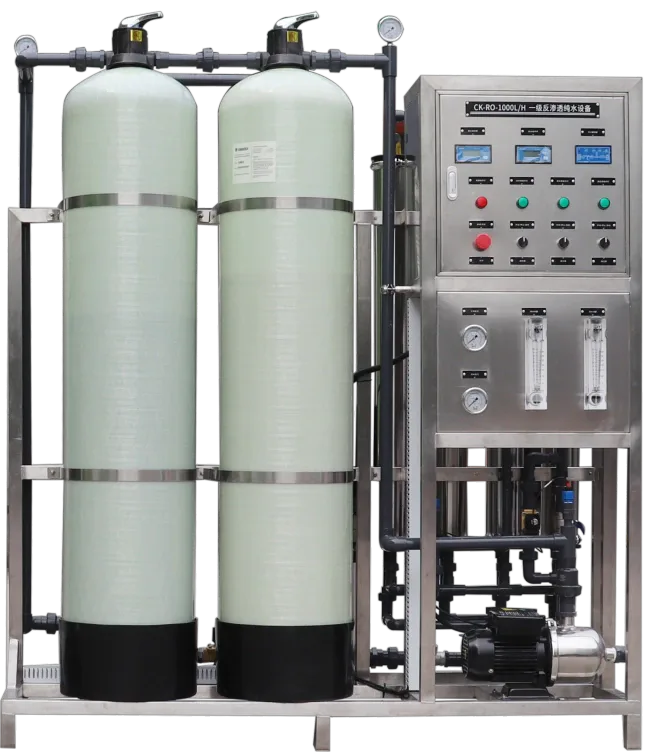
| 60–100 | 0.9–3.0 m³/day | 0.5–1.0 m³/h | CK-RO-1000L |
| 120–180 | 1.8–5.4 m³/day | 1.0–2.0 m³/h | CK-RO-2000L |
| 200–300 | 3.0–9.0 m³/day | 2.0–3.0 m³/h | CK-RO-3000L |
| 350–500 | 5.0–15.0 m³/day | 3.0–5.0 m³/h | CK-RO-5000L |
Typical planning values at 15–30 L/seat/day, 8–10 operating hours and a peaking factor of 1.5–2.0. Confirm against metered consumption and the water analysis.
04
Which treatment train does a restaurant need?
The most economical design is split-stream rather than treating every litre to drinking standard. Softened water feeds dishwashers, steamers, water heaters and hand-wash sinks; RO water feeds ice machines, coffee and tea brewers, cold brew and drinking points. The two branches share pretreatment but not the membrane, so capital and operating cost stay proportional to the actual need. Softening the kitchen branch also protects the RO from hardness carry-over if the two share a feed line, although the RO should still have its own cartridge guard.
Pretreatment follows the feed water. Municipal supply normally needs a 5 µm cartridge and activated carbon for chlorine, chloramine and odour. Hardness above 120 ppm as CaCO₃ calls for softening, which also protects the RO membrane. Turbid well water needs multimedia filtration first. The main stage is a 0.5–5 m³/h RO unit with 95–99% salt rejection; post-treatment is UV at 30–40 mJ/cm² and a storage tank on recirculation.
| Problem | Treatment stage | Typical equipment |
|---|---|---|
| Chlorine, chloramine and odour | Pretreatment | Activated carbon filter or carbon block |
| Hardness and scale | Pretreatment | Softener, 0.5–5 m³/h |
| Turbidity, iron and manganese | Pretreatment | Multimedia or sand filter |
| Dissolved salts and taste | Main stage | Reverse osmosis, 0.5–5 m³/h |
| Bacteria in storage and at the tap | Post-treatment | UV sterilizer and tank recirculation |
05
Which capacity and configuration fit your restaurant size?
Use the table below to move from daily demand to a complete train. Storage is normally sized for one to two hours of peak demand; if the ice machine and the coffee bar run at the same time, check the combined draw with a simultaneity factor of 0.8–0.9. Keep 10–15% spare capacity for membrane fouling and seasonal trade. For a new build, add the ice machine, coffee bar and drinking fountains as separate loads rather than one lump figure; the sum is usually more accurate than a per-seat estimate.
| Daily demand | Peak flow | Pretreatment | Main stage | Post-treatment |
|---|---|---|---|---|
| Up to 1 m³/day | 0.25–0.5 m³/h | 5 µm cartridge + carbon block | CK-RO-500L | UV + 1 m³ tank |
| 1–3 m³/day | 0.5–1.0 m³/h | Carbon + 0.5 m³/h softener | CK-RO-1000L | UV + 2 m³ tank |
| 3–6 m³/day | 1–2 m³/h | Carbon + 1–2 m³/h softener | CK-RO-2000L | UV + 3 m³ tank |
| 6–10 m³/day | 2–3 m³/h | Carbon + 2–3 m³/h softener | CK-RO-3000L | UV + 5 m³ tank |
| 10–15 m³/day | 3–5 m³/h | Multimedia + carbon + softener | CK-RO-5000L | UV + 5–8 m³ tank |
Table shows a single-stream RO option sized to the potable peak. With split-stream, downsize the RO to the drinking and ice branch and let the softener carry the kitchen peak.
06
What are the installation requirements for a restaurant?
A 0.5–1 m³/h skid needs about 1.5 × 1.0 m of floor, while a 2–3 m³/h system needs 2.5 × 1.5 m, with 2.2 m clear height and 0.8 m service access at the front. Provide a floor drain or a 100 mm channel so concentrate and backwash water can drain by gravity. Do not install the RO in a ceiling void or a sealed cabinet; membrane housings and pumps need inspection access. Allow space for replacing a 4040 or 8040 membrane element, which needs a straight pull of about 1.2 m.
Power is 220 V single phase up to 1 m³/h and 380 V three phase above 2 m³/h, with a dedicated breaker and earth. Feed pressure should stay between 2 and 4 bar; below 1.5 bar add a booster pump. Place the softener brine tank within 3 m of the valve head and leave a clear path for salt bags. Keep the UV unit after the storage tank, and recirculate the loop at least once every 24 hours to avoid stagnant water.
- Floor space: 1.5 × 1.0 m (small) to 2.5 × 1.5 m (medium)
- Floor drain within 1 m of the skid; no lift pump if possible
- Dedicated power circuit with earth leakage protection
- Brine tank within 3 m, on a level floor able to carry 200 kg
- Storage tank sized for 1–2 hours of peak demand
- Separate food-grade lines to ice, coffee and drinking points
07
How is a restaurant water system maintained?
Maintenance follows consumable intervals rather than taste complaints. Replace the 5 µm cartridge every one to three months, the carbon block every three to six months, and check softener salt weekly. Resin typically lasts three to five years, RO membranes two to three years, and UV lamps 9,000–12,000 hours. Record permeate flow, conductivity and pressure daily; a 10–15% drop in normalised flow means it is time to clean or investigate. Keep a log book at the skid; it is the fastest way to separate a fouled membrane from a failing pump.
Ice machines and coffee equipment also need their own sanitation schedule, because the filter protects the water but not the machine downstream. Clean ice bins and dispense spouts as the manufacturer specifies, backflush coffee machines daily, and sanitise the storage tank and loop quarterly. Keep a spare set of cartridges and a spare UV lamp on site so a failure does not stop service.
| Item | Interval | Action |
|---|---|---|
| 5 µm cartridge | 1–3 months | Replace; shorten interval if feed is turbid |
| Carbon block | 3–6 months | Replace; do not exceed rated volume |
| Softener salt | Weekly | Top up to half tank; break salt bridges |
| RO membrane | 2–3 years | Replace when rejection or flow drops |
| UV lamp | 9,000–12,000 h | Replace lamp and clean quartz sleeve |
| Storage tank and loop | Quarterly | Drain, sanitise and flush |
Specifications
Delivery and service — typical ranges
| Item | Typical range |
|---|---|
| Standard skid lead time | 15–30 days after drawing approval |
| Containerized / turnkey lead time | 30–60 days after drawing approval |
| Warranty | 12–18 months from shipment |
| Factory testing | Hydrostatic pressure test and trial run with water before packing |
| Documentation | General arrangement drawing, P&ID, test record, O&M manual and spare-parts list |
| Packaging | Seaworthy plywood crate, or container for containerized plants |
| Installation support | Remote guidance as standard; on-site engineer available on request |
| Operator training | 1–2 days at commissioning, covering operation, CIP and consumables |
| Spare parts | Recommended two-year list quoted separately with the equipment |
| Payment terms | Typically 30% deposit and 70% before shipment; confirmed in the quotation |
| Minimum order | 1 unit |
| Loading port | Guangzhou or Shenzhen, China |
| Power supply | 220/380/415/440 V, 50/60 Hz; confirmed on order |
| Ambient temperature | 5–40 °C |
| Enclosure protection | IP54 for indoor skids; higher IP available on request |
| Certification | CE and ISO 9001; model-specific test reports on request |
Typical industry ranges for planning. Final scope, commercial terms and lead time are confirmed in the quotation.
FAQ
Frequently asked questions
Questions buyers actually ask during sizing and quotation. Answers match the specifications above.
01 Do I need RO for ice and coffee, or is a carbon filter enough?
02 Why is my ice cloudy even with a filter?
03 Will softened water taste salty?
04 Can one system serve the whole restaurant?
05 What size RO unit does a 100-seat restaurant need?
06 How often should filters be changed?
07 Can the system be installed under the counter?
08 What feed pressure does the system need?
Next step
Send your water analysis, get a factory quotation
Tell us the source water, TDS, hardness, iron and daily demand. Factory engineers reply with a flow rate, process train and budget range within one working day.