Reverse osmosis · 0.5–50 m³/h · 50–75% recovery
Commercial RO System — Reverse Osmosis for Drinking & Process Water
Quick answer
A commercial RO system pushes water through a semi-permeable membrane at 10–25 bar to remove 95–99% of dissolved salts, nitrate, sulphate, heavy metals and microorganisms. A complete system includes pretreatment, high-pressure pump, membrane array, controls and CIP. HydroWorks builds 0.5–50 m³/h single- and two-stage systems, including RO+EDI and containerized units.
- Permeate capacity
- 0.5–50 m³/h Permeate capacity
- Recovery rate
- 50–75% Recovery rate
- Permeate conductivity
- ≤10 µS/cm Permeate conductivity
- Salt rejection
- 95–99% Salt rejection
01
What is a commercial RO system and how does it work?
Reverse osmosis is a pressure-driven separation. Feed water is pressurised above its osmotic pressure and forced across a polyamide composite membrane. Water molecules pass; dissolved salts, organics above roughly 200 Da, colloids and microorganisms are rejected and leave with the concentrate stream. A commercial system packages this process into a skid with pretreatment, a high-pressure pump, membrane housings, instrumentation, a control panel and a clean-in-place connection.
The three numbers that define a commercial RO system are permeate flow, recovery rate and salt rejection. Permeate flow is the product water you can use; recovery is permeate divided by feed; rejection is the percentage of salt removed. They interact: pushing recovery higher concentrates the brine, raises scaling risk and usually requires softening or antiscalant dosing.
- Typical operating pressure: 10–15 bar for brackish water, 15–25 bar for high TDS
- Membrane elements: 4040 and 8040 spiral-wound, depending on capacity
- Controls: PLC or relay logic, conductivity display, low-pressure and high-pressure protection
- Materials: stainless steel frame, FRP or stainless pressure vessels
02
What is an industrial RO plant?
An industrial RO plant is a reverse-osmosis train built for continuous duty, larger capacity or a process guarantee rather than intermittent commercial use. It usually adds instrumentation, PLC or SCADA control, redundancy, chemical cleaning and a defined concentrate route. Capacity is not the only difference: an industrial plant is specified by availability, recovery, permeate quality and the cost of downtime, not only by litres per hour.
The CK-RO series covers 0.5–50 m³/h per train, so many “industrial” duties are met by a single packaged unit. Above that, plants use duplicate membrane arrays, multiple trains or containerized modules. Ask for the design feed analysis, recovery, pump power, membrane array, control philosophy, footprint and spare-parts list when comparing an industrial quotation with a commercial skid.
- Continuous duty: 24/7 operation, standby pump or duplicate train
- Instrumentation: flow, pressure, conductivity, temperature, alarm and trend logging
- Serviceability: CIP connection, sampling points and accessible membrane housings
- Commercial route: concentrate disposal, power supply and footprint agreed before design
03
When should you use an ultrafiltration water treatment system?
An ultrafiltration water treatment system removes particles, colloids, bacteria and viruses by size, typically down to 0.01–0.1 µm. It does not remove dissolved salts, hardness or nitrate. Use it as RO pretreatment when the feed has high turbidity or SDI, or as a standalone barrier when the TDS is already acceptable but the microbiological or particulate load is not.
Compared with RO, UF runs at lower pressure, recovers a higher fraction of feed and keeps minerals in the water. That makes it a poor choice when the problem is salinity, nitrate or sodium, and a good choice when the problem is turbidity, algae or bacteria. The two processes are often combined: UF protects the RO, and the RO removes the dissolved salts that UF cannot.
- Removes: particles, colloids, bacteria, viruses, algae
- Does not remove: TDS, hardness, nitrate, sodium
- Typical roles: RO pretreatment, surface-water polishing, reuse barrier
04
Single-stage, two-stage or RO+EDI — which configuration do you need?
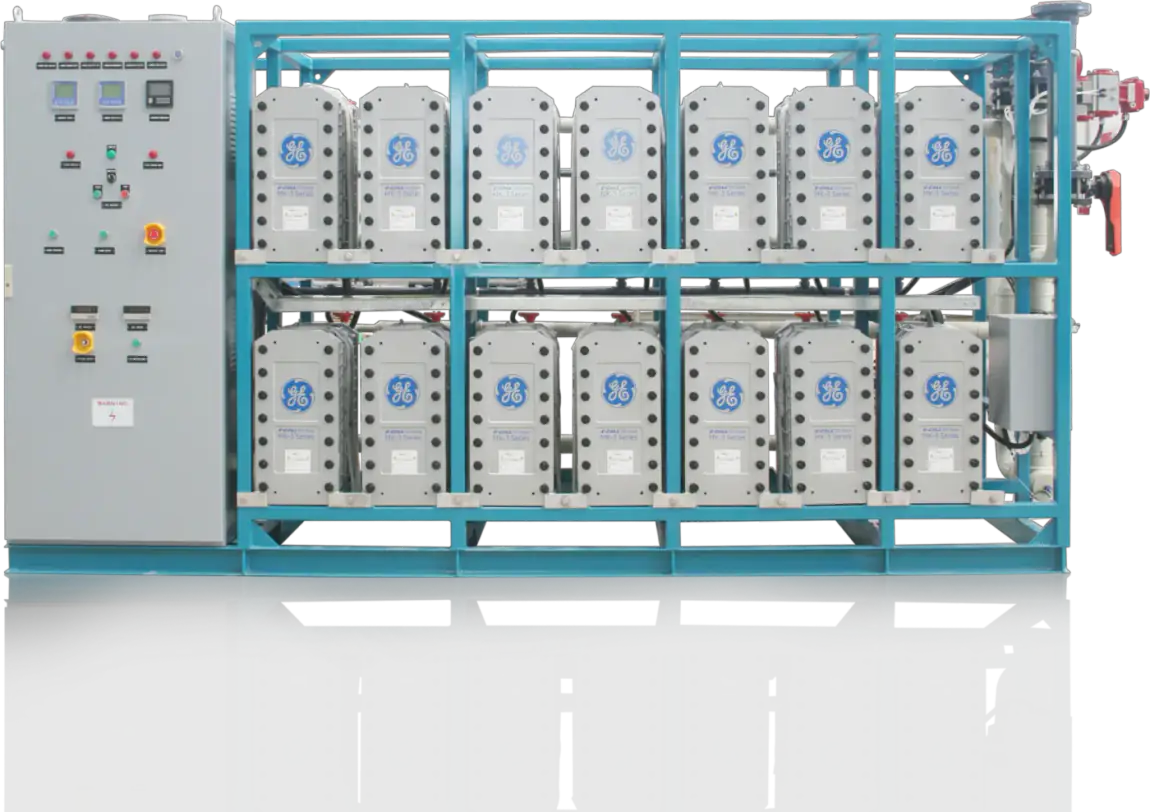
A single-stage system passes the water through the membrane once. It is the standard choice for drinking water, food service and general process water where 95–98% rejection is enough. A two-stage system passes the concentrate from the first stage through a second array, raising overall recovery to 65–75% and reducing wastewater. RO+EDI adds electrodeionisation after the RO to reach ultrapure water without chemical regeneration.
| Configuration | Recovery | Permeate quality | Best for |
|---|---|---|---|
| Single-stage RO | 50–65% | ≤10 µS/cm from ≤300 µS/cm feed | Drinking water, restaurants, hotels, general process |
| Two-stage RO | 65–75% | ≤5 µS/cm, lower wastewater | High TDS feed, water-scarce sites, boiler make-up |
| RO + EDI | 65–75% (RO stage) | >10 MΩ·cm ultrapure | Electronics, pharmaceuticals, cosmetics, laboratories |
| Containerized RO | 55–75% | ≤10 µS/cm | Remote sites, camps, rapid deployment |
05
What pretreatment does a commercial RO system need?
Membranes are damaged by chlorine, fouled by suspended solids and scaled by hardness and silica. Pretreatment is therefore selected against the feed analysis, not copied from a standard skid. The table shows the usual response to each risk; most systems combine two or three of them.
| Feed risk | Indicator | Pretreatment |
|---|---|---|
| Suspended solids | Turbidity > 1 NTU, SDI15 > 5 | Multimedia filter + 5 µm cartridge |
| Free chlorine | > 0.1 ppm | Activated carbon or bisulphite dosing |
| Hardness | > 120 ppm as CaCO₃ at high recovery | Softener or antiscalant |
| Iron and manganese | > 0.3 ppm Fe, > 0.05 ppm Mn | Oxidation + multimedia filtration |
| Organics and colour | High COD, taste and odour | Activated carbon, possibly coagulation |
| Bacteria | Positive microbiological count | Chlorination/dechlorination, UV downstream |
06
What recovery rate can you expect, and how much water is rejected?
Recovery is limited by the solubility of the salts left in the concentrate. At 50% recovery, half of the feed leaves as concentrate; at 75%, only a quarter does. Higher recovery means less wastewater but more scaling risk and higher pump pressure. For a 10 m³/h system, moving from 50% to 75% recovery cuts concentrate from 10 m³/h to 3.3 m³/h — a significant difference where water is metered or discharge is regulated.
Concentrate can be reused for toilet flushing, cooling tower make-up or irrigation when local rules allow and the salinity is acceptable. Where discharge is restricted, a two-stage arrangement or an additional concentrator may be justified, but it should be evaluated against the cost of water and discharge fees rather than added by default.
| Recovery | Permeate | Concentrate | Typical configuration |
|---|---|---|---|
| 50% | 5.0 m³/h | 5.0 m³/h | Single-stage, softener |
| 65% | 6.5 m³/h | 3.5 m³/h | Single-stage, antiscalant |
| 75% | 7.5 m³/h | 2.5 m³/h | Two-stage, softened feed |
Illustrative mass balance; actual recovery depends on feed chemistry, temperature and membrane array.
07
Which models and capacities are available?
The CK-RO series covers 0.5–50 m³/h in single-stage configuration. Motor power rises with capacity, and recovery improves as the array becomes larger. All models are quoted with pretreatment, controls and commissioning scope, because a bare membrane skid is rarely a working system.
| Model | Permeate (m³/h) | Motor (kW) | Recovery |
|---|---|---|---|
| CK-RO-500L | 0.5 | 1.5 | 50% |
| CK-RO-1000L | 1 | 2.2 | 50% |
| CK-RO-2000L | 2 | 3 | 50–60% |
| CK-RO-3000L | 3 | 4.5 | 55–65% |
| CK-RO-4000L | 4 | 6.5 | 55–65% |
| CK-RO-5000L | 5 | 8 | 60–70% |
| CK-RO-10T | 10 | 18 | 60–70% |
| CK-RO-20T | 20 | 30 | 65–75% |
| CK-RO-30T | 30 | 40 | 70–75% |
| CK-RO-50T | 50 | 70 | 70–75% |
Permeate conductivity ≤10 µS/cm at feed conductivity ≤300 µS/cm, 25 °C. Other feed conditions require a revised design.
08
What drives membrane life and operating cost?
Membranes typically last two to three years when pretreatment is right and CIP is done on schedule. The main cost drivers are replacement elements, feed pump energy, antiscalant or salt for softening, cartridge filters and labour. Fouling shows up first as rising differential pressure or falling permeate flow at constant pressure; scaling shows up as falling rejection and rising conductivity.
- CIP when normalized flow drops 10–15% or differential pressure rises 10–15%
- Replace cartridge filters every 1–3 months depending on feed turbidity
- Keep free chlorine below 0.1 ppm at the membrane inlet
- Log feed pressure, permeate flow and conductivity weekly
09
Can the RO system be skid-mounted or containerized?
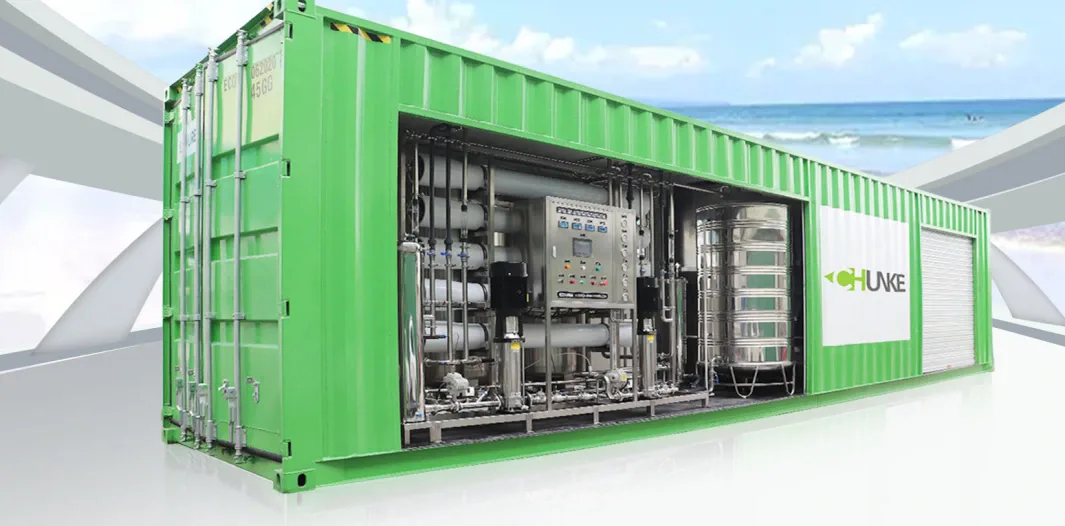
Yes. Systems from 4 to 25 m³/h can be built into a 20- or 40-foot container with pretreatment, RO, disinfection, controls and lighting, tested as a unit before shipment. Containerized systems suit remote sites, camps and projects where civil works are slow or where the plant may later be relocated. Skid-mounted systems are the usual choice when a plant room already exists.
Specifications
Delivery and service — typical ranges
| Item | Typical range |
|---|---|
| Standard skid lead time | 15–30 days after drawing approval |
| Containerized / turnkey lead time | 30–60 days after drawing approval |
| Warranty | 12–18 months from shipment |
| Factory testing | Hydrostatic pressure test and trial run with water before packing |
| Documentation | General arrangement drawing, P&ID, test record, O&M manual and spare-parts list |
| Packaging | Seaworthy plywood crate, or container for containerized plants |
| Installation support | Remote guidance as standard; on-site engineer available on request |
| Operator training | 1–2 days at commissioning, covering operation, CIP and consumables |
| Spare parts | Recommended two-year list quoted separately with the equipment |
| Payment terms | Typically 30% deposit and 70% before shipment; confirmed in the quotation |
| Minimum order | 1 unit |
| Loading port | Guangzhou or Shenzhen, China |
| Power supply | 220/380/415/440 V, 50/60 Hz; confirmed on order |
| Ambient temperature | 5–40 °C |
| Enclosure protection | IP54 for indoor skids; higher IP available on request |
| Certification | CE and ISO 9001; model-specific test reports on request |
Typical industry ranges for planning. Final scope, commercial terms and lead time are confirmed in the quotation.
FAQ
Frequently asked questions
Questions buyers actually ask during sizing and quotation. Answers match the specifications above.
01 How much does a commercial RO system cost?
02 Can RO remove bacteria and viruses?
03 How much water does an RO system waste?
04 What is SDI and why does it matter for RO?
05 What is CIP and how often is it needed?
06 Do I need a softener before the RO?
07 What is the difference between RO and UF?
08 What is the lead time?
09 How is the system commissioned?
Next step
Send your water analysis, get a factory quotation
Tell us the source water, TDS, hardness, iron and daily demand. Factory engineers reply with a flow rate, process train and budget range within one working day.