Turnkey & certification
Containerized Water Plant: Scope, Testing and Certification
Quick answer
A containerized plant is bought as one tested unit, but it is still a project: the container has to arrive on a foundation with power, water and drain ready, and the certification package has to match the unit that ships. This guide covers capacity, factory testing, site scope and the documents to request.
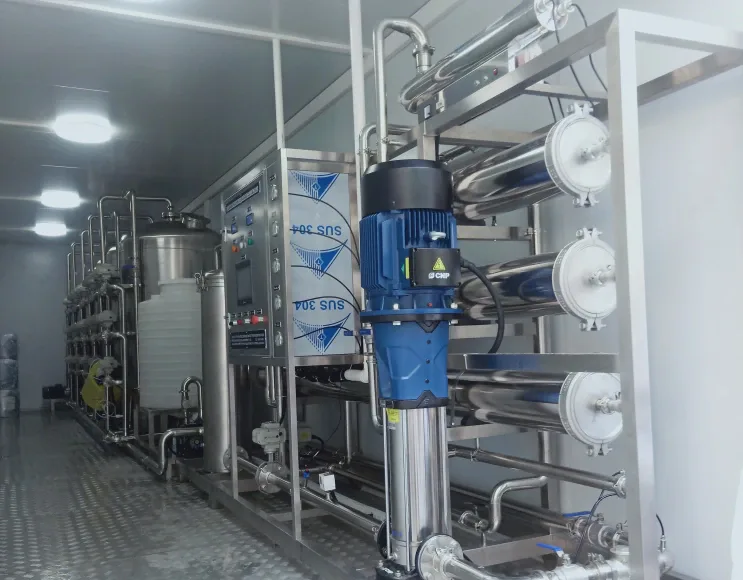
What is a containerized water treatment plant?
A containerized water treatment plant is a complete treatment train assembled inside a steel ISO container. It can include multimedia filtration, softening, dosing, reverse osmosis, UV or ozone, a control panel, lighting, ventilation and drains. Capacities run from 4 to 25 m³/h, in 20-foot and 40-foot containers. The container is not a shipping crate around loose equipment; it is the plant room, the weather protection and the structural base in one unit.
The process inside is the same as a site-built plant. The difference is where the work happens: fabrication, piping, wiring and testing move to the factory, while the site prepares a foundation and connects utilities. That shift is what makes a containerized plant attractive when the site is remote, the climate is harsh, the schedule is short or the plant may be relocated.
- 20-foot container: typically 4–10 m³/h with pretreatment
- 40-foot container: typically 10–25 m³/h, or more process steps
- Installed motor power: 7–30 kW depending on capacity
- RO recovery: 55–75%, depending on feed chemistry
What is inside a 20- or 40-foot container?
A typical train starts with raw water booster pumps, multimedia filters and a softener, followed by a 5 µm cartridge filter, high-pressure pump, RO membrane array, CIP connection, UV or ozone and a treated-water outlet. The control panel, cable tray, service lighting and drain channel run along the walls. Chemical dosing and a small clean-in-place tank can be included if the layout allows.
Raw water tanks, treated-water storage and large chemical tanks usually stay outside. They are heavy when full, they need maintenance access, and they would consume most of the container length. The general arrangement drawing should show exactly what is inside the container, what sits on a separate skid and what the buyer supplies locally.
Layout follows maintenance access, not packing density. Membrane housings need withdrawal space equal to the element length, filter vessels need headroom for media replacement, and the control panel should be readable from the door. A 40-foot container at 25 m³/h may have less free aisle than a 20-foot unit at 4 m³/h, because the membrane array fills the frame. Confirm aisle width and the lifting path on the drawing before fabrication.
| Item | 20-foot container | 40-foot container |
|---|---|---|
| Permeate flow | 4–10 m³/h | 10–25 m³/h |
| Pretreatment | Multimedia filter, softener, cartridge | Same, plus optional second filter or dosing |
| RO array | Single-stage, 4040 or 8040 elements | Single- or two-stage, 8040 elements |
| Disinfection | UV or ozone, mounted downstream | UV or ozone, with room for a larger reactor |
| Controls | PLC, conductivity display, alarms | PLC, data logging, remote signal |
| External items | Raw water tank, treated storage, drain | Raw water tank, treated storage, drain |
How is the plant tested before shipment?
Every container is assembled and tested as a unit. Testing begins with a pressure test of vessels, headers and piping, followed by an electrical inspection and instrument calibration. The plant then runs wet on feed water: pump rotation, permeate flow, recovery, conductivity, leak points and every alarm and interlock are checked. A test report with readings and photographs is issued before packing.
When representative feed water is not available, the wet test uses prepared water of similar conductivity and the report records the substitution. Membranes are loaded for the test, then preserved for transport; instruments are zeroed and ranged before packing. Photographs of the internal layout, pipe labels and panel help the site team compare the delivered unit with the tested one.
- 01
Pressure and leak test
Vessels, headers and piping are tested above working pressure; flanges and welds are inspected.
- 02
Electrical and control check
Panel wiring, motor rotation, instrument signals and safety interlocks are verified.
- 03
Wet test
The plant runs on feed water; permeate flow, recovery and conductivity are recorded.
- 04
Alarm and interlock test
Low pressure, high pressure, low level and conductivity alarms are triggered and checked.
- 05
Preservation and packing
Membranes are preserved, loose parts secured, openings sealed and the container prepared for sea freight.
What site work is needed before the container arrives?
The site scope is deliberately small: a level reinforced foundation, a power supply sized to the installed load, a raw water connection, a treated-water connection and a drain. The container arrives with its internal piping, wiring, lighting and controls complete, so no plant room is built and no long site wiring is pulled through a building.
Confirm four numbers before delivery: the foundation loading in kN/m², the supply voltage and frequency, the raw water pressure and flow at the connection, and the drain capacity during backwash. A container that arrives before the power cable is terminated becomes a very expensive storage box, and the standing time is usually charged to the party that owns the delay.
| Interface | Requirement | Who provides |
|---|---|---|
| Foundation | Level, reinforced, rated for operating weight, anchor points at corner castings | Buyer, to supplier drawing |
| Power | Cable and breaker sized to installed motor load and control voltage | Buyer to the container terminal box |
| Raw water | Flow and pressure at the inlet, with an isolation valve | Buyer to the container flange |
| Treated water | Connection to storage tank or distribution loop | Buyer, tank and pipework |
| Drain | Capacity for backwash, RO concentrate and regeneration | Buyer to the container drain |
The split is confirmed line by line in the quotation; the container is not a building and does not include local permits.
What does a turnkey contract include?
Turnkey means one contract covers the plant from design to operator training: design, manufacturing, factory testing, shipping, installation supervision, commissioning and training. The buyer still provides the foundation, power, water, drain, storage and permits. The boundary is the interface, and it should be written into the quotation rather than assumed. Commissioning at site usually takes 3–7 days, and the UV dose is verified at 30–40 mJ/cm² before handover.
| Stage | Supplier scope | Deliverable |
|---|---|---|
| Design | Water analysis review, process design, layout, electrical and piping drawings | Approved drawing set and equipment list |
| Manufacturing | Vessel fabrication, skid assembly, piping, wiring, panel building | Completed plant with nameplates and documentation |
| Factory testing | Pressure test, electrical check, instrument calibration, wet test | Test report, photographs and inspection record |
| Shipping | Preservation, packing, lifting plan, export documents | Container ready for transport |
| Installation | Installation manual, remote support or supervisor on site | Plant set, levelled and connected |
| Commissioning | Flushing, membrane loading, pressure and recovery setting, water test | Commissioning report and as-built notes |
| Training | Start-up, backwash, CIP and troubleshooting for operators | Training record and operation manual |
Which certifications and documents apply?
The certification package for a containerized plant normally covers four things: CE marking for the electrical and mechanical assembly, an ISO 9001 quality management certificate for the manufacturing process, high-tech enterprise recognition for the company, and patent certificates for specific design features. Each document has a different scope, and none of them is a water-quality certification.
CE marking is supported by a declaration of conformity and a technical file covering the applicable directives. ISO 9001 covers how the factory controls design, purchasing, production and inspection; it does not certify the performance of a particular model. High-tech enterprise status and patents describe research and intellectual property, not third-party test results. Model-specific test reports and factory run records fill that gap.
| Document | Issued by | What it covers | What it does not cover |
|---|---|---|---|
| CE declaration of conformity | Manufacturer, under EU directives | Electrical safety, EMC, machinery and pressure equipment as applicable | Drinking-water quality or membrane performance |
| ISO 9001 certificate | Accredited certification body | Quality management system at the factory | Product specifications or site performance |
| High-tech enterprise certificate | National authority | Research capability and technology status | Individual product compliance |
| Patent certificates | Intellectual property office | Specific design features and methods | Manufacturing quality or treated water quality |
| Model test report | Manufacturer or third-party laboratory | Flow, pressure, conductivity and safety checks for that model | Long-term field performance |
How do you verify certification scope in a tender?
Ask for the certificate, not a logo. Check the certificate number, the issuing body, the standard and the validity date. Then check the scope statement: a certificate for a trading company does not cover a factory, and an ISO 9001 certificate for one product line does not automatically cover another. For CE, request the declaration of conformity and the applicable directive list, and confirm that the electrical ratings on the nameplate match the declaration.
- 01
Check the legal entity
Confirm that the certificate holder is the company that will manufacture the plant.
- 02
Read the scope
Match the product description, model range and factory address to the offer.
- 03
Check validity
Verify the certificate is current and ask for the latest surveillance audit report.
- 04
Verify the body
Confirm the certification body is accredited for the standard and the scope.
What documents should accompany the shipped unit?
The document package should let the site team install, start and maintain the plant without calling the factory for routine questions. It normally includes the general arrangement drawing, P&ID, electrical schematic, terminal list, nameplate data, factory test report, operation and maintenance manual, spare parts list and the certification documents. The serial number on the nameplate should match the test report and the declaration of conformity.
Send the documents in the language the operators use, and keep one set in the control panel pocket and one in the site office. A test report that cannot be found during an inspection is treated as missing, even if it was issued. Where a third-party inspector is involved, agree the inspection points and the document list before fabrication, not after the container is packed.
FAQ
Frequently asked questions
Questions buyers actually ask during sizing and quotation. Answers match the specifications above.
01 What capacity fits in a 20-foot container?
02 Does the container include pretreatment?
03 What is tested at the factory?
04 Does a containerized plant need a building?
05 Which certificates come with the plant?
06 How long does commissioning take?
Related
Systems related to this article
Continue reading
Related technical guides
- Turnkey & certification Containerized vs Site-Built Water Treatment Plant Compare containerized and site-built water treatment plants on schedule, civil works, quality control, relocation and capacity, with a decision checklist.
- Turnkey & certification Turnkey Water Treatment Plant: Scope and Handover Turnkey water treatment scope: design, manufacturing, factory testing, shipping, installation, commissioning, training and clear site interfaces.
- Turnkey & certification What CE, ISO 9001 and Patents Actually Cover CE marking, ISO 9001, high-tech status and patents cover different things. Learn what each document proves, what it does not, and what to request in a tender.
Next step
Send your water analysis, get a factory quotation
Tell us the source water, TDS, hardness, iron and daily demand. Factory engineers reply with a flow rate, process train and budget range within one working day.