Turnkey & certification
Containerized vs Site-Built Water Treatment Plant
Quick answer
The process equipment can be identical; the difference is where it is assembled and how it is protected. A container moves fabrication and testing into a factory and leaves only foundation and connections on site. A plant room suits a site that already has a building. This guide compares the two on schedule, civil works, quality and relocation.
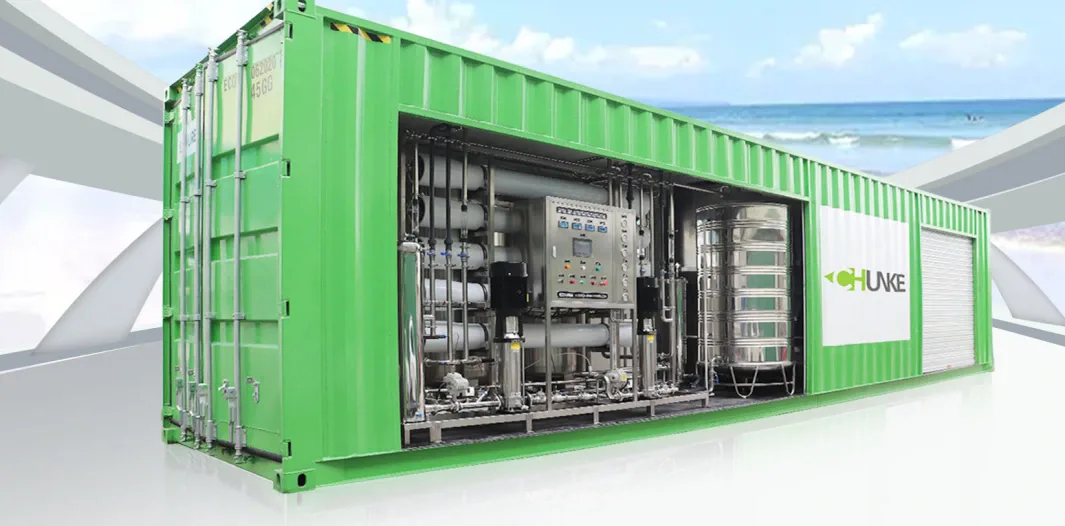
What is the real difference between containerized and site-built?
The treatment train is the same: pretreatment, reverse osmosis, disinfection and controls. A containerized plant puts that train inside a steel ISO container that provides walls, roof, lighting, ventilation, drainage and lockable access. Capacities are 4–25 m³/h in 20- and 40-foot containers. A site-built plant puts the same equipment inside a room built from concrete or steel on site. The process design, membrane array and instrumentation do not change with the enclosure.
The real difference is the boundary of factory work. In a container, piping, wiring, panel building and wet testing happen before shipment, under factory supervision. In a plant room, those tasks happen on site, after civil works, with local labour and weather in the schedule. That single shift explains most of the differences in schedule, quality and cost.
- Container: factory-assembled, factory-tested, relocatable enclosure
- Site-built: equipment installed into a permanent room
- Both: same pretreatment, RO, disinfection and control philosophy
- Both: require foundation, power, water and drain at the interface
Which option is faster to deliver and commission?
A containerized plant usually wins on schedule because factory work runs in parallel with site preparation. The container can be fabricated and tested while the foundation is poured and the power connection is arranged. A site-built plant is sequential: civil works must finish before equipment can be set, and piping and wiring follow the building, not the other way round.
Commissioning is also shorter for a container. Because the train was wet-tested in the factory, site work is limited to setting, anchoring, connecting utilities and repeating a short functional test. A site-built plant needs a longer flush, leak check and instrument loop check because those tasks were never done as a complete unit. In practice, a container is typically delivered in 4–9 weeks after drawing approval, while a site-built plant typically takes 14–24 weeks after site access.
Schedule risk matters as much as schedule length. A container is built once and tested once, so the critical path runs through factory capacity and shipping. A site-built plant has several critical paths: civil completion, steel delivery, trade sequencing and weather. Each additional path adds a chance of delay, and delay on a remote site costs more than delay in a factory.
| Stage | Containerized | Site-built |
|---|---|---|
| Civil works | Level foundation, 1–2 weeks | Building, drains, 8–16 weeks |
| Equipment fabrication | Parallel with civil works | Starts after building is ready |
| Site installation | Set, anchor and connect, 2–5 days | Set, pipe and wire, 2–4 weeks |
| Commissioning | 3–7 days, test repeated from factory | 1–2 weeks, first full wet test |
| Total, typical | 4–9 weeks after drawing approval | 14–24 weeks after site access |
Ranges depend on container size, customs, site access and weather; they are planning values, not commitments.
How do civil works and site labour compare?
A container needs a foundation and a cable trench, nothing more. The foundation is typically a reinforced concrete slab or strip footing sized for the operating weight and anchor points at the corner castings. A site-built plant needs a building with a floor, walls, roof, doors, lighting, ventilation, drainage and fire protection, plus the space and time to build it.
Site labour follows the same pattern. A container crew is small: a crane, a rigger, an electrician and a pipefitter for 2–5 days. A plant room needs civil contractors, steel erectors, plumbers, electricians and instrument technicians over 2–4 weeks, and each trade adds coordination and delay. Where local labour is scarce or expensive, the container reduces the site workforce and the number of interfaces.
| Factor | Containerized | Site-built |
|---|---|---|
| Foundation | Slab or strip footing with anchor points | Building foundation plus equipment plinths |
| Building | Not required | Walls, roof, doors, fire protection |
| Drainage | Container floor drain to site drain | Floor drains, trenches and sump |
| Ventilation | Integrated fans and louvers | Designed and installed on site |
| Site trades | Crane, rigger, electrician, pipefitter | Civil, steel, plumbing, electrical, instruments |
| Weather exposure | Low after the container is closed | High during construction and installation |
When is a containerized plant the better choice?
Choose a container when the site cannot support a permanent building, when the schedule is short, or when the plant may move. Remote communities, construction and mining camps, island and coastal sites, and temporary facilities all fit this pattern. The container also suits harsh climates because insulation, ventilation and corrosion protection are built into the enclosure rather than added by local contractors.
A second reason is quality control. Factory assembly and wet testing catch wiring errors, leaks and instrument faults before shipment, when correction is cheap. On a remote site, a missing cable gland or a reversed pump rotation can cost days of standing time and a second mobilization.
- No suitable building and no time to build one
- Remote, island, coastal or off-grid site
- Plant may be relocated within 3–5 years
- Short schedule with fixed commissioning date
- Harsh climate requiring a controlled enclosure
When is a site-built plant room better?
A site-built plant room wins when a suitable building already exists. The civil cost is then sunk, the space is available, and local contractors can install the equipment without the transport and lifting constraints of a container. This is common in factories, hospitals, hotels and municipal plants where a plant room was included in the original building.
Capacity also matters. The container range is 4–25 m³/h; above that, a site-built plant is the normal choice, because multiple containers and their interconnecting pipework become more complex than one large room. Very large pretreatment vessels, tall softeners and generous chemical storage are also easier to arrange in a building.
The third case is expansion. A plant room can add a second RO train, a larger tank or a new pretreatment step using the same walls and drains. A container expands by adding another container, which is clean but may not fit the available space or the existing pipe route.
- Building already exists and is structurally suitable
- Flow above 25 m³/h or very large pretreatment
- Local contractors available and freight to site is difficult
- Phased expansion planned within the same room
How do relocation, expansion and lifecycle differ?
A container is an asset that can be lifted onto a truck and moved. A 20-foot container is about 6.1 m long and a 40-foot about 12.2 m, so the lifting plan and site access must be checked before delivery. That matters for construction camps, temporary mining projects and leased sites. The move still requires disconnection, preservation, transport and re-commissioning, but it avoids writing off the treatment plant when the site closes. A plant room is effectively permanent; moving it means dismantling equipment and rebuilding the enclosure.
Maintenance access is comparable, but the container has less free space. Membrane withdrawal, filter media replacement and pump service all happen within the frame, so the layout must leave enough aisle. A plant room can be designed with wider access and a permanent maintenance bench. In both cases, the maintenance routine and spare parts holding determine reliability more than the enclosure type.
Operating cost follows the process, not the enclosure. Pump energy, membrane replacement, cartridges, salt and labour are the same for both options at the same flow and feed water. What differs is enclosure upkeep: a container needs coating inspection, door seals and ventilation fans; a building needs roof, walls and drains. Budget both over a 10-year horizon, and include a second mobilization if the site is remote.
How do you decide between the two?
Decide with 5 questions, in this order. The answers usually point to one option before any price comparison is made; if they do not, the site conditions are genuinely mixed and both should be priced.
- 01
Is there a suitable building?
If yes, price a site-built room first. If no, a container avoids the building entirely.
- 02
What flow is required?
Up to 25 m³/h fits a container; above that, a plant room is usually simpler.
- 03
How fixed is the site?
A leased or temporary site favours a relocatable container.
- 04
What labour is available?
Scarce or expensive local labour favours factory assembly.
- 05
What is the schedule?
A fixed commissioning date favours parallel factory work.
FAQ
Frequently asked questions
Questions buyers actually ask during sizing and quotation. Answers match the specifications above.
01 Can a containerized plant be expanded later?
02 Is a container cheaper than a building?
03 Does a container need a crane?
04 Can a container work in extreme cold?
05 Which option suits a 50 m³/h plant?
06 Can a site-built plant be pre-tested?
Related
Systems related to this article
Continue reading
Related technical guides
- Turnkey & certification Containerized Water Plant: Scope, Testing and Certification Containerized plants from 4–25 m³/h in 20- and 40-foot containers: factory testing, site connections, turnkey scope and CE, ISO 9001 and patent documents.
- Turnkey & certification Turnkey Water Treatment Plant: Scope and Handover Turnkey water treatment scope: design, manufacturing, factory testing, shipping, installation, commissioning, training and clear site interfaces.
- Turnkey & certification What CE, ISO 9001 and Patents Actually Cover CE marking, ISO 9001, high-tech status and patents cover different things. Learn what each document proves, what it does not, and what to request in a tender.
Next step
Send your water analysis, get a factory quotation
Tell us the source water, TDS, hardness, iron and daily demand. Factory engineers reply with a flow rate, process train and budget range within one working day.