Turnkey & certification
Turnkey Water Treatment Plant: Scope and Handover
Quick answer
Turnkey is a contract boundary, not a promise that the buyer does nothing. The supplier designs, builds, tests, ships, commissions and trains; the buyer prepares the site and provides utilities. Projects succeed when both lists are written down and the interfaces are inspected before the container or skid arrives.
What does turnkey mean for a water treatment plant?
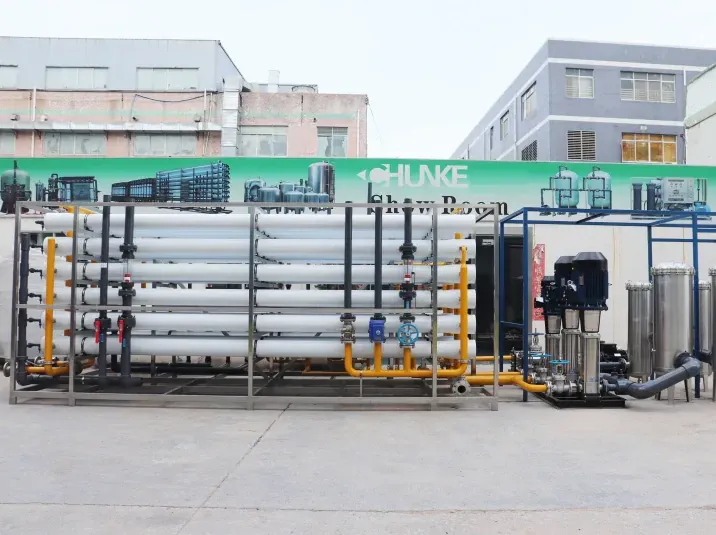
Turnkey means one contract covers the plant from design to operator training. A typical containerized scope covers 4–25 m³/h in a 20- or 40-foot container, with reverse osmosis at 10–25 bar and 50–75% recovery. The supplier takes responsibility for the process design, fabrication, factory testing, shipping documents, installation supervision, commissioning and training. The buyer remains responsible for the site: foundation, power, raw water, drain, treated-water storage and local permits. The plant is handed over in a condition that can be started by trained operators.
It is not the same as every item being in one company scope. A turnkey contract still has interfaces, and the interfaces are where most disputes occur. The useful definition is therefore narrower: turnkey means the supplier guarantees a working plant up to the agreed battery limits, and both parties know exactly where those limits sit.
Ask for the battery limits in writing. A turnkey price that does not state what is excluded cannot be compared with a lower price that lists exclusions. The two offers may differ by a storage tank, a transformer or a week of supervision, and those items usually cost more than the apparent difference in the equipment.
- One contract for design, equipment, commissioning and training
- Supplier guarantees a working plant to the agreed boundary
- Buyer provides site, utilities and permits
- Battery limits are listed, not implied
What is in the supplier scope?
The supplier scope normally follows seven stages. Design starts with a water analysis review and ends with an approved drawing set. Manufacturing covers vessel fabrication, skid assembly, piping, wiring and panel building. Factory testing includes pressure, electrical, instrument and wet tests. Shipping covers preservation, packing, lifting plan and export documents. Installation is handled by manual and remote support, or by a supervisor on site. Commissioning usually takes 3–7 days and proves flow, pressure, recovery and water quality. Training covers start-up, backwash, cleaning and troubleshooting. Typical lead time is 30–60 days after drawing approval, with factory testing completed before shipment.
| Stage | Work included | Deliverable |
|---|---|---|
| Design | Water analysis review, process design, layout, electrical and piping drawings | Approved drawing set and equipment list |
| Manufacturing | Vessel fabrication, skid assembly, piping, wiring, panel building | Completed plant with nameplates |
| Factory testing | Pressure test, electrical check, calibration, wet run, alarm test | Test report and inspection record |
| Shipping | Preservation, packing, lifting plan, export documents | Unit ready for transport |
| Installation | Manual, remote support, or supervisor on site | Plant set, levelled and connected |
| Commissioning | Flushing, membrane loading, set-points, water test | Commissioning report |
| Training | Start-up, backwash, CIP, troubleshooting | Training record and O&M manual |
What remains the buyer scope?
The buyer scope is the site and everything that touches it. That includes a level foundation designed for the operating weight, a power supply with cable and breaker sized to the installed load (typically 7–30 kW), a raw water connection at the agreed pressure and flow, a drain sized for backwash and concentrate, treated-water storage, and all local permits and inspections. Chemicals, spare parts beyond the initial set and local labour are also buyer items unless the quotation says otherwise.
Two items are often forgotten. The first is treated-water storage: the plant produces water, but it does not build the tank or the distribution loop. Storage is normally sized at 30–50% of daily demand, and the loop is a separate scope item. The second is the import and inland transport scope. A quotation that says FOB or CIF leaves customs clearance, inland haulage, unloading and site storage with the buyer, and those steps can delay commissioning as much as a manufacturing delay.
Verify readiness before shipment, not on arrival. Send the supplier photographs of the foundation, terminal box, raw water flange and drain, and ask for written confirmation that each interface is acceptable. This takes an hour and prevents the most expensive kind of delay: a plant that is complete, paid for and idle.
| Item | Typical requirement | Evidence at handover |
|---|---|---|
| Foundation | Level, reinforced, anchor points, cable trench | As-built drawing and level record |
| Power | Cable, breaker and earth to the terminal box | Insulation and earth test report |
| Raw water | Agreed flow and pressure at the inlet | Flow and pressure reading |
| Drain | Capacity for backwash, concentrate and regeneration | Drain capacity confirmation |
| Treated storage | Tank and distribution loop, sized for peak | Tank capacity and level control |
| Permits | Building, discharge, electrical and water permits | Permit copies |
Where do turnkey projects usually go wrong?
Most disputes are not about equipment quality; they are about readiness. Power is not terminated, the drain is undersized, the foundation is 50 mm out of level, or the treated-water tank has not been ordered. The plant arrives complete and cannot be started, and both parties begin counting standing time.
The second common failure is scope ambiguity around installation. A quotation may include commissioning but not installation supervision, or may include a supervisor for five days without stating what happens after day five. The third is acceptance: if the contract does not define the test conditions, flow, pressure and water quality, the handover can stall on a reading that nobody agreed to measure.
- Utilities not ready when the plant arrives
- Foundation level or loading outside tolerance
- Storage tank and distribution loop excluded but assumed
- Installation supervision days not defined
- Acceptance test conditions not written down
What happens during installation and commissioning?
Installation starts with setting and levelling the unit, anchoring it, and connecting power, raw water, treated water and drain. The supplier checks the interfaces against the drawing before energising. Commissioning then follows a fixed sequence so that each step is proven before the next begins. The sequence usually takes 3–7 days, including a 5 µm cartridge check and a UV dose verification at 30–40 mJ/cm².
Keep a commissioning log with date, time, reading and initials. The log becomes the baseline for later maintenance, and it is the first document an operator should check when permeate flow seems low. Without a baseline, every decline looks like a fault, and every fault looks like a membrane problem.
- 01
Flush and leak check
Flush piping and vessels, then pressure-test the train at 1.5 times design pressure and check every flange and joint.
- 02
Load membranes and media
Install membrane elements, load filter media, and set pretreatment flow rates.
- 03
Set pressure and recovery
Adjust the high-pressure pump, concentrate valve and recovery to the design point.
- 04
Verify water quality
Test conductivity, hardness, chlorine and turbidity against the agreed values.
- 05
Train operators and hand over
Walk through start-up, backwash, CIP and alarms, then sign the commissioning record.
What documents and training should be handed over?
The handover package should be usable without the supplier present. Keep 2 sets of documents: one in the control panel pocket and one in the site office. The package normally includes the general arrangement drawing, P&ID, electrical schematic, terminal list, factory test report, commissioning report, operation and maintenance manual, spare parts list and training record. Drawings should reflect as-built conditions, not the original design if changes were made on site.
Training should be hands-on, not a slide presentation. A 2-day session is usually enough for operators to start and stop the plant, perform a backwash, prepare a cleaning solution, read the pressure drop and interpret an alarm. Record who attended and which tasks they performed; a training record without a practical demonstration is weak evidence at handover.
- As-built drawings and P&ID
- Factory test report and commissioning report
- O&M manual in the operator language
- Spare parts list with recommended first-year stock
- Training record with practical tasks
How should the scope be written into the contract?
Write the scope as a matrix, not as a paragraph. Each row is an item, each column is a party, and every cell says supply, install, test or exclude. Attach the matrix to the quotation and make it part of the contract. Where a cell is unclear, treat it as excluded until it is agreed in writing; that is safer than assuming inclusion and discovering the gap at commissioning.
State the acceptance criteria in measurable terms: permeate flow in m³/h at a stated temperature, recovery percentage, permeate conductivity in µS/cm, and a continuous run of at least 4 hours. State who provides feed water, power and chemicals for the test, and what happens if those are not ready. Finally, list the documents that must be delivered before the final payment is released.
Use the same matrix for change orders. When the buyer adds a tank, moves the plant or changes the power supply, update the matrix and re-price the affected rows. A scope matrix that is not maintained becomes fiction within a month of contract signature.
| Item | Supplier | Buyer | Acceptance evidence |
|---|---|---|---|
| Process design | Supply | Review and approve | Approved drawing set |
| Treatment equipment | Supply and factory test | Review test report | Factory test report |
| Foundation | Drawing only | Build to drawing | Level and anchor record |
| Power and drain | Terminal data | Supply and connect | Electrical and drainage test |
| Commissioning | Perform and report | Provide utilities and operators | Signed commissioning report |
| Training | Deliver and record | Release operators | Training record |
Every cell should say supply, install, test, review or exclude; blank cells are the most common source of dispute.
FAQ
Frequently asked questions
Questions buyers actually ask during sizing and quotation. Answers match the specifications above.
01 Is turnkey the same as EPC?
02 Who arranges shipping and customs clearance?
03 Who provides the foundation?
04 What if site utilities are not ready on time?
05 What training is included?
06 How is acceptance defined?
Related
Systems related to this article
Continue reading
Related technical guides
- Turnkey & certification Containerized Water Plant: Scope, Testing and Certification Containerized plants from 4–25 m³/h in 20- and 40-foot containers: factory testing, site connections, turnkey scope and CE, ISO 9001 and patent documents.
- Turnkey & certification Containerized vs Site-Built Water Treatment Plant Compare containerized and site-built water treatment plants on schedule, civil works, quality control, relocation and capacity, with a decision checklist.
- Turnkey & certification What CE, ISO 9001 and Patents Actually Cover CE marking, ISO 9001, high-tech status and patents cover different things. Learn what each document proves, what it does not, and what to request in a tender.
Next step
Send your water analysis, get a factory quotation
Tell us the source water, TDS, hardness, iron and daily demand. Factory engineers reply with a flow rate, process train and budget range within one working day.