Softening & pretreatment
Water Hardness Levels: ppm, gpg and Softener Choice
Quick answer
Hardness is the sum of calcium and magnesium, and the number only becomes useful when it is compared with the equipment it touches. This guide converts ppm, gpg and German degrees, sets out four practical hardness bands, and explains when a softener is justified for heaters, laundries, boilers and RO feed.
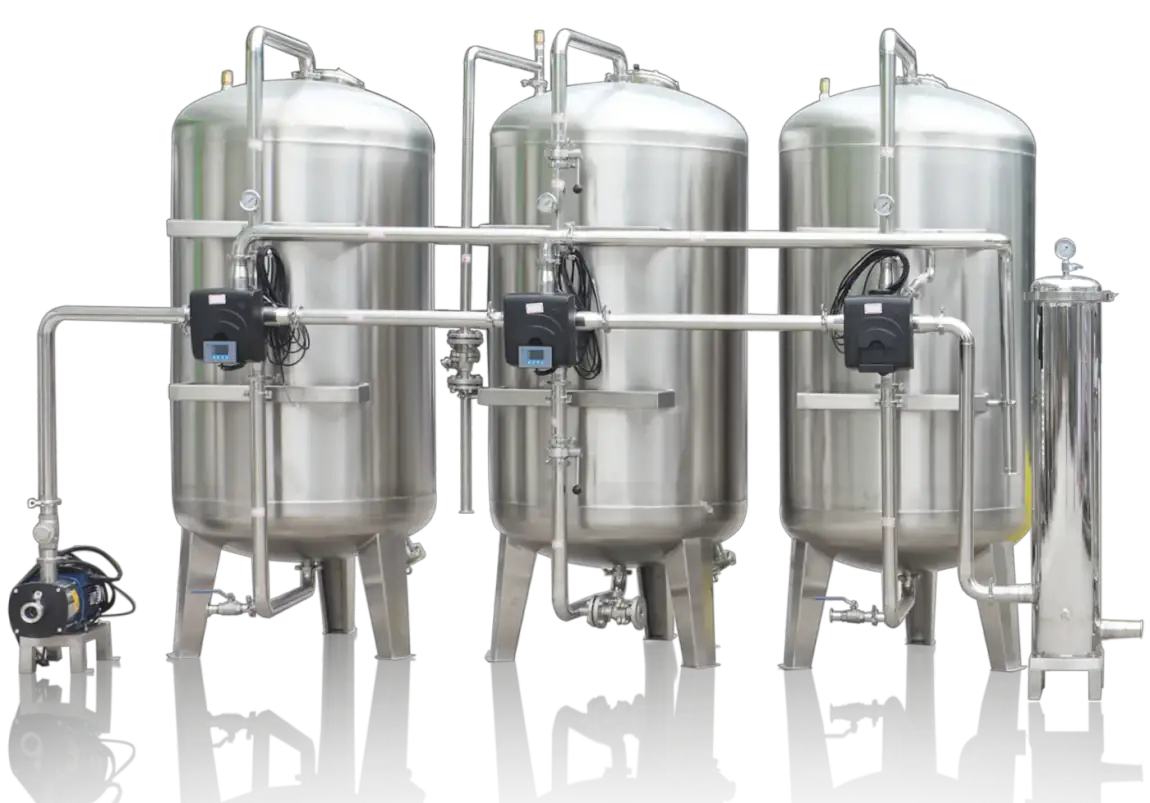
What is water hardness and how is it measured?
Hardness is the concentration of dissolved calcium and magnesium, expressed as an equivalent amount of calcium carbonate. The calculation is simple: multiply calcium in mg/L by 2.5 and magnesium in mg/L by 4.1, then add the two. A water with 80 mg/L calcium and 12 mg/L magnesium therefore has about 249 mg/L as CaCO₃. Other metals contribute in small amounts, but calcium and magnesium dominate in most supplies.
Field measurement usually uses an EDTA titration or a photometer. A titration kit gives a colour change at the endpoint and is accurate enough for routine checks; a photometer reads a coloured complex and is better for low hardness after softening. Test strips are acceptable for a first indication but not for sizing a softener, because a single colour block can cover 50 ppm or more.
| Unit | Equivalent as CaCO₃ | Example |
|---|---|---|
| mg/L (ppm) | 1 mg/L | 120 mg/L = 120 ppm |
| Grains per gallon (gpg) | 17.1 mg/L | 7 gpg = 120 mg/L |
| German degree (°dH) | 17.8 mg/L | 6.7 °dH = 120 mg/L |
| French degree (°f) | 10 mg/L | 12 °f = 120 mg/L |
Conversions are rounded. Confirm the unit on the laboratory report before comparing it with a softener selection table.
What are the four hardness bands?
The industry uses four bands: soft, moderately hard, hard and very hard. They are conventions, not regulatory limits, and different countries draw the boundaries a little differently. The bands are still useful because they connect a laboratory number to a visible effect — scale on a heater, soap that will not lather, or a softener that regenerates every day.
A supply at 90 ppm is not a problem for a cold-water line, but it may be a problem for a combi oven with a small heat exchanger. Conversely, 140 ppm is manageable for a toilet supply and unacceptable for a boiler. Read the band together with the temperature, the equipment and the daily volume, not as a verdict on its own.
| Band | mg/L as CaCO₃ | gpg | Typical effect and response |
|---|---|---|---|
| Soft | 0–60 | <3.5 | Little scaling; softening optional and rarely economic |
| Moderately hard | 61–120 | 3.5–7 | Decide by equipment, temperature and daily volume |
| Hard | 121–180 | 7–10.5 | Softening usually recommended for heaters and RO |
| Very hard | >180 | >10.5 | Softening required for boilers, laundry and RO feed |
Bands are industry conventions. The decision also depends on alkalinity, pH, temperature and the equipment being protected.
Is hard water a health risk?
No. The WHO Guidelines for Drinking-water Quality do not set a health-based guideline value for hardness, and calcium and magnesium are essential nutrients at ordinary concentrations. Hard water is a nuisance and a cost, not a contaminant. The health question that does arise is sodium: softening exchanges calcium and magnesium for sodium, adding roughly 8 mg/L of sodium per grain per gallon of hardness removed.
For most people the added sodium is small. It matters when the source is very hard and the softened water is the only drinking supply, or when a strict low-sodium diet is medically required. In that case, treat the drinking-water line with RO, soften only the hot-water and appliance lines, or blend softened water with a low-hardness stream.
At what hardness should you install a softener?
Below 60 ppm, a softener is rarely economic. Above 120 ppm, softening is usually justified; above 180 ppm, it is normally necessary for heaters, boilers and RO feed. Between 60 and 120 ppm the answer depends on the equipment. A coffee machine, combi oven, steam iron or hot-water cylinder concentrates scale on its hottest surface and may need protection at 80 ppm, while a cold-water toilet line does not.
For reverse osmosis, the usual trigger is hardness above about 120 ppm as CaCO₃ when recovery above 65% is required, or when sulphate and silica are high. For boiler make-up, the target is near-zero hardness with controlled blowdown. For laundry, 0–60 ppm protects heaters and reduces detergent use. These are starting points; the local water analysis and equipment warranty decide the final specification.
| Application | Typical target | Why |
|---|---|---|
| Drinking water | 80–150 mg/L as CaCO₃ | Taste and stability; hardness is not a health limit |
| Coffee and combi ovens | Below 60–80 mg/L | Small heat exchangers scale quickly |
| Laundry | 0–60 mg/L | Protects heaters and reduces detergent |
| Boiler make-up | Near zero | Scale on heat transfer surfaces reduces efficiency |
| RO feed | Below 120 mg/L, or softened | Controls calcium carbonate scaling at higher recovery |
Typical values only. Confirm against the equipment manufacturer requirements and the local drinking-water standard.
How does hardness affect RO, boilers and laundry?
In an RO system, hardness salts concentrate in the brine as recovery rises. Calcium carbonate and magnesium salts can precipitate on the membrane surface, raising differential pressure and reducing permeate flow. Softening removes the hardness ions before they reach the membrane, which allows higher recovery and longer cleaning intervals. The trade-off is sodium: softening raises the sodium content of the feed but does not lower TDS, so the RO still does the desalination.
In a boiler, scale on a heat transfer surface acts as an insulator. Even a thin layer forces a higher flue-gas or tube temperature, wastes fuel and can overheat tubes. Softened make-up plus controlled blowdown is the standard defence. In a laundry, hardness consumes detergent, forms soap scum on linen and leaves grey, stiff fabric; 0–60 ppm is a common target for both linen quality and heater protection.
How should you test hardness correctly?
Sample at the point where the softener will be installed, not downstream of an existing softener or after a storage tank that may have blended water. Take the raw-water sample before any treatment, and repeat it in the wet and dry seasons if the source is a borehole, river or reservoir. For a softener check, sample the outlet weekly and record the result next to the salt added and the regeneration count.
Use a titration kit or photometer and report the result as mg/L CaCO₃, with the unit stated. A result of 7 gpg is not comparable with a 120 ppm selection table until it is converted to 120 mg/L. If the outlet hardness rises above about 1 ppm, check for a salt bridge, a blocked injector or a control valve set to the wrong resin volume before assuming the resin is exhausted.
Should you soften all the water or only part of it?
Softening every litre is rarely necessary. In a hotel, guest bathrooms, laundry and boiler make-up benefit, while irrigation, toilet flushing and cooling tower make-up may tolerate harder water. A partial-softening layout reduces salt consumption and the volume of brine discharge, and it keeps some hardness in the drinking-water supply, which many people prefer for taste.
Where the softener is the only treatment before a drinking-water point, confirm the sodium level against the local standard and the needs of the building occupants. Where an RO follows, softening only the RO feed is often the cleanest arrangement: the resin is protected, the salt use is limited to the process stream, and the rest of the building keeps its original water.
How do you choose between a softener, antiscalant and RO?
A softener removes hardness; an antiscalant keeps hardness salts dispersed so they do not crystallise on a membrane; RO removes the salts altogether. They are not interchangeable. Softening is the robust choice for boilers, laundries and high-recovery RO. Antiscalant suits low-to-moderate hardness and moderate recovery, where salt consumption and brine discharge are a concern. RO is justified when the water also needs desalination, not merely softening.
A practical decision sequence is: measure hardness and alkalinity; list the equipment to be protected; set the maximum allowable hardness at each point; then choose the lowest-cost process that meets those limits and can be maintained on site. The CK-SF series covers 0.5–15 m³/h, so most building-scale duties fall inside one catalogue range, but the model is still selected from peak flow, inlet hardness and regeneration hours.
| Situation | Usual choice | Reason |
|---|---|---|
| Hardness above 180 ppm, boiler or laundry | Softener | Removes hardness at the source; protects heat transfer |
| Hardness 60–120 ppm, moderate flow | Softener or antiscalant | Decide by equipment sensitivity and salt cost |
| RO feed at 65% recovery or above | Softener or antiscalant | Prevents calcium carbonate scaling on the membrane |
| Hardness plus high TDS or nitrate | RO, with softening as pretreatment | Only RO removes dissolved salts |
| Very hard water, drinking supply only | RO for the drinking line | Avoids adding sodium to the drinking water |
Typical guidance. Final selection depends on the full water analysis, recovery target and local discharge rules.
FAQ
Frequently asked questions
Questions buyers actually ask during sizing and quotation. Answers match the specifications above.
01 What hardness is considered hard water?
02 How do I convert gpg to ppm?
03 Does a softener remove TDS?
04 Is softened water safe to drink?
05 Why does hardness matter more in hot water?
06 Can I blend softened and raw water?
07 How often should hardness be tested?
Related
Systems related to this article
Continue reading
Related technical guides
- Softening & pretreatment Softener, Sand & Carbon: Pretreatment Guide How sand filters, activated carbon and softeners work together before RO, with hardness thresholds, CK-SF capacities and media replacement rules.
- Softening & pretreatment Sand Filter Backwash: When, How Fast, How Long Backwash triggers, bed expansion, flow rates and rinse steps for sand and multimedia filters, with worked 10–30 m³/h examples and a rinse sequence.
- Softening & pretreatment When to Change Activated Carbon Filter Media Chlorine breakthrough, pressure drop, iodine value and UV254: how to tell when activated carbon is exhausted and how to replace it safely on site.
Next step
Send your water analysis, get a factory quotation
Tell us the source water, TDS, hardness, iron and daily demand. Factory engineers reply with a flow rate, process train and budget range within one working day.