Softening & pretreatment
When to Change Activated Carbon Filter Media
Quick answer
Activated carbon does not fail with a warning light. It fails when chlorine appears at the outlet, taste returns, or the bed stops backwashing properly. This guide explains the four signals that matter, what iodine value does and does not tell you, and how to replace a carbon charge without contaminating the downstream system.
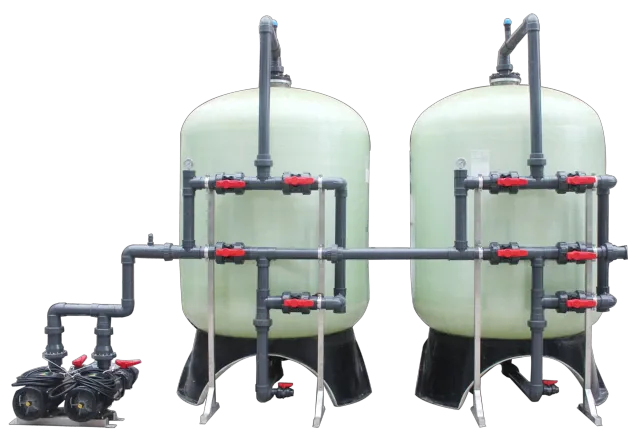
How do you know when activated carbon is exhausted?
Four signals matter, and they do not arrive together. The first is chlorine breakthrough at the outlet: free chlorine above 0.1 ppm on an RO feed, or a rising ORP reading. The second is a return of taste, odour or colour, often with a rising UV254 value. The third is a pressure differential that stays high after a correct backwash, indicating fouling rather than exhaustion. The fourth is simply time in service, which is the weakest signal on its own.
In dechlorination service, breakthrough is the decisive signal because the downstream membrane is at risk. In taste and odour service, the decisive signal is sensory: the water tastes or smells wrong again. In both cases, do not wait for all four. Replace when the signal that protects the most valuable downstream equipment crosses its limit.
| Signal | Threshold or observation | What it means |
|---|---|---|
| Free chlorine at outlet | Above 0.1 ppm, or rising trend | Breakthrough; membrane protection lost |
| Taste, odour or colour | Returns before the planned change | Adsorption capacity exhausted for that compound |
| UV254 | Rising from the commissioning baseline | Dissolved organics passing through |
| Differential pressure | 0.5–1 bar above clean-bed baseline after backwash | Fouling or compaction, not necessarily exhaustion |
| Time in service | 12–24 months in dechlorination duty | Planning guide only; confirm with tests |
Thresholds are typical. The binding chlorine limit is the membrane manufacturer requirement, usually 0.1 ppm or lower at the RO inlet.
What is chlorine breakthrough and why is 0.1 ppm the limit?
Activated carbon removes free chlorine by reducing hypochlorous acid and hypochlorite to chloride at the carbon surface. The reaction consumes carbon sites, so capacity declines gradually. At first the outlet chlorine is effectively zero; then it begins to appear in pulses as the mass transfer zone moves through the bed; then it passes continuously. The last stage can take only days, which is why a periodic grab sample is not enough on a critical RO feed.
Polyamide membranes are oxidised by free chlorine, and the damage is not reversible: salt rejection falls and the element must be replaced. Most membrane manufacturers set a maximum of 0.1 ppm at the inlet, and many specify zero. Monitor free chlorine or ORP at the carbon outlet, not at the inlet, and interlock the RO feed pump to stop or alarm on a high reading. Chloramine breaks through more slowly and needs 15–20 minutes of EBCT and a larger carbon volume.
What do differential pressure and backwash tell you?
A rising differential pressure means the bed is accumulating solids, biofilm or compacted fines. It is not proof that the carbon is chemically exhausted. Backwash at 20–40 m/h for 10–15 minutes, enough to expand the bed by 20–30%, every one to two weeks or when the differential rises 0.5–1 bar above the clean baseline. If the pressure stays high after a correct backwash, the bed may be fouled by iron, oil or biofilm and the carbon may need replacement even if chlorine has not broken through.
Backwash too strong washes carbon to drain and lowers the bed depth; too weak leaves the bed compacted and creates channels. Watch the sight glass and check the backwash flow, not only the timer. After any backwash, run a rinse at service flow and do not send the first turbid water to the product line. Carbon fines that escape the vessel will be caught by the 5 µm cartridge downstream, but that cartridge is a safety net, not a substitute for correct backwash.
What does iodine value tell you, and what does it not?
Iodine value measures micropore volume in mg/g. Water-treatment carbons commonly fall between 700 and 1100 mg/g, and a higher value generally means more capacity for small molecules such as chlorine and volatile organics. It is a useful purchasing specification because it distinguishes a genuinely activated carbon from a low-activity filler, but it is a laboratory index, not a prediction of the working capacity in your vessel.
Iodine value says little about colour removal, which depends more on mesopores and on the molecular size of the organics, and nothing about how long the carbon will last under a given chlorine load. Also ask for apparent density, mesh size, raw material and abrasion resistance. Where the duty is critical, run a column test with the actual water and measure breakthrough at the design EBCT rather than relying on a datasheet.
| Parameter | Typical value | Why it matters |
|---|---|---|
| Iodine value | 700–1100 mg/g | Micropore volume; capacity for small molecules |
| Empty bed contact time | 10–15 min dechlorination; 15–20 min chloramine | Contact time for adsorption to occur |
| Service velocity | 5–15 m/h | Avoids bed compaction and channeling |
| Bed depth | 0.8–1.5 m | Provides mass transfer zone and backwash room |
| Backwash expansion | 20–30% | Releases trapped solids without losing carbon |
| Outlet free chlorine for RO feed | Below 0.1 ppm | Protects polyamide membranes |
Typical ranges; final design follows the water analysis, carbon supplier data and membrane warranty.
How long does activated carbon last?
In dechlorination service, 12–24 months is a common interval. In taste and odour service with a high organic load, it may be shorter; in clean municipal water with low chlorine and a generous EBCT, it can be longer. The range is wide because carbon life depends on the chlorine concentration, the organic load, the EBCT, the backwash quality and the temperature, not on the calendar alone.
A plant that doubles its EBCT by halving the flow does not double the carbon life, but it does gain margin. Conversely, a plant that pushes flow above the design value shortens the mass transfer zone and can see early breakthrough even with a good carbon. Log the treated volume, not only the months, and compare the actual throughput with the design throughput before blaming the carbon supplier.
How do you replace the carbon charge correctly?
Replacement is a wet, dirty job that is easy to do badly. Isolate and drain the vessel, open the manway, and remove the spent carbon by vacuum or by a water ejector. Do not dump it through a valve. Inspect the distributor, collector and lining while the vessel is open, and replace any cracked or blocked internals before adding new media.
Load the new carbon to the design bed depth, backwash to classify the bed and remove fines, then rinse at service flow until the outlet is clear. Disinfect the vessel and downstream line before returning to drinking-water service, and replace the 5 µm cartridge after the first rinse. Test the outlet for chlorine, turbidity and, where required, bacteriological parameters before the water is released to the process.
- 01
1. Isolate, drain and open
Close inlet and outlet, relieve pressure, drain to the approved point and open the manway with the vessel depressurised.
- 02
2. Remove spent carbon
Vacuum or eject the media; keep it wet and contain the fines. Do not let spent carbon dry out and become airborne.
- 03
3. Inspect and load
Check internals and lining, then load new carbon to the recorded bed depth and confirm the freeboard for 20–30% expansion.
- 04
4. Backwash, rinse and test
Backwash to remove fines, rinse until clear, disinfect, replace the 5 µm cartridge and test chlorine, turbidity and bacteria before release.
What should you monitor between replacements?
The monitoring schedule should match the risk. On an RO feed, free chlorine or ORP at the carbon outlet should be continuous with an alarm; a weekly grab sample is a backup, not the primary defence. On a drinking-water carbon filter, turbidity, chlorine and a periodic bacteriological test are the minimum. On a taste and odour filter, sensory checks and UV254 are more useful than chlorine alone.
| Frequency | Check | Action if out of range |
|---|---|---|
| Continuous | Outlet free chlorine or ORP on RO feed | Alarm and stop the RO feed pump |
| Weekly | Differential pressure, outlet turbidity, visual sight glass | Backwash; investigate if pressure stays high |
| Monthly | UV254 or taste and odour check; actual backwash flow | Plan replacement if the trend is rising |
| Quarterly | Bacteriological test on drinking-water carbon | Disinfect or replace if positive |
| Annually | Bed depth, internals, lining, cartridge history | Top up, repair or schedule media change |
Adjust the schedule to the local drinking-water rules and the membrane warranty conditions.
Can spent carbon be regenerated or reused?
Granular carbon can be thermally regenerated off site, but the process is carried out by specialist facilities, not in the plant room. Regenerated carbon may have lower capacity and a different pore structure, so it is not automatically equivalent to virgin carbon for a critical duty. On-site steam or chemical regeneration is rare in building-scale plants and is not a substitute for replacement.
Spent carbon is not usually hazardous in drinking-water service, but it has adsorbed whatever was in the water, which may include organics, pesticides or metals. Check the local disposal rules, keep the material wet to avoid dust, and document the quantity and destination. If the carbon was used on an industrial stream, test the spent media before choosing a disposal route.
FAQ
Frequently asked questions
Questions buyers actually ask during sizing and quotation. Answers match the specifications above.
01 How often should activated carbon be replaced?
02 What is chlorine breakthrough?
03 Does a high iodine value guarantee good performance?
04 Why does the carbon bed pressure drop keep rising?
05 Can I top up carbon instead of replacing it?
06 Is it safe to drink water from a carbon filter?
07 What should be checked after a carbon change?
Related
Systems related to this article
Continue reading
Related technical guides
- Softening & pretreatment Softener, Sand & Carbon: Pretreatment Guide How sand filters, activated carbon and softeners work together before RO, with hardness thresholds, CK-SF capacities and media replacement rules.
- Softening & pretreatment Sand Filter Backwash: When, How Fast, How Long Backwash triggers, bed expansion, flow rates and rinse steps for sand and multimedia filters, with worked 10–30 m³/h examples and a rinse sequence.
- Softening & pretreatment Water Hardness Levels: ppm, gpg and Softener Choice Hardness bands in ppm, gpg and °dH, what each level does to heaters and RO membranes, and when a softener is worth installing for your building.
Next step
Send your water analysis, get a factory quotation
Tell us the source water, TDS, hardness, iron and daily demand. Factory engineers reply with a flow rate, process train and budget range within one working day.