Softening & pretreatment
Sand Filter Backwash: When, How Fast, How Long
Quick answer
A sand filter rarely fails because the media wears out; it fails because the bed is not cleaned properly. Backwash starts when differential pressure rises 0.5–1 bar above the clean baseline, runs at 40–60 m/h for 5–10 minutes, and ends with a rinse. This guide gives the triggers, the hydraulics and the checks.
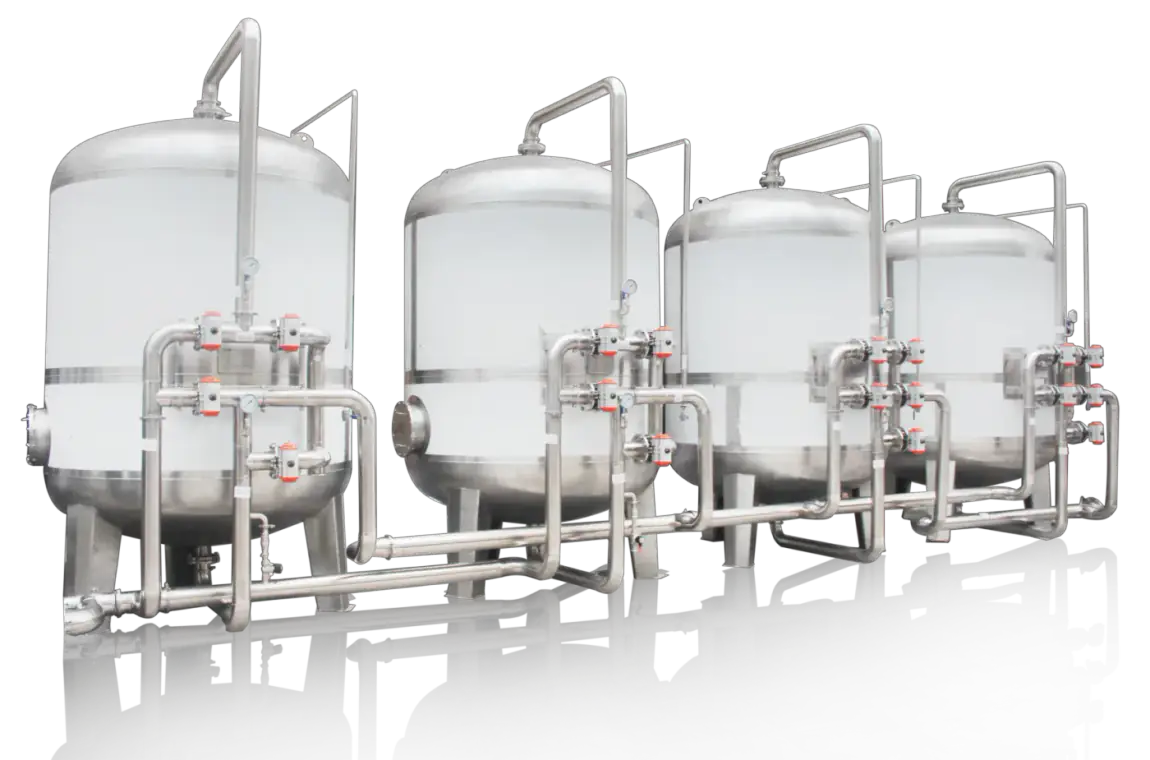
Why does a sand filter need backwashing?
During service, water enters the top of the vessel, passes down through the bed at 10–15 m/h and leaves through a collector at the bottom. Particles are captured in the top 100–200 mm of the media, where the grains are finest and the flow is first forced to change direction. As that layer fills, the resistance rises and the pressure differential across the bed climbs.
Backwashing reverses the flow upward. The bed expands by 20–30%, the grains separate and rub against each other, and the captured solids are flushed to drain. Without that expansion, the bed stays compacted, channels form, and the filter keeps producing water while bypassing the particles it was meant to remove. A clean bed is not a cosmetic issue; it is the difference between filtration and a leak.
When should you trigger a backwash?
Use two triggers and act on whichever comes first: differential pressure at 0.5–1 bar above the clean-bed baseline, or a fixed interval. Record the baseline after commissioning with a clean bed at the design flow. A filter that backwashes only on a timer can run blinded for days; one that backwashes only on pressure can sit dirty through a low-flow period when the differential never reaches the setpoint.
The interval is site-specific. A filter on a turbid river may need backwash once or twice a day; a filter on clean municipal water may run a week. If the filter backwashes every few hours, the problem is usually upstream: high turbidity, coagulant carry-over, algae or an undersized bed. Fixing the cause is cheaper than shortening the cycle again.
- Record the clean-bed differential pressure at design flow after every media change
- Set the pressure trigger at 0.5–1 bar above that baseline, not at an absolute gauge value
- Set a maximum interval as a backup, typically 24–72 hours on surface water
How fast and how long should backwash run?
Quartz sand typically needs 40–60 m/h of upward flow for 5–10 minutes, enough to expand the bed by 20–30% without carrying media to drain. That is roughly three to four times the service flow. A 10 m³/h filter may therefore draw 35–45 m³/h during backwash, and a 30 m³/h filter may draw 100–150 m³/h. The backwash pump, supply line and drain must be sized for that peak.
Lighter media need lower rates. Anthracite may fluidise at 25–40 m/h, and a multimedia bed usually sits between anthracite and sand at 35–50 m/h. Too high a rate washes the lightest grains out through the sight glass; too low a rate leaves the bed compacted. Watch the sight glass during the first minute and adjust to visible expansion, not only to the nameplate figure.
| Media | Backwash rate | Duration | Bed expansion |
|---|---|---|---|
| Quartz sand | 40–60 m/h | 5–10 minutes | 20–30% |
| Anthracite | 25–40 m/h | 5–10 minutes | 20–30% |
| Multimedia | 35–50 m/h | 6–12 minutes | 20–30% |
| Granular activated carbon | 20–40 m/h | 10–15 minutes | 20–30% |
Values depend on grain size, density, water temperature and freeboard. Confirm with the media supplier and observe expansion in the sight glass.
What does a complete backwash sequence look like?
A complete cycle has four parts: isolate the filter from the process, backwash, rinse, and return to service. If air scour is fitted, it runs before or during the first part of backwash for 1–3 minutes, then stops before the bed is fluidised. Air scour helps with heavy solids and multimedia beds but is not universal; on a simple sand bed, water-only backwash is usually enough.
Rinse at service flow for 2–5 minutes after backwash. The first rinse water is turbid and must go to drain, not to the product line. Return the filter only when the sight glass is clear and the outlet turbidity has fallen back to its normal value. If the plant has a treated-water tank, schedule backwash so that the tank covers the interruption rather than pulling the pressure down.
- 01
1. Isolate and depressurise
Close the inlet and outlet valves, open the drain path and confirm that the vessel is depressurised before moving any valve.
- 02
2. Air scour, if fitted
Run air at the design rate for 1–3 minutes to break up surface crust and loosen solids; stop air before the bed lifts.
- 03
3. Backwash to drain
Raise flow gradually to 40–60 m/h, check 20–30% expansion in the sight glass and hold for 5–10 minutes or until the waste water clears.
- 04
4. Rinse and return
Rinse at service flow for 2–5 minutes, verify outlet turbidity and differential pressure, then reopen the inlet and outlet in the correct order.
How much water does a backwash consume?
Backwash water is the backwash flow multiplied by its duration. For a 10 m³/h filter with a bed area of about 0.83 m², a 40 m/h backwash is 33 m³/h; eight minutes at that rate uses about 4.4 m³. A 30 m³/h filter with 2.5 m² of bed area at 50 m/h uses about 125 m³/h, or 10–20 m³ per event. As a share of production, that is typically a few percent, but it rises sharply when the filter runs short cycles.
The water must come from somewhere. If the raw-water supply is sized only for service flow, backwash will starve the process or fail to reach the design rate. A backwash storage tank is often cheaper than a larger supply main, and it lets the filter backwash at the design rate even when the source is intermittent. Check that the drain can take the peak without flooding the plant room.
| Service flow | Bed area | Backwash at 40–60 m/h | Water per 5–10 min |
|---|---|---|---|
| 5 m³/h | 0.42 m² | 17–25 m³/h | 1.4–4.2 m³ |
| 10 m³/h | 0.83 m² | 33–50 m³/h | 2.8–8.3 m³ |
| 20 m³/h | 1.67 m² | 67–100 m³/h | 5.6–16.7 m³ |
| 30 m³/h | 2.50 m² | 100–150 m³/h | 8.3–25.0 m³ |
Bed area calculated at 12 m/h service velocity. Actual figures depend on vessel diameter and design velocity.
What goes wrong when backwash is too weak or too strong?
Too weak: the bed does not expand, channels remain, and the differential pressure stays high after the cycle. The filter may still produce clear water for a while because the channels let water bypass the dirty media, then turbidity breaks through suddenly. Too strong: the lightest grains leave through the sight glass, the bed depth falls, and the remaining media is coarser, so outlet turbidity rises even though the vessel looks clean.
A third failure is a backwash that runs long enough but never reaches the design flow, usually because a valve is partly closed, the pump is worn or the supply line is undersized. The operator sees a normal timer and a normal valve position, but the bed is only half cleaned. Install a flow indicator on the backwash line and record the actual rate, not just the duration.
| Symptom | Likely cause | Check |
|---|---|---|
| Media in the sight glass | Backwash rate too high or freeboard too low | Flow rate, bed expansion, media depth |
| Differential stays high after backwash | Bed not expanded, channels, oil or biofilm | Actual backwash flow, sight glass, media condition |
| Turbidity breaks through suddenly | Channelling or exhausted media | Media inspection, outlet turbidity trend |
| Short runs, frequent backwash | High inlet solids, coagulant carry-over, undersized bed | Raw turbidity, coagulant dose, service velocity |
Fix the cause before increasing backwash frequency. More backwash on a blinded bed only wastes water.
How do you verify that the bed is actually clean?
Three checks are enough for routine operation. First, watch the sight glass: the waste water should start dark, clear within a few minutes and show 20–30% bed expansion without grains leaving. Second, compare the differential pressure immediately after backwash with the clean-bed baseline; a persistent gap means incomplete cleaning. Third, check outlet turbidity after the rinse and confirm it has returned to the normal value before the filter goes back online.
Every month, measure the actual backwash flow and duration, and inspect the media through the top manway. Every year, check bed depth against the design, look for cracks in the distributor and collector, and confirm that the freeboard is still sufficient. If the bed remains blinded after a correct backwash, or if channelling is visible, the media may be coated or exhausted rather than merely dirty.
- Weekly: record differential pressure before and after backwash, plus outlet turbidity
- Monthly: verify actual backwash flow, duration and bed expansion
- Yearly: measure bed depth, inspect internals and top up lost media
When should the filter media be replaced?
Sand and anthracite are usually replaced every three to five years, but age alone is a poor trigger. Replace sooner if the bed stays blinded after a correct backwash, if channelling persists, if the media is coated with oil or biofilm, or if the bed depth can no longer be maintained because grains are being lost. A filter that needs backwash every few hours after media inspection usually has a media problem, not a valve problem.
When replacing, record the vessel diameter, bed depth and design velocity on the nameplate. Refill to the design depth with media that matches the original gradation, backwash to classify the bed, and disinfect the vessel before it returns to drinking-water service. Mixing a new coarse layer over an old fine layer usually produces worse filtration than replacing the whole bed.
FAQ
Frequently asked questions
Questions buyers actually ask during sizing and quotation. Answers match the specifications above.
01 How often should a sand filter be backwashed?
02 What is the correct backwash flow for a 10 m³/h sand filter?
03 Can I backwash with treated water instead of raw water?
04 Why is media escaping through the sight glass?
05 Does a sand filter remove iron and manganese?
06 How much water does backwashing waste?
Related
Systems related to this article
Continue reading
Related technical guides
- Softening & pretreatment Softener, Sand & Carbon: Pretreatment Guide How sand filters, activated carbon and softeners work together before RO, with hardness thresholds, CK-SF capacities and media replacement rules.
- Softening & pretreatment When to Change Activated Carbon Filter Media Chlorine breakthrough, pressure drop, iodine value and UV254: how to tell when activated carbon is exhausted and how to replace it safely on site.
- Softening & pretreatment Water Hardness Levels: ppm, gpg and Softener Choice Hardness bands in ppm, gpg and °dH, what each level does to heaters and RO membranes, and when a softener is worth installing for your building.
Next step
Send your water analysis, get a factory quotation
Tell us the source water, TDS, hardness, iron and daily demand. Factory engineers reply with a flow rate, process train and budget range within one working day.