Softening & pretreatment
Softener, Sand & Carbon: Pretreatment Guide
Quick answer
Most pretreatment problems come from the wrong stage order or a stage nobody inspects. Sand filtration removes turbidity to about 100 µm, activated carbon removes chlorine, and a softener removes hardness above roughly 120 ppm. This guide explains what each stage does, how the CK-SF series covers 0.5–15 m³/h, and when media must be replaced.
What does a pretreatment train do before reverse osmosis?
A reverse osmosis membrane removes 95–99% of dissolved salts, but it is not a filter. It needs feed water that is low in suspended solids, free of oxidants and inside a hardness envelope. Pretreatment exists to deliver those three conditions, and each stage has one job: sand filtration removes turbidity, activated carbon removes chlorine and organics, and a softener removes calcium and magnesium.
The usual order is sand filter, activated carbon, softener, 5 µm cartridge, then the RO. The order matters more than the number of stages. Carbon placed after the softener would expose the resin to the full chlorine load; a softener placed before the sand filter would be fouled by turbidity. Adding a fourth vessel rarely fixes a sequence that was wrong from the start.
What does the sand filter remove, and where does it sit?
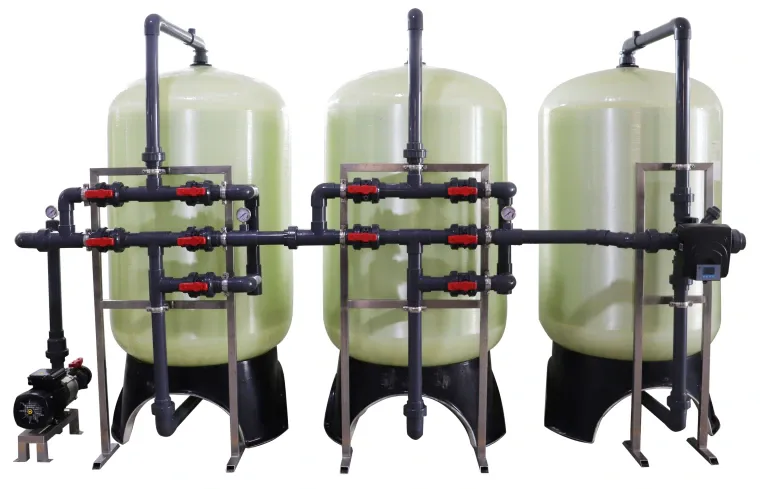
A sand or multimedia filter is a pressure vessel packed with graded quartz sand, anthracite or both. Water passes down through the bed at 10–15 m/h, and particles down to about 100 µm are captured. From feed up to 100 NTU, the outlet is typically ≤5 NTU. The sand filter series covers 0.5–50 m³/h with motors from 0.37 to 7.5 kW, and each vessel is sized from bed area rather than from a nominal model number.
The filter sits first because everything downstream prefers clear water. Turbidity blinds carbon, coats resin and fouls membranes. A sand filter does not remove dissolved salts, hardness, nitrate or colour; it is a physical barrier only. When the source is above about 50 NTU, runs shorten and backwash water use rises quickly, so coagulation or settling should come before the filter rather than a larger vessel after it.
- Filtration accuracy: about 100 µm; outlet ≤5 NTU from feed up to 100 NTU
- Service velocity: 10–15 m/h; backwash 40–60 m/h for 5–10 minutes
- Backwash trigger: 0.5–1 bar above the clean-bed differential pressure
When does hardness justify a softener?
Hardness is calcium and magnesium, measured as mg/L calcium carbonate. Below 60 ppm, scale forms slowly and a softener is rarely economic. Between 60 and 120 ppm the decision depends on temperature and equipment: a coffee machine, steam boiler or hot-water cylinder may still need protection, while a cold-water line may not. Above 120 ppm, softening is usually justified; above 180 ppm it is normally necessary for heaters, boilers and RO feed.
The common units are easy to confuse. One grain per gallon is 17.1 mg/L as CaCO₃, one German degree is 17.8 mg/L, and one French degree is 10 mg/L. A report in gpg therefore needs conversion before it can be compared with a selection table. Hardness is not a health parameter, but it is a cost parameter: it shortens heat exchanger life and raises detergent use in laundries.
What does the CK-SF softener cover?
The CK-SF series covers 0.5–15 m³/h in eight catalogue sizes. Resin vessels run from 844 to 3672, resin charges from 30 to 650 kg and brine tanks from 25 to 800 L. Outlet hardness stays below about 1 ppm as CaCO₃ until the resin approaches exhaustion. Automatic valves meter treated volume and start regeneration, which typically takes 60–90 minutes.
Salt is the main consumable. A practical setting is 80–160 g of salt per litre of resin per regeneration, with brine at 8–12%. The theoretical minimum is about 1.2 kg sodium chloride per kilogram of hardness removed; real plants use roughly twice that because regeneration is not perfectly efficient. Twin-tank units alternate so that softened water continues to flow while one vessel regenerates.
- Inlet pressure: 2–6 bar dynamic; below 2 bar brine draw becomes unreliable
- Resin life: 5–10 years in municipal water; chlorine shortens it
- Test outlet hardness weekly with a titration kit or photometer
| Model | Softened water (m³/h) | Typical application |
|---|---|---|
| CK-SF-500L | 0.5 | Cafe, clinic, small laboratory |
| CK-SF-1000L | 1 | Restaurant, small guesthouse |
| CK-SF-2000L | 2 | Guesthouse, small laundry |
| CK-SF-3000L | 3 | Hotel, laundry |
| CK-SF-5000L | 5 | Hotel, laundry, process water |
| CK-SF-10T | 10 | Resort, campus, boiler feed |
| CK-SF-15T | 15 | Large hotel, district boiler feed |
Series range: resin vessels 844–3672, resin charge 30–650 kg, brine tanks 25–800 L. Confirm the vessel and resin charge against inlet hardness and the regeneration schedule.
Why does activated carbon sit between the sand filter and the softener?
Activated carbon removes free chlorine, chloramine, taste, odour and dissolved organics by adsorption. In a pretreatment train its most important job is dechlorination: free chlorine above 0.1 ppm oxidises polyamide RO membranes, and the damage is irreversible. It also protects cation resin, which chlorine degrades over time, and it lowers the organic load that would otherwise foul the membrane.
Design is set by empty bed contact time, not by vessel volume alone. Dechlorination typically needs 10–15 minutes of EBCT; chloramine, taste and odour need 15–20 minutes. Water-treatment carbons commonly have an iodine value of 700–1100 mg/g and a surface area of 500–1500 m²/g, but iodine value describes micropore volume and does not guarantee removal of a specific contaminant.
Carbon is also the stage most often left without monitoring. Chlorine breakthrough can reach a membrane within days of resin exhaustion, so a sample tap and a chlorine or ORP analyser at the carbon outlet are not optional on an RO feed. Replace the carbon on breakthrough, not only on a calendar date.
Which stage order and sample points should you specify?
Specify sample taps before and after every stage, pressure gauges across each bed, and a drain sized for backwash. The sand filter and carbon filter need backwash flow several times the service flow, so the raw-water supply and drain must be checked against that peak, not against the product flow. A train that cannot backwash itself will pass water quality only until the first dirty bed.
| Stage | Removes | Key design value | Monitor |
|---|---|---|---|
| Sand / multimedia filter | Suspended solids down to 100 µm | 10–15 m/h service; 40–60 m/h backwash | Differential pressure, outlet turbidity |
| Activated carbon | Free chlorine, chloramine, taste, organics | 10–15 min EBCT; iodine 700–1100 mg/g | Outlet free chlorine or ORP, UV254 |
| Softener | Calcium and magnesium | 0.5–15 m³/h; outlet below 1 ppm | Outlet hardness, salt level, regeneration count |
| 5 µm cartridge | Carbon fines and residual particles | Differential pressure below 0.5 bar | Cartridge pressure drop, replacement date |
Place the cartridge after the carbon bed, never before the sand filter. Carbon fines and media fragments must not reach the membrane.
How do you size the train from peak flow and water analysis?
Start with the laboratory analysis and the peak hourly flow, not the daily volume. Size the sand filter at 10–15 m/h bed velocity, the carbon filter at 5–15 m/h with 10–15 minutes EBCT, and the softener from peak flow, inlet hardness and the hours available between regenerations. Then check that the backwash peak can be supplied without starving the process. For a 10 m³/h sand filter, backwash may demand 35–45 m³/h for 5–10 minutes.
A train sized only on average flow will pass water quality on paper and fail in summer. Peak demand, backwash demand and regeneration downtime are the three numbers that decide whether the plant keeps running. Write them on the design sheet together with the maximum inlet turbidity, hardness and chlorine, so that a later capacity change can be checked against the original assumptions.
What maintenance schedule keeps the train reliable?
Weekly, record pressure differential across the sand and carbon beds, outlet hardness and carbon outlet chlorine. Monthly, verify backwash flow and duration and look for media in the sight glass. Annually, inspect media depth, clean the brine tank and calibrate the instruments. Replace sand every 3–5 years, carbon on breakthrough rather than on age alone, and resin when capacity stays low after the regeneration settings and salt dose have been verified.
- Sand: backwash at 0.5–1 bar above the clean-bed baseline, 40–60 m/h for 5–10 minutes
- Carbon: backwash every 1–2 weeks at 20–40 m/h; replace when outlet chlorine exceeds 0.1 ppm
- Softener: keep the brine tank at least half full; break salt bridges before adding salt
- Cartridge: replace every 1–3 months, or when differential pressure exceeds 0.5 bar
FAQ
Frequently asked questions
Questions buyers actually ask during sizing and quotation. Answers match the specifications above.
01 Do I need all three stages — sand, carbon and softener?
02 Can a softener remove iron and manganese?
03 What is the difference between a sand filter and a carbon filter?
04 How often should the sand filter be backwashed?
05 What does the iodine value of activated carbon mean?
06 Can the carbon filter be installed after the softener?
07 How much space does a 5 m³/h pretreatment train need?
08 Why does the softener run out of capacity before the calculated volume?
Related
Systems related to this article
Continue reading
Related technical guides
- Softening & pretreatment Water Hardness Levels: ppm, gpg and Softener Choice Hardness bands in ppm, gpg and °dH, what each level does to heaters and RO membranes, and when a softener is worth installing for your building.
- Softening & pretreatment Sand Filter Backwash: When, How Fast, How Long Backwash triggers, bed expansion, flow rates and rinse steps for sand and multimedia filters, with worked 10–30 m³/h examples and a rinse sequence.
- Softening & pretreatment When to Change Activated Carbon Filter Media Chlorine breakthrough, pressure drop, iodine value and UV254: how to tell when activated carbon is exhausted and how to replace it safely on site.
Next step
Send your water analysis, get a factory quotation
Tell us the source water, TDS, hardness, iron and daily demand. Factory engineers reply with a flow rate, process train and budget range within one working day.