Commercial RO
RO Pretreatment: What Membranes Need Before the Pump
Quick answer
An RO membrane is the most expensive component in the plant and the easiest to destroy. Pretreatment exists to remove four risks: scaling, particulate fouling, oxidant damage and biological growth. This guide maps each risk to a measurable indicator, a treatment step and an operating limit, so the membrane reaches its expected life.
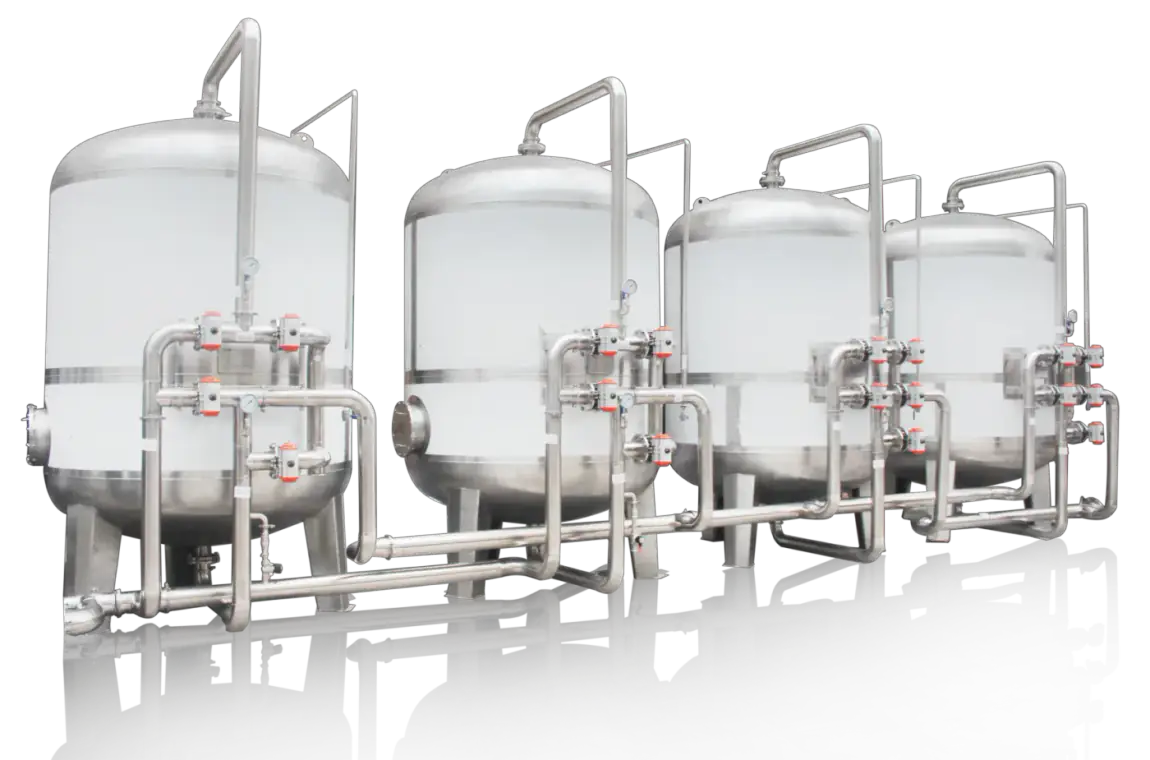
Which four risks does RO pretreatment have to control?
The first risk is scaling: calcium carbonate, calcium sulphate, barium sulphate and silica precipitate in the concentrate as recovery rises. The second is particulate and colloidal fouling, which blocks the feed spacer and raises differential pressure. The third is oxidation, where free chlorine attacks the polyamide active layer. The fourth is biological growth, which forms biofilm on the membrane surface and is difficult to clean completely.
Each risk has its own indicator and its own treatment. A design that controls turbidity but not chlorine, or hardness but not silica, still fails. The table below is the working map from analysis result to pretreatment step; the thresholds are the ones that most membrane warranties and commercial system designs use.
| Risk | Indicator | Pretreatment |
|---|---|---|
| Carbonate and sulphate scaling | Hardness above 120 mg/L as CaCO₃ at recovery above 65%; LSI above +0.5 | Softener, antiscalant or pH adjustment |
| Silica scaling | Concentrate above 100–150 mg/L at 25 °C | Reduce recovery, raise pH, or silica antiscalant |
| Particulate and colloidal fouling | SDI15 above 5; turbidity above 1 NTU | Coagulation, multimedia filter, 5 µm cartridge |
| Oxidation by chlorine | Free chlorine above 0.1 mg/L; ORP above 200 mV | Activated carbon or sodium bisulphite dosing |
| Iron and manganese | Iron above 0.1 mg/L; manganese above 0.05 mg/L | Oxidation plus multimedia filtration |
| Biological growth | Bacterial counts, high TOC, warm feed | Chlorination and dechlorination, UV, periodic disinfection |
Do you need a softener or is antiscalant enough?
Softening removes calcium and magnesium, so it controls carbonate and sulphate scaling at almost any recovery the resin can support. Antiscalant works at low doses, typically 2–5 mg/L, and extends solubility limits by roughly two to three times, but it is salt-specific and removes nothing. At 120 mg/L hardness and 65% recovery, antiscalant is often sufficient. Above 65–70% recovery, or when sulphate, barium or silica sit near saturation, a softener is the more robust choice.
The trade-off is real. A softener consumes salt and produces regeneration brine, and it must be sized on hardness load, not on flow alone; the CK-SF range covers 0.5–15 m³/h with 30–650 kg of resin and 25–800 L salt boxes. An antiscalant consumes chemical and adds a failure mode: if the dosing pump stops, the membrane is unprotected within hours. Whichever route is chosen, the dose or the resin volume must be calculated from the feed analysis and the target recovery.
A softener also captures iron that slips past a failed oxidation step, which is why well-water trains usually soften after iron filtration, not before it. The resin is a guard, not a substitute for iron removal: it holds only a limited amount before capacity and pressure drop suffer.
How does chlorine destroy a polyamide membrane?
Free chlorine oxidises the polyamide active layer. The damage is invisible and irreversible: salt passage rises first, then flux rises as the layer thins, and the element fails. Most warranties limit free chlorine to 0.1 mg/L at the membrane inlet. Chloramine is slower but still damaging, and carbon removes it less effectively than free chlorine.
Two methods remove the oxidant. Activated carbon adsorbs chlorine and needs an empty bed contact time of 10–15 minutes; sodium bisulphite is dosed at about 1.5–3 mg per mg of free chlorine, with 10–20% excess, and needs good mixing. Whichever is used, verify with a colorimetric test at the membrane inlet and keep an ORP probe below 200 mV. A carbon bed that has exhausted will pass chlorine without any visible change.
What filtration accuracy actually protects a membrane?
A sand filter rated at 100 µm with an outlet of 5 NTU is a clarification step, not a membrane guard. The RO needs turbidity below 1 NTU and SDI15 below 5, so a 5 µm cartridge follows the media filter. The cartridge is a guard: it protects the membrane from a media upset and from particles that pass the filter, but it is not a colloid removal stage. Replace it every 1–3 months or when differential pressure rises 0.5–1.0 bar.
Media selection matters as much as the rating. Multimedia beds of anthracite, sand and garnet handle turbidity and iron flocs; catalytic media handle dissolved iron and manganese after oxidation; granular activated carbon handles chlorine, taste and some organics. Using one vessel for all three duties usually means each duty is done poorly.
How do you size multimedia and carbon vessels?
Size on peak flow, not average. Multimedia beds usually run at 10–30 m/h with 0.8–1.2 m of depth, and backwash at 20–30 m/h for 10–15 minutes. Carbon needs an empty bed contact time of 10–15 minutes at peak flow, which is about 1 m³ of carbon for every 4–6 m³/h. A carbon bed that is too shallow shows chlorine breakthrough earlier than the replacement schedule predicts.
Allow for backwash water and for the pressure drop across a dirty bed. A media filter at 0.5–1.0 bar above clean is ready for backwash; a carbon bed that keeps a high differential pressure after backwash is compacted or fouled and may need replacement rather than more backwashing. Carbon is usually replaced every 12–24 months, depending on chlorine load and organics.
- Multimedia: 10–30 m/h service, 0.8–1.2 m bed, 20–30 m/h backwash
- Carbon: 10–15 minutes empty bed contact time at peak flow
- Sand filter rating 100 µm, outlet below 5 NTU, followed by a 5 µm cartridge
- Replace carbon every 12–24 months; replace cartridges every 1–3 months
How is pretreatment performance monitored?
Monitor the indicators that predict membrane damage, not only the ones that are easy to read. Differential pressure across each vessel, SDI15, turbidity, free chlorine or ORP, and iron are the core set. A pretreatment train that is never measured is a set of vessels with unknown performance, and the membrane becomes the instrument that detects the failure.
| Parameter | Frequency | Action limit |
|---|---|---|
| SDI15 | Weekly, and after media changes | Above 5: inspect coagulation and media |
| Turbidity | Continuous with alarm | Above 1 NTU at the RO inlet |
| Free chlorine or ORP | Continuous with alarm | Above 0.1 mg/L, or ORP above 200 mV |
| Cartridge differential pressure | Daily | Rise of 0.5–1.0 bar: replace |
| Media vessel differential pressure | Daily | Above clean bed by 0.5–1.0 bar: backwash |
| Iron and manganese | Monthly | Iron above 0.1 mg/L, manganese above 0.05 mg/L |
Can ultrafiltration replace conventional pretreatment?
Ultrafiltration with 0.01–0.1 µm pores delivers SDI15 of 1–3 and turbidity below 0.1 NTU, with a smaller footprint than coagulation plus media and a more consistent output when the raw water changes. It needs its own backwash and chemically enhanced backwash, and its integrity must be verified, because a fibre break passes colloids and pathogens. Many systems use UF as RO pretreatment and keep a 5 µm cartridge as the final guard.
UF does not remove dissolved salts, chlorine or hardness. It is a particle barrier, not a desalination step, and it does not replace carbon or a softener. The decision between UF and conventional media is usually about raw water variability, footprint and operator skill, not about the RO itself.
What should be checked before the membranes are installed?
Flush the pretreatment train to drain and confirm that the water at the membrane inlet meets the limits before any element is installed. Verify SDI15, turbidity, free chlorine, iron, hardness and pH, and check that the cartridge housing is clean and the O-rings are seated. Starting a new membrane on unfinished pretreatment is the most expensive way to commission a plant.
Record the baseline after 30–60 minutes of stable operation: feed pressure, permeate flow, concentrate flow, conductivity and temperature. Every later cleaning decision is measured against this baseline, and without it the operator cannot distinguish normal seasonal drift from fouling.
FAQ
Frequently asked questions
Questions buyers actually ask during sizing and quotation. Answers match the specifications above.
01 Is pretreatment always required for an RO system?
02 Softener or antiscalant — which is better?
03 Can I skip the carbon filter if the water has no chlorine?
04 How often should carbon media be replaced?
05 Does ultrafiltration remove chlorine?
06 Can a 1 µm cartridge replace pretreatment?
07 What is the first sign that pretreatment is failing?
Related
Systems related to this article
Continue reading
Related technical guides
- Commercial RO Commercial RO System Guide: Design, Sizing, Operation How commercial RO systems work, which CK-RO model fits, what feed water they need, and how to size, run and maintain a commercial 0.5–50 m³/h plant.
- Commercial RO RO Membrane Life: Fouling, Cleaning and Replacement Why RO membranes last two to three years, how normalisation reveals fouling, which CIP chemistry fits which foulant, and when replacement beats cleaning.
- Water quality basics SDI and Turbidity: Setting RO Feed Water Limits SDI predicts colloidal fouling; turbidity does not. Learn the 15-minute test, the limits membranes need, and which pretreatment actually lowers SDI.
Next step
Send your water analysis, get a factory quotation
Tell us the source water, TDS, hardness, iron and daily demand. Factory engineers reply with a flow rate, process train and budget range within one working day.