Commercial RO
Commercial RO System Guide: Design, Sizing, Operation
Quick answer
A commercial RO system is a pressure-driven separation packaged as a working plant: pretreatment, high-pressure pump, membrane array, controls and cleaning connections. This guide explains what each part does, how the CK-RO range covers 0.5–50 m³/h, and the feed limits, recovery rates and maintenance that decide whether the system lasts.
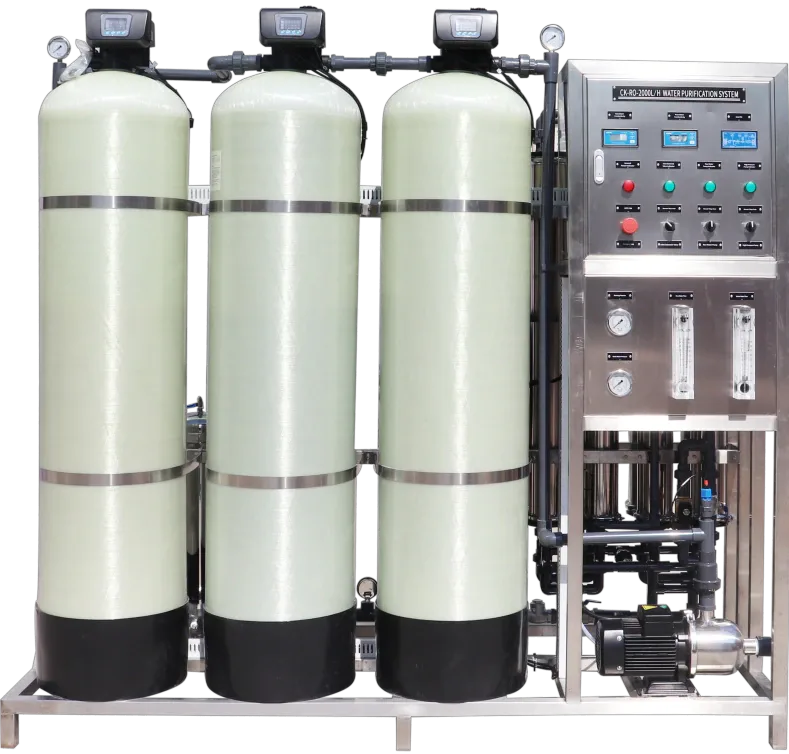
What is a commercial RO system and what does it include?
Reverse osmosis forces water across a semi-permeable polyamide membrane at 10–25 bar, above the osmotic pressure of the feed. Water molecules pass; dissolved salts, most organics above roughly 200 Da, colloids and microorganisms are rejected into the concentrate. A commercial system packages this into a skid with pretreatment, a high-pressure pump, membrane housings, instrumentation, a control panel and a clean-in-place connection.
The three numbers that define the plant are permeate flow, recovery rate and salt rejection. Permeate flow is the product water; recovery is permeate divided by feed; rejection is the share of salt removed. They interact. Pushing recovery higher concentrates the brine, raises scaling risk and usually requires softening or antiscalant dosing.
- Pretreatment: multimedia, carbon, softener or antiscalant, selected from the feed analysis
- High-pressure pump: 10–15 bar for brackish water, 15–25 bar for high TDS
- Membranes: 4040 and 8040 spiral-wound elements in FRP or stainless vessels
- Controls: PLC or relay logic, conductivity display, low and high pressure protection
Which CK-RO model fits your capacity?
The CK-RO series covers 0.5–50 m³/h of permeate in single-stage configuration, with motor power rising from 1.5 kW to 70 kW. Recovery improves as the array becomes larger: a single-element 0.5 m³/h unit recovers about 50%, while a 50 m³/h array reaches 70–75%. Select by permeate flow at the design temperature, not by a round number on a brochure.
Model numbers describe permeate at the reference condition, not at every site. A CK-RO-5000L rated at 5 m³/h at 25 °C produces less at 15 °C and more at 30 °C, and the recovery printed in the table assumes a feed inside the stated limits. Ask for the design point, not only the model.
| Model | Permeate (m³/h) | Motor (kW) | Recovery |
|---|---|---|---|
| CK-RO-500L | 0.5 | 1.5 | 50% |
| CK-RO-1000L | 1 | 2.2 | 50% |
| CK-RO-2000L | 2 | 3 | 50–60% |
| CK-RO-3000L | 3 | 4.5 | 55–65% |
| CK-RO-5000L | 5 | 8 | 60–70% |
| CK-RO-10T | 10 | 18 | 60–70% |
| CK-RO-20T | 20 | 30 | 65–75% |
| CK-RO-50T | 50 | 70 | 70–75% |
Permeate conductivity ≤10 µS/cm at feed conductivity ≤300 µS/cm, 25 °C. Other feed conditions require a revised design.
Single-stage, two-stage or RO+EDI — which do you need?
A single-stage system passes the water through the membrane once. It is the standard choice for drinking water, food service and general process water where 95–98% rejection is enough. A two-stage system passes the first-stage concentrate through a second array, raising overall recovery to 65–75% and reducing wastewater. RO+EDI adds electrodeionisation after the RO to reach ultrapure water without chemical regeneration.
| Configuration | Recovery | Permeate quality | Best for |
|---|---|---|---|
| Single-stage RO | 50–65% | ≤10 µS/cm from ≤300 µS/cm feed | Drinking water, restaurants, hotels, general process |
| Two-stage RO | 65–75% | ≤5 µS/cm, lower wastewater | High TDS feed, water-scarce sites, boiler make-up |
| RO + EDI | 65–75% at the RO stage | Above 10 MΩ·cm | Electronics, pharmaceuticals, cosmetics, laboratories |
| Containerized RO | 55–75% | ≤10 µS/cm | Remote sites, camps, rapid deployment |
What feed water quality does the system require?
A membrane is a precision element, not a filter. It needs water that has already been clarified, dechlorinated and stabilised. The limits below come from membrane warranty conditions and from the experience of systems that reach their expected element life. A design that ignores one of them usually fails on that one, not on the others.
- SDI15 below 5, ideally below 3; turbidity below 1 NTU
- Free chlorine below 0.1 mg/L, or ORP below 200 mV at the membrane inlet
- Iron below 0.1 mg/L and manganese below 0.05 mg/L
- Hardness above 120 mg/L as CaCO₃ needs softening when recovery exceeds 65%
- Feed pressure 1–3 bar at the pump suction; design temperature 15–30 °C
What recovery rate and permeate quality can you expect?
Across the CK-RO range, recovery is 50–75%. At 50%, a 10 m³/h feed yields 5 m³/h of permeate and 5 m³/h of concentrate; at 75%, it yields 7.5 and 2.5. Permeate conductivity is at or below 10 µS/cm when the feed is at or below 300 µS/cm at 25 °C, corresponding to 95–99% salt rejection. Nitrate rejection is similar; boron rejection is lower, typically 40–80% at neutral pH, which matters for irrigation and some process uses.
Temperature moves both numbers. Permeate flow changes by roughly 3% per °C, so a system rated at 25 °C produces less in winter and more in summer at the same pressure. Recovery is limited by the solubility of the salts left in the concentrate, which is why the same skid is rated differently on a soft feed and a hard one.
Blending is a legitimate way to hit a mineral target: bypass 10–20% of the feed around the RO and the permeate picks up a controlled amount of hardness and alkalinity, which reduces corrosion in the distribution line. The blend ratio must be fixed by a valve and verified with a conductivity meter, not adjusted by feel.
How do you size a system for a building or process?
Size on daily volume and the refill window, not on the instantaneous peak alone. A site that uses 20 m³ per day and can refill a 10 m³ tank over 10 hours needs 2 m³/h of permeate, not 20. Add 10–20% margin for fouling and cold water, and check that the RO runs at least 4–6 hours per day; short cycling wastes water through repeated flushing and wears the pump.
For process water, start from the equipment requirement: boiler make-up, humidification, ice machines, beverage dilution and rinsing each specify a flow and a quality. Where demand is spiky, a storage tank with a level switch and a booster set decouples the RO from the process, and the RO can run at its efficient point instead of following every draw.
| Input | Value | Result |
|---|---|---|
| Daily demand | 20 m³/day | Base volume |
| Refill window | 10 hours | 2 m³/h average |
| Fouling and cold-water margin | 15% | 2.3 m³/h design |
| Selected model | CK-RO-3000L | 3 m³/h at 25 °C, 55–65% recovery |
Example only. Final selection follows the water analysis and the site operating pattern.
What maintenance does a commercial RO system need?
Membranes typically last two to three years when pretreatment is right and cleaning is done on schedule. The cost drivers are replacement elements, pump energy, antiscalant or softening salt, cartridge filters and labour. Fouling appears first as rising differential pressure or falling permeate flow at constant pressure; scaling appears as falling rejection and rising conductivity.
Clean in place when the normalised permeate flow falls 10–15% or the differential pressure rises 10–15% from the commissioning baseline. Clean too often and you shorten element life; clean too late and the foulant becomes irreversible. Log feed pressure, permeate flow, concentrate flow and conductivity weekly so the trend is visible before a shutdown.
- Replace cartridge filters every 1–3 months depending on feed turbidity
- Keep free chlorine below 0.1 mg/L at the membrane inlet
- Verify instrument calibration quarterly: pressure gauges, flow meters, conductivity
- Inspect pumps, valves and O-rings annually and replace worn seals
Can the plant be containerized or skid-mounted?
Yes. Systems from 4 to 25 m³/h can be built into a 20- or 40-foot container with pretreatment, RO, disinfection, controls and lighting, tested as a unit before shipment. The CK-RO containerized range covers 4–25 m³/h with 7–30 kW motors and 55–75% recovery. Containerized systems suit remote sites, camps and projects where civil works are slow or the plant may later be relocated; skid-mounted systems are the usual choice when a plant room already exists.
Every unit is pressure-tested and run before shipment, and comes with an installation manual, a wiring diagram, commissioning support and a 12–18 month warranty. Larger projects can include an engineer on site for commissioning and operator training on cleaning and consumable replacement.
FAQ
Frequently asked questions
Questions buyers actually ask during sizing and quotation. Answers match the specifications above.
01 How much does a commercial RO system cost?
02 Can RO remove bacteria and viruses?
03 How much water does the system reject?
04 Do I need a softener before the RO?
05 What is CIP and how often is it needed?
06 What is the difference between RO and UF?
07 How is the system commissioned?
08 What warranty is included?
Related
Systems related to this article
Continue reading
Related technical guides
- Commercial RO RO Recovery Rate: Balancing Yield and Scaling Recovery decides how much water an RO makes and how concentrated the brine becomes. See the 50–75% range, concentration factors and ways to raise yield safely.
- Commercial RO RO Pretreatment: What Membranes Need Before the Pump Scaling, fouling, chlorine and bacteria decide membrane life. Match pretreatment to the feed analysis, size carbon and media beds, and set monitoring limits.
- Commercial RO RO Membrane Life: Fouling, Cleaning and Replacement Why RO membranes last two to three years, how normalisation reveals fouling, which CIP chemistry fits which foulant, and when replacement beats cleaning.
Next step
Send your water analysis, get a factory quotation
Tell us the source water, TDS, hardness, iron and daily demand. Factory engineers reply with a flow rate, process train and budget range within one working day.