Commercial RO
RO Membrane Life: Fouling, Cleaning and Replacement
Quick answer
Membrane life is decided by pretreatment and by what the operator notices in the first month. Most elements last two to three years, but oxidation, iron fouling or a failed softener can end an array in under a year. This guide covers normalisation, symptoms that identify a foulant, cleaning chemistry and when replacement is cheaper than another CIP.
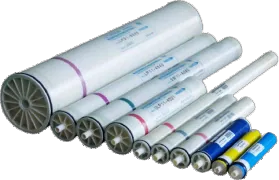
How long do RO membranes actually last?
Most commercial RO membranes last two to three years. With good pretreatment, stable operation and cleaning before fouling becomes irreversible, five years is achievable; with chlorine damage or iron fouling, an array can fail in months. The calendar is a planning number, not a replacement criterion. Replace when normalised performance no longer meets the process requirement, not when a date arrives.
Membrane element warranties are commonly prorated and assume feed water inside the specified limits. They do not cover oxidation, and they do not cover fouling caused by pretreatment that was allowed to fail. The warranty protects against manufacturing defects, not against operation.
The first year is the most informative: early failures usually come from commissioning debris, a pretreatment upset or an oxidant excursion, not from normal ageing. Record what happened in that year, because the same event will explain the next failure.
What is normalisation and why does it matter?
Normalisation corrects permeate flow, salt passage and differential pressure to reference conditions, usually 25 °C and a fixed pressure. Without it, a cold week looks like fouling and a warm week looks like recovery. Permeate flow changes about 3% per °C, so a 10 °C swing moves flow by roughly 30% with no change in the membrane at all.
Track normalised flow, normalised salt passage and differential pressure against the commissioning baseline. A 10–15% fall in normalised flow, or a 10–15% rise in differential pressure, is the usual trigger for cleaning. A 5–10% rise in normalised salt passage points to oxidation or seal damage and is not fixed by cleaning.
Salt passage is calculated from feed and permeate conductivity, but a handheld meter is not precise enough to detect a one-point change. Use the installed instruments, compare at the same recovery and temperature, and record the readings rather than remembering them.
- Reference temperature 25 °C; correct flux by about 3% per °C
- Clean at 10–15% normalized flow loss, not at 30%
- Rising salt passage is a damage indicator, not a fouling indicator
- Compare at the same recovery; changing recovery changes every number
What do the symptoms tell you?
A membrane gives three measurable signals: flow, differential pressure and salt passage. The pattern, not any single number, identifies the problem. Falling flow with rising differential pressure is fouling or scaling. Rising salt passage with rising flow is oxidation. Rising differential pressure in the first stage points to particulate or biological fouling; the same rise in the last stage points to scaling in the concentrate end.
| Symptom | Likely cause | First action |
|---|---|---|
| Normalized flow down 10–15%, differential pressure up | Particulate, organic or biological fouling | Inspect cartridge and pretreatment; alkaline CIP |
| Differential pressure up sharply, flow down, cold feed | Carbonate or sulphate scaling | Check LSI and recovery; acid CIP |
| Salt passage up 5–10%, flow up | Chlorine oxidation or O-ring leak | Test free chlorine and ORP; inspect seals |
| Last-stage differential pressure up, flow down | Scaling in the concentrate end | Check silica, sulphate and recovery; acid or chelant CIP |
| Flow down, differential pressure normal | Low temperature or clogged cartridge | Check temperature and cartridge pressure drop |
Always confirm with the normalized baseline before starting a cleaning cycle.
How does CIP work and which chemical fits which foulant?
CIP circulates a cleaning solution through the array at low pressure and controlled temperature. Clean one stage at a time, soak, then flush to drain. Do not exceed the element manufacturer limits for pH and temperature: a hot caustic clean can hydrolyse the membrane, and a strong acid can attack the support layer. Measure the cleaning result by normalized flow and salt passage after the flush, not by appearance.
Cleaning one stage at a time matters because the first stage usually carries the particulate load while the last stage carries the scaling load. A single loop mixes the two and can drive dissolved scale from one stage into the other, where it precipitates on a surface that was previously clean.
| Foulant | Chemistry | Typical condition |
|---|---|---|
| Carbonate scale | Citric acid, sulfamic acid or dilute hydrochloric acid | pH 2–3, 25–35 °C |
| Iron and manganese oxides | Acid with a chelating agent such as EDTA | pH 2–3, 25–35 °C |
| Organics and biofilm | Sodium hydroxide with a surfactant | pH 11–12, 30–40 °C |
| Silica | Alkaline solution, sometimes with a specific silica cleaner | pH 11–12, 30–40 °C; removal is partial |
| Calcium sulphate | Chelating agent such as EDTA | Near neutral pH, 25–35 °C |
Chemical choice and limits must follow the element datasheet; the values above are typical ranges, not universal instructions.
When should you replace elements instead of cleaning?
Replace when cleaning no longer restores performance. Practical criteria: normalised flow stays more than 25% below baseline after two or three cleaning cycles; normalised salt passage stays 5–10% above baseline; differential pressure remains above the limit; or the element is mechanically damaged, with telescoping, a cracked end cap or a leaking permeate tube.
In a parallel array, one failed element can be replaced alone, because the others see the same feed. In a series array, replacing one element changes the balance of the whole bank and is usually done as a set. Mixing new and old elements in the same vessel also makes performance comparisons meaningless.
What kills membranes early?
Chlorine is the most common cause. Free chlorine above 0.1 mg/L oxidises the polyamide layer, and the damage is invisible until salt passage rises. Iron and manganese oxides are second: they plug the feed spacer, and acid cleaning recovers only part of the loss. Scaling from a failed softener or an empty antiscalant tank is third. Biofouling follows warm feed, long idle periods and no disinfectant residual.
Long idle periods are underestimated. A plant that sits wet and warm for a month can grow more biofilm than one that runs continuously for a year, because there is no crossflow to sweep the surface and no disinfectant residual to hold growth back.
- Free chlorine above 0.1 mg/L: irreversible oxidation, the leading cause of early failure
- Iron above 0.1 mg/L and manganese above 0.05 mg/L: oxide fouling
- Permeate backpressure above about 0.3 bar: can telescope or crack the element
- Dry storage or freezing: flux is lost permanently and cannot be restored
- Water hammer and pressure spikes: mechanical damage to the element and seals
How should membranes be stored when the plant is idle?
For a few days, flush with permeate and keep the elements wet. For longer periods, fill the vessels with a 1% sodium metabisulphite solution, seal the permeate and concentrate ports, and store below 35 °C away from sunlight. Do not let the solution freeze. Refresh it every month, or as the element datasheet requires, and flush to drain before restart.
An element that dries out loses flux permanently. A membrane stored in untreated water grows biofilm within days in warm weather, and the first CIP after restart is often too late. If the plant will be idle for months, remove the elements, store them wet in sealed bags with preservative, and protect them from freezing and sunlight.
What records make membrane life predictable?
Keep a one-page weekly log: feed pressure, feed and permeate conductivity, permeate and concentrate flow, temperature and differential pressure per stage. Add every CIP with date, chemical, pH, temperature, duration and performance before and after. Add cartridge changes and any pretreatment upset.
Two years of records are more useful than any single reading, because membrane ageing is a slope, not a point. The slope tells you whether the next capital cost is a cleaning, a set of elements or a pretreatment upgrade.
After 12 months the log shows whether the array is ageing normally or heading toward a failure, and it settles warranty discussions. A membrane returned without operating data cannot be assessed, and the manufacturer will attribute the failure to operation by default.
FAQ
Frequently asked questions
Questions buyers actually ask during sizing and quotation. Answers match the specifications above.
01 How long do RO membranes last?
02 Does cleaning extend membrane life?
03 Can I clean membranes with chlorine?
04 What is normalisation?
05 How often should a commercial RO be cleaned?
06 Can membranes be stored dry?
07 How do I know an element is finished?
Related
Systems related to this article
Continue reading
Related technical guides
- Commercial RO Commercial RO System Guide: Design, Sizing, Operation How commercial RO systems work, which CK-RO model fits, what feed water they need, and how to size, run and maintain a commercial 0.5–50 m³/h plant.
- Commercial RO RO Recovery Rate: Balancing Yield and Scaling Recovery decides how much water an RO makes and how concentrated the brine becomes. See the 50–75% range, concentration factors and ways to raise yield safely.
- Commercial RO RO Pretreatment: What Membranes Need Before the Pump Scaling, fouling, chlorine and bacteria decide membrane life. Match pretreatment to the feed analysis, size carbon and media beds, and set monitoring limits.
Next step
Send your water analysis, get a factory quotation
Tell us the source water, TDS, hardness, iron and daily demand. Factory engineers reply with a flow rate, process train and budget range within one working day.