Drinking water & disinfection
Drinking Water UV and Ozone: Complete Guide
Quick answer
Drinking water is a train, not a single filter. Pretreatment removes turbidity and chlorine, RO removes dissolved salts, remineralisation restores stability, and a final UV or ozone barrier protects the point of use. This guide explains each stage, the 30–40 mJ/cm² UV dose, ozone CT, and what must be tested locally.
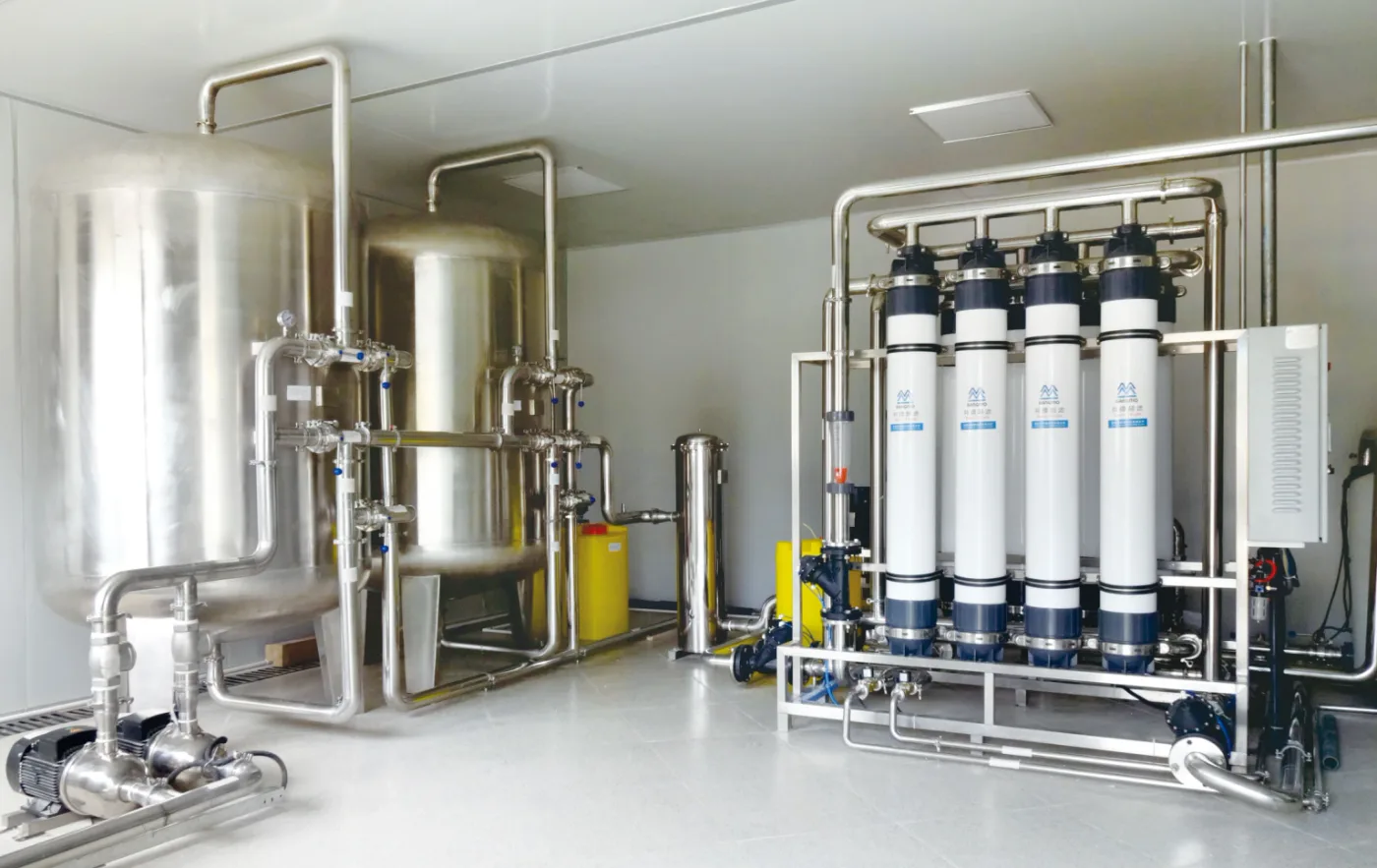
What does a drinking water treatment train include?
A drinking water treatment system is a sequence of unit operations selected from the raw-water analysis. The usual train is pretreatment, reverse osmosis, remineralisation and pH correction, hygienic storage, then a final UV or ozone barrier. Not every source needs every stage: clean municipal water may need only carbon, a cartridge and disinfection, while a brackish borehole may need softening, RO and remineralisation.
Capacity is quoted at a defined condition, typically 0.5–50 m³/h with RO recovery of 50–75% and permeate conductivity of ≤10 µS/cm from feed at ≤300 µS/cm. Those figures are a design envelope, not a guarantee for every source. The train must be sized from peak hourly demand, raw-water chemistry and the local drinking-water standard.
| Stage | Main duty | Typical design value |
|---|---|---|
| Pretreatment | Turbidity, chlorine, organics, hardness, iron | Sand to 100 µm and ≤5 NTU; carbon EBCT 10–15 min |
| Reverse osmosis | Dissolved salts, nitrate, heavy metals, most microorganisms | 50–75% recovery; 95–99% salt rejection |
| Remineralisation | Calcium, magnesium, alkalinity, pH stability | pH 7.0–8.5; alkalinity 50–100 mg/L as CaCO₃ |
| Hygienic storage | Buffer between production and demand | Sealed vent, conical bottom, no dead legs |
| Final barrier | Microbiological protection at the point of use | UV 30–40 mJ/cm², or ozone 0.2–0.5 mg/L residual |
Stage selection follows the raw-water analysis. A clean source may omit RO; a high-TDS source may need two-stage RO.
Which contaminants does each stage remove?
No single stage removes everything. Sand filtration handles particles, carbon handles chlorine and dissolved organics, softening handles hardness, and RO handles dissolved salts. UV and ozone inactivate microorganisms but leave different residuals. Knowing which stage owns which contaminant prevents the common mistake of adding a second carbon filter when the real problem is nitrate, or adding UV when the real problem is turbidity shielding the lamp.
Turbidity is the most important upstream parameter for disinfection. Above 1 NTU, particles shield microorganisms from UV light and consume ozone before it reaches them. Most drinking-water UV systems therefore require a 5 µm cartridge and turbidity below 1 NTU, and many designers target below 0.5 NTU. A UV reactor with a clean lamp and a dirty water supply delivers a dose on paper, not in the water.
| Contaminant | Sand | Carbon | Softener | RO | UV / ozone |
|---|---|---|---|---|---|
| Turbidity and particles | Yes | No | No | Yes | Requires clear water |
| Free chlorine | No | Yes | No | Partial | No |
| Hardness | No | No | Yes | Yes | No |
| Nitrate, fluoride, arsenic | No | No | No | Yes | No |
| Taste, odour, colour | Partial | Yes | No | Yes | Ozone oxidises |
| Bacteria and viruses | Partial | No | No | Yes | Yes |
Qualitative summary. Actual removal depends on the specific contaminant, dose and operating conditions.
How much UV dose is needed, and when is UV the right barrier?
Drinking-water practice commonly uses 30–40 mJ/cm² at 254 nm, stated at the end of lamp life and after a fouling allowance. Bacteria need less, viruses generally need more, and protozoan cysts such as Cryptosporidium are inactivated at comparatively low UV doses but still require a validated reactor. Regulated supplies may demand a specific log credit and a defined validation protocol.
UV is the right barrier when the water is clear and the risk is microbiological at the point of use. It adds nothing to the water and leaves no residual, which suits bottling, beverage, food service and building drinking-water loops. It is the wrong barrier when the water is turbid, when the tank and loop need protection, or when colour, iron and manganese must be oxidised; in those cases, ozone or a combination is more appropriate.
- Wavelength: 254 nm low-pressure mercury or amalgam lamps
- Water quality: turbidity below 1 NTU, 5 µm cartridge upstream, UVT above 90%
- Lamp life: 8,000–9,000 hours; size the reactor at end-of-life output
- Residual: none, so downstream hygiene and storage design carry the protection
How is ozone dosed and what is CT?
Drinking water typically uses 1–3 mg/L of ozone, with 5–15 minutes of contact time. Bottle rinsing uses 2–4 mg/L. The dose is set by the ozone demand of the water, not by a single figure: organics, iron, manganese and nitrite consume ozone before it acts on microorganisms. Measure the demand with a bench test, then confirm the dissolved residual at the contact tower outlet.
CT is the product of dissolved ozone concentration and contact time, usually written mg·min/L. One mg/L held for ten minutes gives a CT of 10. The CT that counts is the residual after demand, not the dose at the injector. For example, a tower holding 5 m³ at 10 m³/h gives a nominal 30-minute contact time; a residual of 0.4 mg/L after demand gives a CT of 12 mg·min/L.
Ozone decays quickly: typically 20–30 minutes in clean water at 20 °C, and faster with high organic or metal demand. That is why it is generated on site and dosed continuously. For storage protection, recirculate the tank through the ozone contactor and monitor ORP or dissolved ozone, keeping a residual of about 0.2–0.5 mg/L. Where bromide is present, check bromate formation.
UV or ozone — which final barrier should you choose?
Choose UV when the water is clear, the risk is microbiological at the tap and no residual is wanted. Choose ozone when the water needs oxidation, when the storage tank and recirculation loop need protection, or when colour, taste, iron and manganese must be addressed. Some plants use both: ozone for the tank loop and UV at the point of use, because ozone protects the bulk water while UV protects the last metre.
| Criterion | UV at 254 nm | Ozone |
|---|---|---|
| Typical dose | 30–40 mJ/cm² | 1–3 mg/L, 5–15 min contact |
| Residual | None | 0.2–0.5 mg/L, decays in minutes |
| Water clarity | Below 1 NTU; UVT above 90% | Contacting and off-gas removal required |
| Colour, taste and odour | No effect | Oxidises colour and taste compounds |
| Iron and manganese | No effect | Oxidises, then filtration removes |
| By-products | None at 254 nm | Bromate possible where bromide is present |
Typical values. Final selection depends on raw water, local standard and validation requirements.
How should storage and distribution be protected?
RO permeate has no chlorine residual, so any microorganism entering the tank or pipework can settle and form biofilm. A tank vented to a dusty room, drained through a dead leg or held at 30 °C is a better incubator than a raw-water line. Most post-treatment contamination appears after the membrane, not before it, which is why storage hygiene matters more than the RO itself.
Use a conical or sloped bottom, a sealed overflow with an insect screen, a 0.2 µm hydrophobic vent filter, a spray ball and no dead legs longer than three pipe diameters. Keep storage to one day or less. Recirculate through UV, or hold 0.2–0.5 mg/L ozone and monitor ORP. Clean and disinfect tanks every 3–12 months, and after any maintenance entry.
- Test heterotrophic plate count and coliforms at the tap, not only at the RO outlet
- Keep the loop circulating; stagnant branches are where biofilm starts
- Do not store finished water above 25 °C for long periods
What water analysis is needed before design?
Sample at the source, not downstream of an existing softener, and state whether the source is municipal, borehole, river, lake or tanker water. The laboratory report should cover TDS, conductivity, pH, alkalinity, hardness, calcium, magnesium, sodium, chloride, sulphate, nitrate, iron, manganese, arsenic, silica, COD, turbidity and bacterial count. Seasonal samples are needed where the source varies.
Site data matter as much as the chemistry: peak hour, daily volume, operating hours, power, drain, room size, ambient temperature, storage volume, pipe material and discharge rules. A quotation based on daily volume alone will usually undersize the pretreatment and the final barrier, because both are driven by peak flow and by the worst water quality, not by the annual average.
What standards apply, and what must be tested locally?
The binding requirements are those of the destination market. Drinking-water standards differ in their parameter lists, limits and monitoring frequency, and a system designed for one country is not automatically compliant in another. The WHO Guidelines for Drinking-water Quality are a useful technical reference where a national standard is being developed, but they do not replace the local regulation.
Compliance is demonstrated by testing the finished water, not by the equipment label. We do not claim a drinking-water certification or sanitary permit for these systems. The factory works under ISO 9001 and holds CE certification for exported equipment, but those are quality and product-safety certificates, not drinking-water approvals. Any material approval or local test report must be obtained for the destination market.
Before shipment, agree on the acceptance tests: capacity at design temperature, permeate conductivity, UV dose or ozone residual, and a bacteriological sample where the local rules require one. After installation, repeat the tests on site water and keep the results with the operating log.
FAQ
Frequently asked questions
Questions buyers actually ask during sizing and quotation. Answers match the specifications above.
01 Do I need both UV and ozone?
02 What UV dose is used for drinking water?
03 What ozone dose and contact time are needed?
04 Can I drink RO water directly?
05 Why is turbidity important before UV?
06 Does ozone leave a residual in the water?
07 Is the system certified for drinking water?
08 How often are membranes, lamps and carbon replaced?
Related
Systems related to this article
Continue reading
Related technical guides
- Drinking water & disinfection UV Dose Explained: mJ/cm², UVT and Lamp Life What UV dose means, how mJ/cm² is calculated, why UVT and turbidity change the real dose, and how to size a reactor at end of lamp life on site.
- Drinking water & disinfection Ozone vs UV for Drinking Water Disinfection Compare ozone and UV for drinking water: dose and CT, residual protection, colour and iron removal, by-products, and how to choose for your site.
- Drinking water & disinfection Drinking Water Standards and Testing: What to Check Which drinking water parameters to test, how local limits and WHO guidelines differ, and how to prove a treatment system produces compliant water.
Next step
Send your water analysis, get a factory quotation
Tell us the source water, TDS, hardness, iron and daily demand. Factory engineers reply with a flow rate, process train and budget range within one working day.